The 14 peptides in FDA's spotlight: status and evidence at a glance
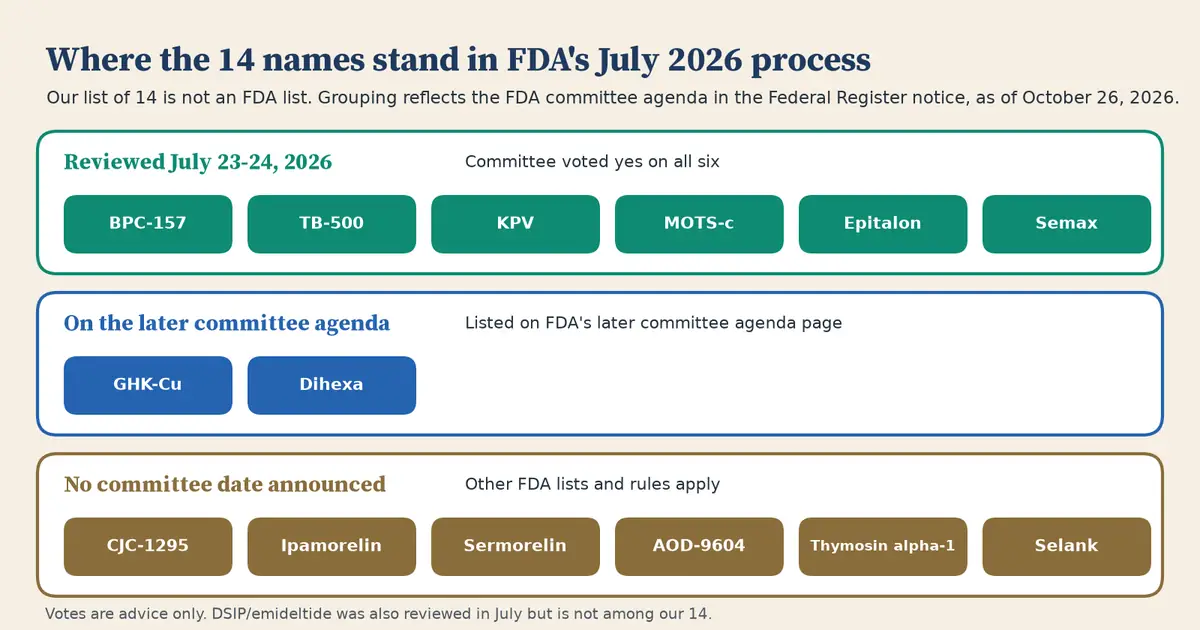
Peptides are a daily topic for many people online, and the rules around them are moving fast enough that what was true a few weeks ago can be out of date. This page keeps one table up to date for 14 names that come up most. It separates four questions that often get blended together: Is it an approved drug? Can a licensed pharmacy compound it under FDA's lists? Did FDA's advisory committee review it in July 2026? Is it named on the anti-doping list for tested sport? A fifth column shows how much human research exists, using the same evidence-stage markers as the rest of the site.
The table also shows a pattern worth knowing. In this set, the peptides with the longest human records, sermorelin (formerly an FDA-approved medicine) and thymosin alpha-1 (approved in several countries), are also the two with an approval history behind them and the deepest trial records. Names that are newer to the clinic, such as KPV, TB-500 and dihexa, sit at the early-stage research step, which is where every medicine begins. [V] A status in this table is a neutral fact about where each peptide is in a process, not a grade.
Facts are as of October 26, 2026. Sources, with retrieval dates, are directly under the table and at the bottom.
The status table: 14 peptides, five separate questions (as of October 26, 2026)
| Peptide | Approved drug? | Compoundable? (FDA 503A/503B lists) | FDA advisory committee, July 23-24, 2026 (press-reported votes) | In tested sport? (WADA 2026 list) | Human evidence record (stage marker) |
|---|---|---|---|---|---|
| BPC-157 | No U.S. approval found | Nomination withdrawn; listed on FDA's category 2 page | In favor, 8-6, 1 abstention [S] | Named, S0 | Early-stage research, mostly cells and animals; three small human studies in newer reviews |
| TB-500 | No U.S. approval found | Nomination withdrawn; listed on FDA's category 2 page | In favor, 8-6, 1 abstention [S] | Named, S2.3 | Early-stage research; FDA found no human exposure data |
| CJC-1295 | No U.S. approval found | Nomination withdrawn; listed on FDA's category 2 page | Not reviewed | Named, S2.2.4 | Small controlled trials in healthy adults |
| Ipamorelin | No U.S. approval found | 503ASection of federal drug law covering compounding by state-licensed pharmacies and doctors, usually for a prescription written for one patient. nomination withdrawn; still category 2 for 503BSection of federal drug law for outsourcing facilities: larger compounders that register with FDA and must follow drug-manufacturing quality rules. | Not reviewed | Named, S2.2.4 | Phase 2 surgery trial completed, well tolerated |
| Sermorelin | Formerly FDA-approved (1990 and 1997 products) | Category 1An interim FDA group of nominated bulk ingredients that FDA generally does not object to pharmacies using while its review continues. Not an approval. on the 503B list; not on the 503A category lists | Not reviewed | Named, S2.2.4 | Long human record from the approval era |
| AOD-9604 | No U.S. approval found | Nomination withdrawn; listed on FDA's category 2 page | Not reviewed | Named, S2.2.3 | Animal studies, then a human weight-loss study |
| MOTS-c | No U.S. approval found | Nomination withdrawn; listed on FDA's category 2 page | In favor, 7-5, 2 abstentions [S] | Named, S4.4.1 | Mouse studies and human observational data |
| Thymosin alpha-1 | Approved in several countries; no U.S. approval | 503A nomination withdrawn; category 3 on 503B | Not reviewed | Not named | Long trial record, including meta-analyses |
| KPV | No U.S. approval found | Nomination withdrawn; listed on FDA's category 2 page | In favor, 8-6, 1 abstention [S] | Not named | Early-stage research: mouse colitis and cell studies |
| GHK-Cu | Cosmetic ingredient; no U.S. drug approval found | Category 1 on 503A, except injectable routes | Later agenda, before end of February 2027 | Not named | Small human skin studies; a phase 2 study is recruiting |
| Epitalon | No U.S. approval found | Nomination withdrawn; listed on FDA's category 2 page | In favor, 7-4 or 7-5 by outlet [S] | Not named | Cell, monkey and small human biomarker studies |
| Selank | No U.S. approval found | Nomination withdrawn; listed on FDA's category 2 page | Not reviewed | Not named | One small Russian comparison with an active drug |
| Semax | Registered in Russia as nasal drops; no U.S. approval | Nomination withdrawn; listed on FDA's category 2 page | In favor, 8-5, 1 abstention [S] | Not named | Rat studies and small Russian clinical work |
| Dihexa | No U.S. approval found | Nomination withdrawn; listed on FDA's category 2 page | Later agenda, before end of February 2027 | Not named | Early-stage research; FDA found no human exposure data |
Colour key (neutral facts, not grades):Approved or long human recordListed, favored, named or early human dataNeutral status factLater agenda or pending
How to read it. "Approved" refers to FDA's drug approval pathway; "no U.S. approval found" means we found none in FDA's records. "Compoundable" refers to FDA's lists for pharmacies (503A) and outsourcing facilities (503B): category 1 is an interim-policy category, and "withdrawn" means the nomination was withdrawn while FDA's safety text stays on its category 2 page. Committee votes are press-reported [S] and are advice only. WADA status [V] describes a sport rule, not a statement about safety. The evidence column uses our stage markers: early-stage research (cells and animals) is the usual first step for any medicine, small human studies come next, then controlled trials, then approval.
Sources for this table (retrieved October 26, 2026): FDA's 503A category list, updated May 14, 2026 [V]; FDA's category 2 page, current as of April 22, 2026 [V]; FDA's 503B bulk-substance page and list [V]; FDA's PCACPharmacy Compounding Advisory Committee: outside experts who advise FDA on compounding questions. Its votes are recommendations, not decisions. meeting pages for July 23-24, 2026 and the announced later meeting [V]; AJMC and RAPS press reports for the votes [S]; WADA's 2026 Prohibited List [V]; DailyMed name searches [V]. Full links are in the numbered list at the bottom.
A note on the list itself. The 14 is a widely shared set of names, passed around in online discussions and AI search summaries, and FDA has not published a list of 14 peptides (we found none in FDA's documents). We use it as a convenient group of names from the policy conversation and check each against FDA's own records. [V]
At a glance
- Six of the 14 went before FDA's Pharmacy Compounding Advisory Committee on July 23-24, 2026. The committee voted in favor of all six, for example BPC-157 (8-6) and semax (8-5), according to press reports, while FDA staff had recommended against. [S]
- Two more, GHK-Cu and dihexa, are on a later agenda FDA announced, before the end of February 2027. The other six have no committee date. [V]
- Evidence runs from long human trial records (thymosin alpha-1, sermorelin) to early-stage lab and animal work (KPV, dihexa, TB-500). [V]
- Thirteen of the 14 appear in FDA's category 2 table of withdrawn nominations, and FDA's risk text stays on that page. Sermorelin is the exception. [V]
- Votes are advice. Nothing becomes law from a committee vote alone. [V]
Compounding pathways, according to FDA's lists
Licensed clinicians prescribe, and licensed pharmacies prepare, certain peptides within FDA's compounding rules today. That is ordinary clinical practice, and FDA's lists decide which of the 14 have a stated pathway. [V] Of the 14, two carry a category 1 entry: sermorelin on the 503B list (marked by FDA as a component of an approved drug) and GHK-Cu on the 503A list for non-injectable routes. Under FDA's interim policy, the agency says it will hold off on enforcement for pharmacies and outsourcing facilities that use category 1 substances while the policy's conditions are met. [V] Thymosin alpha-1 and ipamorelin have 503B entries (category 3 and category 2). The other ten sit in FDA's table of withdrawn nominations. A White House review of an "Interim Access Policy for Compounding Using Certain Peptides" is pending, and its contents are not public, so these lists could change. [V] Our sermorelin page covers how this plays out for the one peptide here with a long approval history.
What the promising evidence looks like
Reading across the table, a few threads stand out.
Peptides with real human records. Thymosin alpha-1 has approvals in several countries and a body of trials, including meta-analyses in hepatitis B and sepsis. [V] Sermorelin was approved in the United States (1990 and 1997) before it was withdrawn from sale in 2009, which our sermorelin page explains was not for safety reasons, and tesamorelin, a related peptide, is approved today. [V]
Peptides with well-designed early human data. CJC-1295 raised growth hormone and IGF-I in two placebo-controlled trials of healthy adults. [V] Ipamorelin completed a phase 2 trial in surgery patients and was well tolerated, without a win on the main outcome. [V]
Peptides with intriguing lab and animal findings. MOTS-c, KPV, TB-500, semax and dihexa each have animal or cell findings that explain why researchers keep studying them. KPV reduced colitis in mice. MOTS-c improved metabolic measures in mice. [V] These labels matter: animal and cell results are the early-stage research that nearly every medicine starts from, and human trials are the next step.
Limits and unknowns
- For several of the 14, FDA says it found no human exposure data at all: TB-500, KPV, MOTS-c and dihexa. [V]
- FDA's category 2 page cites serious adverse events for CJC-1295, and possibly for AOD-9604 with causality unclear. [V]
- Ipamorelin acetate remains in category 2 for outsourcing facilities, and FDA cites a published intravenous study with serious adverse events including death. [V]
- Advisory committee votes were close, staff recommended against the substances the committee favored, and outlets report some tallies differently (epitalon 7-4 versus 7-5). [S]
- A committee vote is advice. A substance reaches the 503A list only through rulemaking. [V]
- A White House review of an "Interim Access Policy for Compounding Using Certain Peptides" is pending, and its contents are not public. [V]
What people get wrong
Claim
"FDA is approving 14 peptides."
What research shows
- Regulatory claim
FDA has not approved any of the 14 as a new drug through the approval pathway, and we found no FDA list of 14. A committee voted on several for the compounding bulk list, which is a different question. [V]
What is unknown
What FDA will decide, and when. The interim policy under White House review has not been published. [V]
This card describes the kind of research that exists.
Why it matters
Peptides are a daily topic for many people online, and the policy is changing fast enough that old information goes stale in weeks. A single table that separates "approved," "compoundable," "reviewed by a committee," and "allowed in tested sport" is a way to keep track. It also shows a pattern: the peptides with the strongest evidence are the ones with the longest human records.
Questions to bring to a clinician or pharmacist
- Is this an approved drug, a compounded preparation, or something else?
- Which row of the table does it fall in, and has that status changed recently?
- What human evidence exists for the reason I'm asking?
- If I compete in a tested sport, have I checked with my anti-doping organization?
What to watch next
Dates and decisions we're tracking
- Date not yet setFDA's committee consult on GHK-Cu, which FDA's 503A list says it plans by the end of February 2027 [V]
- Date not yet setAny rulemaking on substances the July committee backed [V]
- PendingThe White House review of FDA's "Interim Access Policy for Compounding Using Certain Peptides" [V]
- Jan. 1, 2027WADA's 2027 Prohibited List takes effect [S]
Sources (retrieved October 26, 2026 unless noted)
- FDA, "Certain Bulk Drug Substances for Use in Compounding that May Present Significant Safety Risks" (category 2 page), current as of 04/22/2026 [V] — https://www.fda.gov/drugs/human-drug-compounding/certain-bulk-drug-substances-use-compounding-may-present-significant-safety-risks
- FDA, 503B bulk drug substances list, updated March 21, 2025 [V] — https://www.fda.gov/media/94164/download
- FDA, 503A bulk drug substances list, updated May 14, 2026 [V] — https://www.fda.gov/media/94155/download
- Federal Register, Pharmacy Compounding Advisory Committee meeting notice 2026-07361 (agendas) [V] — https://www.federalregister.gov/d/2026-07361
- FDA, "July 23-24, 2026: Meeting of the Pharmacy Compounding Advisory Committee," meeting page [V] — https://www.fda.gov/advisory-committees/advisory-committee-calendar/july-23-24-2026-meeting-pharmacy-compounding-advisory-committee-07232026
- FDA, staff briefing slides for the July 24, 2026 session [V] — https://www.fda.gov/media/193774/download
- AJMC, "FDA Panel Backs 6 Peptides for Compounding," July 31, 2026 [S] — https://www.ajmc.com/view/fda-panel-backs-6-peptides-for-compounding
- Fierce Pharma, "Peptide adcomm day 2: emideltide voted down" [S] — https://www.fiercepharma.com/pharma/peptide-adcomm-day-2-emideltide-voted-down-panels-1st-peptide-pushback
- RAPS, "FDA Advisory Committee Backs Two More Peptides, Rejects One for Compounding List" [S] — https://www.raps.org/resource/fda-advisory-committee-backs-two-more-peptides-rejects-one-for-compounding-list.html
- WADA, 2026 Prohibited List (in force January 1, 2026), text read in full [V] — https://www.wada-ama.org/sites/default/files/2025-09/2026list_en_final_clean_september_2025.pdf
- WADA, 2027 Prohibited List text, read from a copy hosted by FIS (retrieved October 25, 2026) [S] — https://assets.fis-ski.com/f/252177/x/4526d29144/2027list_en_final_clean_26_august_2026_2.pdf
- OMB/OIRA, pending EO 12866 regulatory review, RIN 0910-ZD94 [V] — https://www.reginfo.gov/public/do/eoDetails?rrid=1568964
- Dalmasso G, et al., "PepT1-mediated tripeptide KPV uptake reduces intestinal inflammation," Gastroenterology, January 2008 (abstract on PubMed) [V] — https://pubmed.ncbi.nlm.nih.gov/18061177/
- Kannengiesser K, et al., KPV in murine models of inflammatory bowel disease, Inflammatory Bowel Diseases, March 2008 (abstract on PubMed) [V] — https://pubmed.ncbi.nlm.nih.gov/18092346/
- DailyMed name searches for the 14 peptides covered on this site (tesamorelin returned labels; the other 13 returned none), run October 26, 2026 [V] — https://dailymed.nlm.nih.gov/dailymed/services/v2/spls.json?drug_name=tesamorelin
Spot a mistake? See how we source and our corrections policy.