CJC-1295 and ipamorelin: two growth hormone signals, the human data behind them, and where FDA stands
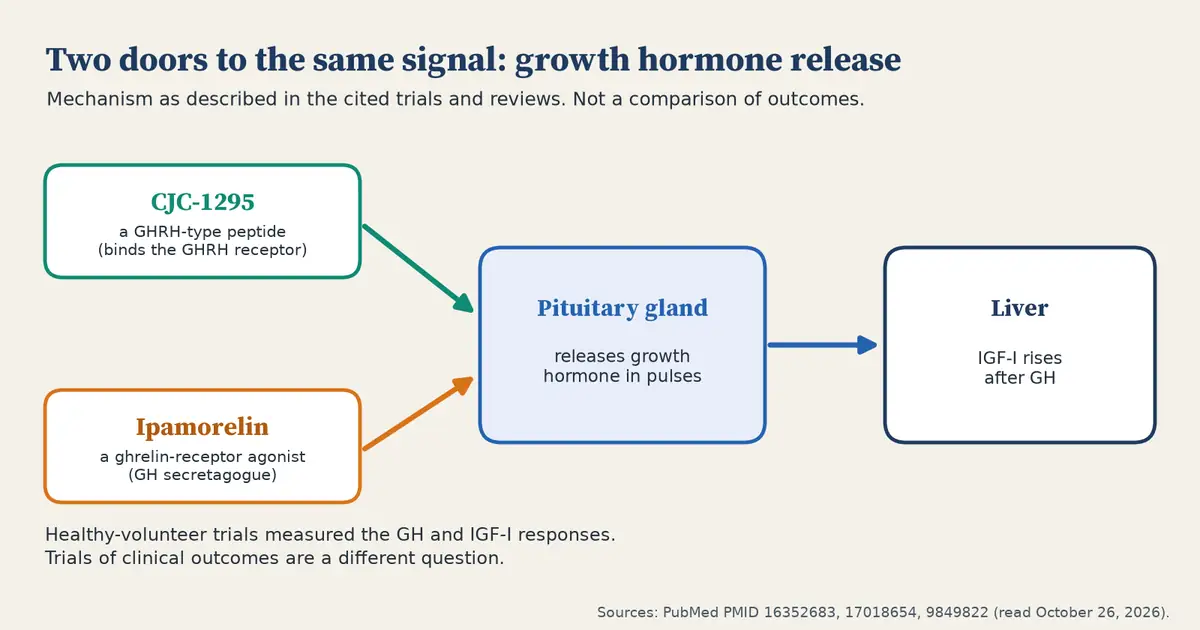
Growth hormone is released in pulses, and two different signals can ask the pituitary to release it. One is GHRH, made in the hypothalamus. The other is ghrelin, the hormone best known for hunger. CJC-1295 is built to mimic the first. Ipamorelin is built to mimic the second. The two are often discussed together because they were designed to hit the same system from different directions.
Both have real papers behind them, including placebo-controlled human trials in healthy adults. Neither has the kind of outcome evidence a drug approval needs, and FDA has said so in detail. This page reports both halves.
Facts are as of October 26, 2026. Sources, with retrieval dates, are at the bottom.
At a glance
- CJC-1295 is a long-acting analog of GHRH. In two randomized, placebo-controlled, double-blind trials in healthy adults aged 21 to 61, it raised growth hormone and IGF-I for days, with no serious adverse reactions reported. That is small, short, healthy-volunteer human evidence. [V]
- A follow-up study in healthy men found that pulses of growth hormone persisted during treatment, with higher baseline (trough) levels. [V]
- Ipamorelin was described in 1998 as the first selective ghrelin-receptor agonist for growth hormone release. In pigs it did not raise the stress hormones ACTH or cortisol the way older compounds did. That is animal evidence. [V]
- A phase 2 trial of ipamorelin in 117 patients after bowel surgery found it was well tolerated but did not beat placebo on the main outcome. [V]
- FDA has withdrawn both from category 2 for pharmacy compounding, but still lists ipamorelin acetate in category 2 for outsourcing facilities. [V]
Two doors to one signal
Growth hormone from the pituitary prompts the liver to release IGF-I, the hormone behind many of its effects. CJC-1295 and ipamorelin each act on a different receptor on the pituitary, and each leads to growth hormone release. Researchers have long been interested in this route because the body's own gland does the releasing. [V]
- 2placebo-controlled trials of CJC-1295 in healthy adults, reported in one 2006 paper [V]
- 1.5-3xrise in IGF-I after a single CJC-1295 administration in that paper [V]
- 117patients enrolled in the phase 2 ipamorelin trial after bowel surgery [V]
- 2006year of both CJC-1295 papers cited here [V]
CJC-1295: what the human trials found
CJC-1295 is a GHRH analog designed to last much longer in the body than natural GHRH, whose short half-life limits its use. A 2006 paper from the Journal of Clinical Endocrinology and Metabolism described two randomized, placebo-controlled, double-blind trials in healthy adults aged 21 to 61. After a single administration, mean growth hormone rose two- to ten-fold for six days or more, and mean IGF-I rose 1.5- to 3-fold. The estimated half-life was about six to eight days, IGF-I stayed elevated after repeated administration, and no serious adverse reactions were reported. The authors called it safe and relatively well tolerated and said the data support its potential as a therapeutic agent. [V]
A second 2006 paper from the University of Illinois at Chicago asked a finer question: does the body's pulsing pattern survive? In healthy men, growth hormone secretion rose with the pulsing preserved. The pulses were unchanged in frequency and size, while the baseline between pulses rose about seven-fold, and IGF-I rose 45%. The authors suggested that long-acting GHRH products could be clinically useful when the pituitary still works normally. [V] The second paper describes the version tested as binding to albumin in the blood, which is how it lasts. [V]
These are respectable, well-designed early studies. They are also in healthy volunteers, short, and focused on hormone levels. A rise in a hormone is not the same as a clinical benefit.
Ipamorelin: selectivity and a surgical trial
Ipamorelin is a five-amino-acid peptide. A 1998 paper in the European Journal of Endocrinology from Novo Nordisk scientists described it as the first selective growth hormone secretagogue. In pigs, older compounds in its class raised ACTH and cortisol, while ipamorelin did not, even at amounts far above those that released growth hormone. The paper called it a very interesting candidate for clinical development. [V] That is animal pharmacology, and the human trials that followed are modest.
A 1999 study in healthy male volunteers characterized how the body handles ipamorelin: a short half-life of about two hours, and a single episode of growth hormone release after each administration. [V] The biggest human study is a 2014 phase 2 randomized, double-blind, placebo-controlled trial in adults recovering from bowel resection. It enrolled 117 patients (114 analyzed). Adverse events were reported in 87.5% of the ipamorelin group and 94.8% of the placebo group. Median time to the first tolerated solid meal was 25.3 hours with ipamorelin and 32.6 hours with placebo, a difference that was not significant (p=0.15). The authors described it as well tolerated, noted that the study was small, and reported no significant efficacy difference. [V]
For a sense of where this class can go, tesamorelin, another GHRH analog, is an FDA-approved medicine for a defined use. [V] Our sermorelin page walks through that precedent.
Limits and unknowns
This is the section for what the evidence does not show, in plain terms.
- FDA's listing for CJC-1295 states that the agency has identified serious adverse events associated with it, including increased heart rate and a systemic vasodilatory reaction, and that available clinical data are limited. [V]
- FDA's listing for ipamorelin points to a published study of ipamorelin given into a vein to improve gastric motility, which it says found serious adverse events, including death, and it says FDA found no safety information for other non-oral routes. FDA does not name that study, and we have not matched it to any paper above. [V]
- The CJC-1295 trials were small and short, and the 2006 pulsing study raised baseline levels. Higher baseline growth hormone is a different pattern from the natural one, and the long-term meaning has not been settled in the sources we read. [V]
- The largest ipamorelin trial we found showed no significant efficacy difference. [V]
- None of the trials above tested either peptide for muscle, sleep, aging or fat loss, so claims about those uses have no support in these papers. [V]
- Names are confusing. The 2006 papers describe the version they tested as long-acting. We cannot tell from those papers how other preparations sold under similar names compare. [U]
Where regulators have put them
| The question | Answer | What the record shows |
|---|---|---|
| Is either an FDA-approved drug? | We found none | A DailyMed name search for each returned no labels. [V] |
| Where is CJC-1295 on FDA's 503A list? | Withdrawn from category 2 | It is in the table of substances nominated but withdrawn (page current as of April 22, 2026). FDA's text there cites serious adverse events and limited clinical data. [V] |
| Where is ipamorelin? | Withdrawn for 503A; category 2 for 503B | Ipamorelin acetate remains in category 2 for outsourcing facilities, added September 29, 2023, and also appears in the withdrawn table. [V] |
| Has the advisory committee reviewed either? | No | Neither was on the July 23-24, 2026 or later agenda FDA announced. [V] |
| Is either allowed in tested sport? | No | WADA's 2026 list names CJC-1295 and ipamorelin under S2.2.4. [V] |
The details matter for readers who see "withdrawn" and assume "cleared." It means the nominators withdrew their requests, so FDA's interim policy no longer places the substance in category 2. It does not mean FDA reviewed and cleared it, and the safety-risk text stays on FDA's page. Our category explainer explains the lists.
CJC-1295 and ipamorelin were not part of the July advisory committee votes. Readers who hear that "FDA is reviewing 14 peptides" should note that these two are on the list people discuss but have no committee date. See the status matrix for all 14.
What people get wrong
Claim
"CJC-1295 and ipamorelin are proven safe and effective for anti-aging."
What research shows
- Evidence-level claim
The trials measured growth hormone and IGF-I in healthy volunteers and, for ipamorelin, recovery after surgery. None tested anti-aging outcomes. [V]
What is unknown
Long-term outcomes of any kind for healthy adults. FDA lists serious adverse events for CJC-1295 and limited clinical data. [V]
This card describes the kind of research that exists.
Why it matters
The growth hormone axis is one of the most thoroughly mapped systems in endocrinology, and peptides that act on it are not a fringe idea. Tesamorelin shows that approval is possible when a sponsor runs the trials. CJC-1295 and ipamorelin show what the early rungs look like: a mechanism that works in a controlled hormone measurement, and a long way left to go on outcomes.
Questions to bring to a clinician or pharmacist
- Is the product I'm asking about an FDA-approved drug, or something compounded?
- Which published human trials tested it for the reason I'm asking, and in whom?
- How do the cardiovascular findings FDA cites for CJC-1295 relate to my own health history?
- If I compete in a tested sport, have I checked with my anti-doping organization?
What to watch next
Dates and decisions we're tracking
- No date setAny FDA decision on ipamorelin acetate's category 2 status for outsourcing facilities [V]
- Date not yet setThe next Pharmacy Compounding Advisory Committee meeting [V]
- PendingThe White House review of FDA's "Interim Access Policy for Compounding Using Certain Peptides" [V]
- Jan. 1, 2027WADA's 2027 Prohibited List takes effect [S]
For how early-stage studies fit in the bigger picture, see the evidence ladder.
Sources (retrieved October 26, 2026 unless noted)
- Teichman SL, et al., "Prolonged stimulation of growth hormone and insulin-like growth factor I secretion by CJC-1295, a long-acting analog of GH-releasing hormone, in healthy adults," Journal of Clinical Endocrinology and Metabolism, March 2006 (abstract on PubMed) [V] — https://pubmed.ncbi.nlm.nih.gov/16352683/
- Ionescu M, Frohman LA, "Pulsatile secretion of growth hormone persists during continuous stimulation by CJC-1295," Journal of Clinical Endocrinology and Metabolism, December 2006 (abstract on PubMed) [V] — https://pubmed.ncbi.nlm.nih.gov/17018654/
- Raun K, et al., "Ipamorelin, the first selective growth hormone secretagogue," European Journal of Endocrinology, November 1998 (abstract on PubMed) [V] — https://pubmed.ncbi.nlm.nih.gov/9849822/
- Gobburu JV, et al., "Pharmacokinetic-pharmacodynamic modeling of ipamorelin, a growth hormone releasing peptide, in human volunteers," Pharmaceutical Research, September 1999 (abstract on PubMed) [V] — https://pubmed.ncbi.nlm.nih.gov/10496658/
- Beck DE, et al., ipamorelin for postoperative ileus after bowel resection, phase 2 randomized trial, International Journal of Colorectal Disease, December 2014 (abstract on PubMed) [V] — https://pubmed.ncbi.nlm.nih.gov/25331030/
- FDA, "Certain Bulk Drug Substances for Use in Compounding that May Present Significant Safety Risks" (category 2 page), current as of 04/22/2026 [V] — https://www.fda.gov/drugs/human-drug-compounding/certain-bulk-drug-substances-use-compounding-may-present-significant-safety-risks
- FDA, "July 23-24, 2026: Meeting of the Pharmacy Compounding Advisory Committee," meeting page [V] — https://www.fda.gov/advisory-committees/advisory-committee-calendar/july-23-24-2026-meeting-pharmacy-compounding-advisory-committee-07232026
- DailyMed name searches for the 14 peptides covered on this site (tesamorelin returned labels; the other 13 returned none), run October 26, 2026 [V] — https://dailymed.nlm.nih.gov/dailymed/services/v2/spls.json?drug_name=ipamorelin
- WADA, 2026 Prohibited List (in force January 1, 2026), text read in full [V] — https://www.wada-ama.org/sites/default/files/2025-09/2026list_en_final_clean_september_2025.pdf
- WADA, 2027 Prohibited List text, read from a copy hosted by FIS (retrieved October 25, 2026) [S] — https://assets.fis-ski.com/f/252177/x/4526d29144/2027list_en_final_clean_26_august_2026_2.pdf
- OMB/OIRA, pending EO 12866 regulatory review, RIN 0910-ZD94 [V] — https://www.reginfo.gov/public/do/eoDetails?rrid=1568964
- FDA, NDA 22-505 (Egrifta, tesamorelin) approval package, approval date November 10, 2010 [V] — https://www.accessdata.fda.gov/drugsatfda_docs/nda/2010/022505Orig1s000Approv.pdf
Spot a mistake? See how we source and our corrections policy.