Everyone in the gym is talking about peptides. Here's what the research actually says
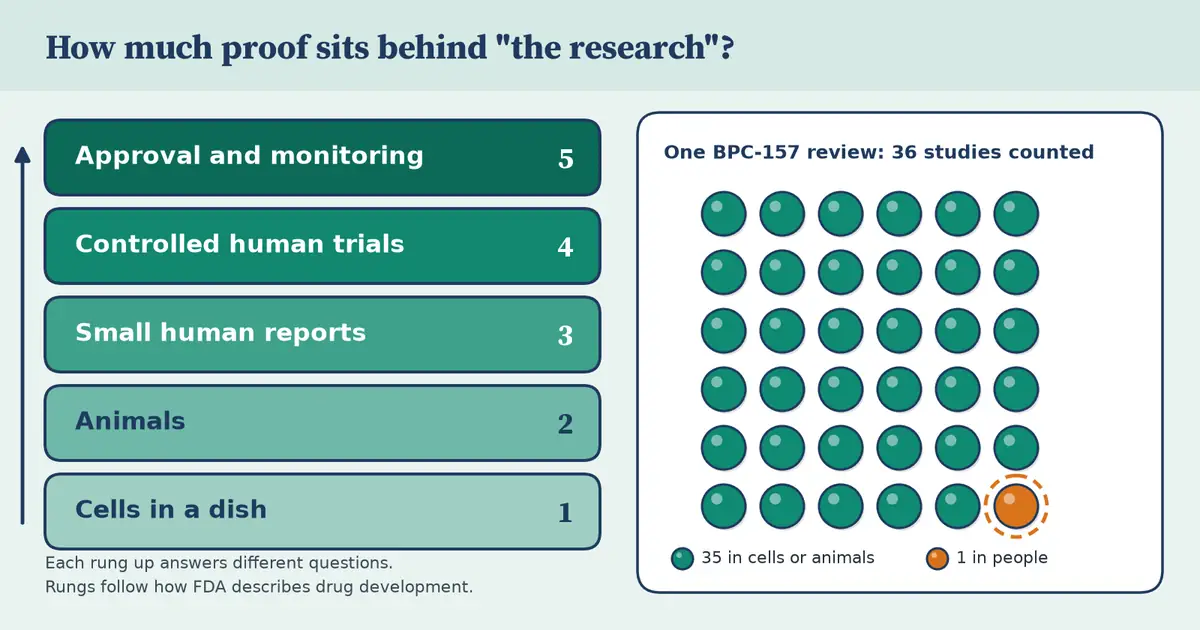
Your gym group chat says "there's research on it." Which kind? For BPC-157, a peptide often name-checked in fitness circles, a 2025 systematic review counted 36 included studies: 35 done in cells or animals and one in people. A newer review, searching through June 2026, counted three human studies with 30 participants in total. The number depends on which review you open, and that is the point of this post.
Facts are as of October 25, 2026. Sources, with retrieval dates, are at the bottom.
Updated October 25, 2026: this post first gave the 2025 review's count of one clinical study as the human evidence. Two other reviews count three human studies, so it now reports all three (see the section on why the counts differ) and the corrections log records the change.
If you only read one box
- "The research" can mean very different things: cells in a dish, animals, a handful of people, or large human trials. They are not equal. [V]
- In the 2025 HSS Journal review (searches to June 3, 2024), 35 of the 36 included BPC-157 studies were preclinical and one was clinical. Its authors wrote "No clinical safety data were found." [V]
- Two later reviews count three human studies, not one: a narrative review published August 12, 2025 and a systematic review published online October 8, 2026 (searches to June 1, 2026). [V]
- The newest review's authors rated the overall certainty of the evidence "very low" and judged the three studies to be of poor methodological quality. [V]
- Counting studies is not the same as judging them. None of this says a peptide works or fails. It says where the evidence sits today. [V]
A ladder, not a verdict
When someone says "the research shows," ask which rung of the ladder they mean. Here is a simple version, built from how FDA describes drug development:
- Cells in a lab (in vitro). Fast and cheap. FDA describes this as part of preclinical research.
- Animals (in vivo). Also preclinical. FDA says its purpose is to learn whether a drug "has the potential to cause serious harm" before it is tested in people.
- Small human reports. Case reports and chart reviews. They can raise questions, but they are not designed to answer them.
- Controlled human trials (Phases 1 to 3). FDA describes Phase 1 as 20 to 100 people, Phase 2 as up to several hundred, and Phase 3 as 300 to 3,000.
- Approval and monitoring. After approval, FDA says Phase 4 studies come after approval and track safety while the drug is on the market.
Sources: FDA's Step 2 and Step 3 drug-development pages. [V]
Each rung up answers different questions. FDA says preclinical research "is not a substitute for studies" of how a drug behaves in people.
The attrition rate is the surprise
Even drugs that earn their way into human trials mostly do not go on to approval. FDA's page says that approximately 70% of drugs move from Phase 1 to the next phase, approximately 33% from Phase 2, and approximately 25-30% from Phase 3. [V]
That is FDA's own rough description of drugs that were already carefully chosen for human testing. It is a good reminder that an early result, however exciting, is a starting point.
What the 2025 BPC-157 review found
The HSS Journal review (Vasireddi and colleagues, 2025) searched PubMed, Cochrane and Embase from each database's start to June 3, 2024. The abstract reports:
- 544 articles identified, 36 studies included: 35 preclinical studies and 1 clinical study.
- The authors describe the body of work as "level IV and level V studies." [V]
- "No clinical safety data were found." [V]
- Their conclusion says the evidence "suggests that BPC-157 shows promise for promoting recovery from musculoskeletal injuries," and that adverse effects are possible "due to unregulated manufacturing, contamination, or unknown clinical safety." [V]
Note the wording. "Shows promise" is the authors' reading of mostly animal and cell work. It is not a finding that anything works in people, and the same abstract says it found no clinical safety data.
Claim
"A review says BPC-157 'shows promise,' so it must work."
What research shows
- Animal
- Cell
- Human (1 study)
The 2025 review's authors wrote that the evidence "suggests that BPC-157 shows promise for promoting recovery from musculoskeletal injuries." Of the 36 studies it included, 35 were preclinical and one was clinical. [V]
What is unknown
Whether what was seen in cells and animals holds up in people. The same abstract reports "No clinical safety data were found," and the newest review rates the overall certainty of evidence "very low." [V]
This card describes the kind of research that exists.
The one human study in the 2025 review, and its limits
The single clinical study in that review is a 2021 paper in Alternative Therapies in Health and Medicine (Lee and Padgett). Here is only its design:
- A retrospective chart review at one clinic, covering a one-year window (2019 to 2020). Follow-up varied from patient to patient.
- 17 patients; 16 were reached by phone. Patients were asked to rate their own pain and how much it helped.
- The paper states that "No specific tools were used to measure" gains in function, quality of life, stiffness or daily activities.
- The authors say future studies are needed.
A small review of charts at one clinic cannot show what would have happened without the treatment, and the abstract describes no untreated comparison group. We are not repeating the study's results here, because a design like this cannot support conclusions about whether something works.
One more lesson hides in the two abstracts. The review and the original study describe the same group's results in different terms: one counts relief lasting more than six months, the other counts "significant improvement." A headline number depends on what was measured, and how. [V]
Why one review counts one human study and another counts three
Reviews count differently because they ask different questions, search to different dates and apply different inclusion rules. Here are the three we read, side by side:
| Review | Published | Searches ran through | Human studies counted |
|---|---|---|---|
| Vasireddi and colleagues, HSS Journal (systematic review) | 2025, volume 21, issue 4 | June 3, 2024 | 1 clinical study among 36 included [V, abstract] |
| McGuire and colleagues, Current Reviews in Musculoskeletal Medicine (narrative review) | August 12, 2025 | March 2025 | 3 pilot studies [V] |
| Poolton, Minett and Kazmi, Acta Orthopaedica Belgica (systematic review) | Online October 8, 2026 | June 1, 2026 | 3 studies, 30 participants in total [V, abstract] |
The table counts studies, not their quality or safety. All three retrieved October 25, 2026.
The two newer reviews appear to cover the same three human studies: a retrospective study of knee pain, a small pilot study for a bladder condition, and a two-person pilot study aimed at safety. The narrative review names its sources, and the knee-pain paper is the 2021 Lee and Padgett study described above. The other two are listed as a 2024 pilot (bladder) and a 2025 pilot (safety). [V]
Part of the gap is timing. The 2025 pilot was published after the HSS Journal review stopped searching in June 2024. We did not check the month of the 2024 paper, so we cannot say whether it also fell outside that window. [U] The newest review also lists ClinicalTrials.gov among its databases and, per its abstract, accepted human studies of any indication, while the HSS Journal review focused on musculoskeletal outcomes, mechanism, metabolism and safety. The abstracts do not say whether those differences explain the whole gap, so we will not guess.
The earlier line "No clinical safety data were found" described the first review's own search window. The 2026 abstract does describe a two-person pilot study aimed at safety, and it reports no treatment-related adverse events. It also rates the overall certainty of the evidence "very low" and the studies as poor in methodological quality. [V]
The newest review's authors conclude that BPC-157 "should not be used clinically in humans outside ethically approved, regulated, high-quality clinical trials." We pass that on as their conclusion, not as advice from this site. [V]
Claim
"The studies found no side effects, so it's safe."
What research shows
- Human (3 small studies)
The 2026 review's abstract says the three human studies, with 30 participants in total, reported no treatment-related adverse events. The authors also judged the studies to be of poor methodological quality. [V]
What is unknown
Whether the same holds in larger, better-controlled studies. The 2025 narrative review says "rigorous, large-scale trials are lacking." [V]
This card describes the kind of research that exists.
Why the rung matters
The conversation about peptides in gyms and wellness circles often skips the question of evidence type. A friend's story, a podcast, a clinic's website and a randomized trial can all be called "research." They are not the same thing.
Knowing the rungs makes a claim quicker to size up. A claim at rung 1 or 2 can be interesting and still say little about what happens in people.
Questions to ask of any claim
- Which rung is this claim on? Cells, animals, case reports or controlled human trials?
- Is there a comparison group? What happened to people who did not get the treatment?
- What were they measuring, and how? Self-reported ratings or standard tools?
- Is there any human safety information? The 2025 review found none. The 2026 review counts one two-person pilot study and rates the whole body of evidence "very low" certainty.
- Is this an approved medicine, or a product with no approval for human use? See peptides in plain English.
What to watch next
- Sport: the World Anti-Doping Agency's 2026 list names several peptides. See peptides and the WADA list.
- Regulators: FDA's advisory committee met on seven peptides in July 2026. Our timeline tracks what is final and what is pending.
- Approved vs wellness: what an FDA label tells you that a gym-chat peptide lacks, in our side-by-side comparison.
- Another example of the ladder: our GHK-Cu explainer quotes a 2026 review on the copper peptide.
- Coming: how to read a clinical-trial listing, and a "Myth vs. evidence" series.
Sources (all retrieved October 25, 2026)
- Vasireddi N, Hahamyan H, Salata MJ, et al., "Emerging Use of BPC-157 in Orthopaedic Sports Medicine: A Systematic Review," HSS Journal 21(4):485-495, 2025 [V, abstract] — https://pubmed.ncbi.nlm.nih.gov/40756949/
- Lee E, Padgett B, "Intra-Articular Injection of BPC 157 for Multiple Types of Knee Pain," Alternative Therapies in Health and Medicine 27(4):8-13, 2021 [V, abstract] — https://pubmed.ncbi.nlm.nih.gov/34324435/
- FDA, "Step 2: Preclinical Research," content current as of 01/04/2018 [V] — https://www.fda.gov/patients/drug-development-process/step-2-preclinical-research
- FDA, "Step 3: Clinical Research," content current as of 01/04/2018 [V] — https://www.fda.gov/patients/drug-development-process/step-3-clinical-research
- McGuire FP, Martinez R, Lenz A, Skinner L, Cushman DM, "Regeneration or Risk? A Narrative Review of BPC-157 for Musculoskeletal Healing," Current Reviews in Musculoskeletal Medicine 18(12):611-619, published August 12, 2025 [V] — https://pmc.ncbi.nlm.nih.gov/articles/PMC12446177/
- Poolton JT, Minett J, Kazmi A, "Human evidence for BPC-157 in orthopaedic and regenerative medicine: a systematic review of efficacy and safety," Acta Orthopaedica Belgica 92(3), published online October 8, 2026 [V, abstract on the journal page] — https://doi.org/10.52628/92.3.15837
Spot a mistake? See how we source and our corrections policy.