Wellness
Peptides in self-care, plain and simple: what people are asking and what the sources say.

Peptides have drifted out of the lab and into ordinary conversation. They turn up on skincare labels, in prescriptions for diabetes and weight loss, and in gym talk about recovery. KFF's late-2025 poll found about one in eight US adults currently taking a GLP-1 drug. [V] So when someone says "peptide," which one do they mean? A prescription medicine, a skincare ingredient, or something with no approval at all? This hub starts with the questions readers actually ask: what a peptide is, what kind of proof sits behind a claim, and which products are approved medicines.
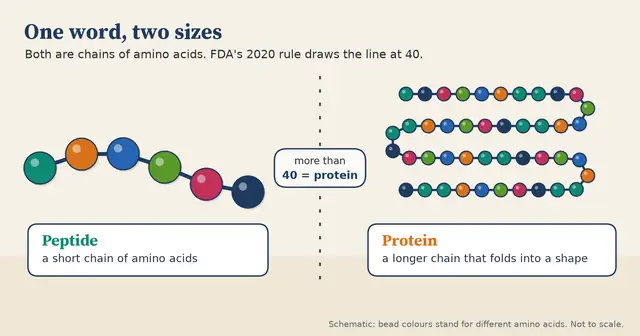
A peptide is a short chain of amino acids. FDA's 2020 rule treats chains of more than 40 amino acids as proteins. [V] Semaglutide, the active ingredient in Wegovy, is a peptide medicine with an FDA-approved label. [V] Other products discussed in wellness circles have no approval for human use. The posts below sort out which is which, with sources and dates.
Evidence labels: [V] verified in a primary document, [S] secondary source. Reviewed October 25, 2026.
Posts in this topic
- Wellness
- Evidence
- FDA
Peptides, in plain English: what they are, and why one word covers so much
What peptides are, how FDA draws the line between a peptide and a protein, and why the same word covers approved medicines and wellness-market products.
- Evidence
- Fitness and recovery
- Wellness
Everyone in the gym is talking about peptides. Here's what the research actually says
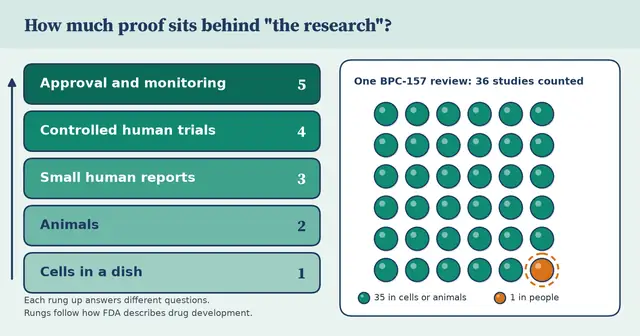
A plain-English evidence ladder, from cells to animals to people, applied to BPC-157: one 2025 review counted 1 human study, a 2026 review counts 3.
- Fitness and recovery
- Safety and quality
- Wellness
Which popular gym peptides are banned in sport? What WADA's 2026 and 2027 lists name
Which peptides do WADA's 2026 and 2027 Prohibited Lists name, what strict liability means for supplements, and what WADA says about GLP-1 drugs.
- Wellness
- FDA
- Policy
From insulin to Ozempic: a timeline of how peptide medicines went from niche to mainstream
A dated timeline of how peptide medicines went from insulin to GLP-1 drugs, and how that changed the money, the FDA rules and public interest.
- Safety and quality
- Compounding
- Wellness
The glutathione injection recall: what FDA's October 1 notice says, and what it doesn't
FDA's Oct 1, 2026 notice on a compounded glutathione injection recall for possible endotoxin: what it says, what CDC and FDA add, what's unconfirmed.
- Compounding
- Advisory committee
- Wellness
GHK-Cu is in skincare and on FDA's compounding list. Here's what "except injectable" means
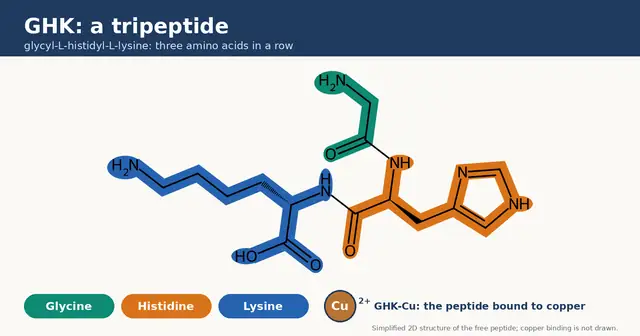
GHK-Cu, the copper peptide in skincare, is on FDA's Category 1 compounding list except for injectables, with an advisory meeting due by February 2027.
- Wellness
- FDA
- Compounding
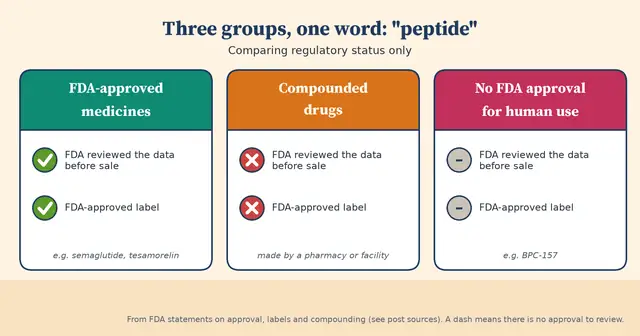
"It's a peptide": three very different things hiding behind one word
Approved peptide medicines, compounded drugs and wellness-market peptides side by side: what FDA reviewed, what a label tells you, and what it does not.


Key terms in plain English
- Peptide
- A short chain of amino acids. Think of beads on a string.
- Protein
- A longer, folded chain. FDA's 2020 rule uses "greater than 40 amino acids" as its line, and FDA says there may be no clear scientific consensus on an exact number. [V]
- Approved medicine
- A drug that FDA has reviewed and approved for stated uses. The approved label lists those uses. [V]
- Preclinical
- Lab and animal research done before studies in people. See the Evidence hub.
Primary sources behind this page
- FDA final rule, Definition of the Term "Biological Product" (Federal Register) (published Feb. 21, 2020)
- Wegovy prescribing information (DailyMed) (version 19, June 30, 2026)
- Systematic review of BPC-157 research, HSS Journal (PubMed) (2025)
- KFF Health Tracking Poll on GLP-1 drug use (published Nov. 14, 2025)
Other topics
Image: AI-generated. Image credits