GHK-Cu is in skincare and on FDA's compounding list. Here's what "except injectable" means
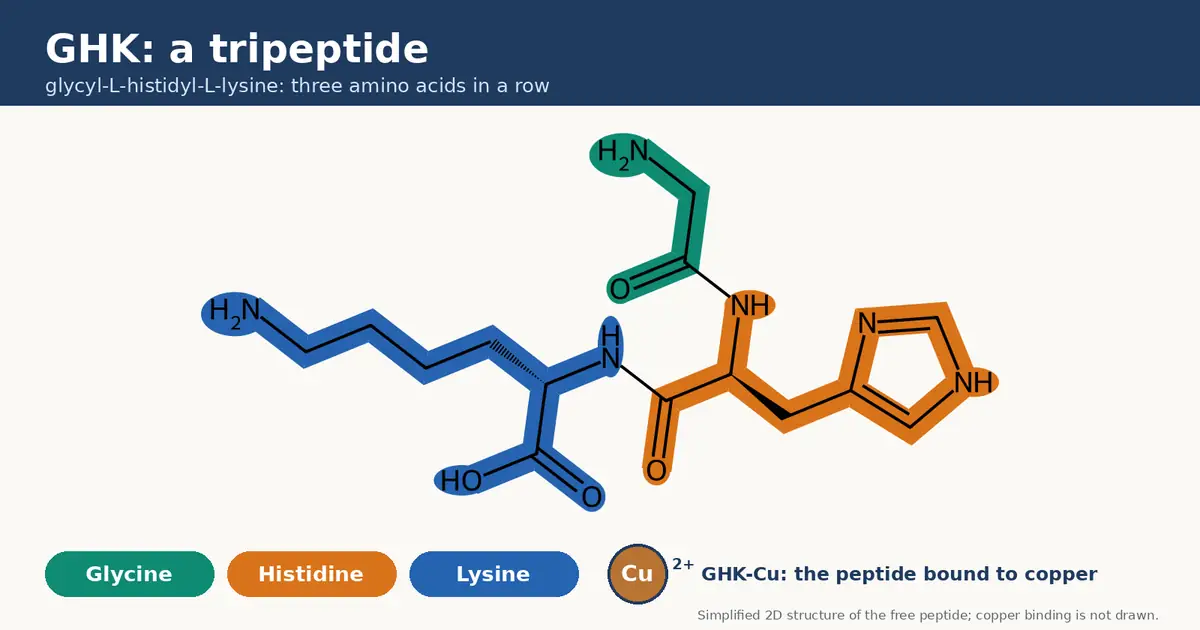
Seen "copper peptide" on a serum label and "GHK-Cu" in a recovery thread? The two names can point to the same ingredient, and FDA's compounding list treats it with a carve-out: "except for injectable routes of administration." That short line, restored in May after a nominator clarified what it meant to withdraw, is why the peptide that skincare shoppers know as a copper peptide is also on an FDA advisory committee agenda for early 2027.
Facts are as of October 25, 2026. Sources, with retrieval dates, are at the bottom.
The gist
- FDA's May 14, 2026 list puts "GHK-Cu (except for injectable routes of administration)" in Category 1 for pharmacy compounding. Category 1 is an interim policy category. It is not an approval. [V]
- FDA says it intends to consult its Pharmacy Compounding Advisory Committee on GHK-Cu before the end of February 2027. As of October 25 we found no Federal Register notice setting a date. [V]
- A 2026 systematic review concluded GHK-Cu "should be regarded as a promising but unproven therapeutic cargo rather than a clinically validated regenerative drug." [V]
What GHK-Cu is
GHK is a three-amino-acid peptide, glycyl-L-histidyl-L-lysine. GHK-Cu is its complex with copper. [V] On cosmetic ingredient lists the copper complex usually appears under the name "copper tripeptide-1." [S] The European Commission's CosIng ingredient database lists COPPER TRIPEPTIDE-1 as "a copper complex of Tripeptide-1," with the function "skin conditioning." [V] An entry in an ingredient inventory is a name and a function. It is not a finding that a product is safe or that it works.
If the word "peptide" itself is new, start with our plain-English peptide explainer.
The FDA list, in plain English
Pharmacies that compound drugs under section 503A can use bulk ingredients that meet certain conditions. While FDA builds its official list, it sorts nominated ingredients into interim categories. Under FDA's interim policy, it "does not intend to take action against" pharmacies, federal facilities or physicians that compound with Category 1 substances, as long as other conditions are met. [V] Our Category 1 and 2 explainer covers the details.
GHK-Cu's entry has a short history, all in FDA's own list (updated May 14, 2026): [V]
- April 22, 2026: FDA removed GHK-Cu from Category 1 because the nominators withdrew it.
- May 5, 2026: one nominator clarified that it meant to withdraw only the injectable route and keep non-injectable routes.
- May 14, 2026: FDA's updated list shows "GHK-Cu (except for injectable routes of administration)" back in Category 1.
So the Category 1 entry covers non-injectable routes. Injectable GHK-Cu is not part of it. The FDA documents we read do not spell out how FDA treats compounding of injectable GHK-Cu, so we do not guess.
Category 1 is not approval
FDA says Category 1 substances can stay under the interim policy "until the agency decides on inclusion of these substances on the 503A bulks list" or until FDA removes them, for example based on "information about safety risks." [V] Separately, FDA states that "compounded drugs are not FDA-approved," and that it "does not verify the safety, effectiveness or quality of compounded drugs before they are marketed." [V] Our comparison of approved and wellness peptides lays out what that difference means.
In our search of FDA's drug-approval database (openFDA Drugs@FDA) on October 25, we found no approved product listed under GHK-Cu, copper tripeptide or prezatide. [V]
Skincare jar or drug? FDA says it depends on the claim
The same ingredient can sit on different sides of the law depending on what a product is intended to do. Under the Food, Drug, and Cosmetic Act, cosmetics are products for "cleansing, beautifying, promoting attractiveness, or altering the appearance." Drugs are intended to treat or prevent disease or "to affect the structure or any function of the body." [V]
FDA says intended use can be shown by the claims made for a product, and it gives "regenerate cells" as an example of a claim that can make a product a drug. It adds that "cosmeceutical" "has no meaning under the law," and that cosmetics other than color additives "do not require FDA approval before they go on the market." [V] We make no claims about any skincare product here.
What the research says so far
The most recent systematic review we found, published August 27, 2026 in Pharmaceutics (Mateescu and colleagues), searched sources through August 12, 2026. Its authors wrote: [V]
- Preclinical data "consistently support effects" on tissue remodeling and repair, "but the clinical evidence remains sparse and does not meet contemporary active-entity quality standards."
- "Historical cosmetic reports are small or incompletely characterized."
- A registered phase 2 wound study "remains recruiting and has no efficacy results; its registration cannot be used as evidence of clinical translation."
ClinicalTrials.gov showed four records for "GHK-Cu" on October 25, including that topical gel wound study (NCT07437586, recruiting). [V] A trial listing tells you a study exists. It is not a result. Our evidence ladder explains why that matters.
Claim
"Copper peptides are backed by clinical research."
What research shows
- Cell
- Animal
- Human (small cosmetic reports)
The August 27, 2026 Pharmaceutics review says preclinical data "consistently support effects" on tissue remodeling and repair. It describes the older cosmetic reports as "small or incompletely characterized." [V]
What is unknown
Whether controlled human trials show a benefit. The review says the clinical evidence "remains sparse," and the one registered phase 2 wound study had no efficacy results at the time. [V]
This card describes the kind of research that exists.
What happens next
FDA's advisory committee page says it "will host an advisory committee meeting before the end of February 2027" on five candidates for the 503A bulks list: GHK-Cu, PEG-MGF, melanotan II, LL-37 and dihexa acetate. Time and location "will be scheduled in the coming months," and FDA said it would publish a Federal Register notice. [V] Advisory committees "make non-binding recommendations." [V] Our Federal Register search on October 25 found no notice yet. [V]
Why one name shows up in two aisles
If you see copper peptides in a serum or hear about GHK-Cu in a recovery thread, the same name can mean a cosmetic ingredient or a compounded drug, and the rules differ. The FDA meeting could shape whether GHK-Cu lands on the official compounding list. Knowing that "Category 1" is not "approved" makes the headlines from that meeting easier to read.
Questions worth asking about any "copper peptide" claim
- Is this a cosmetic or a compounded drug? Look at what the product claims to do, not only at the ingredient name.
- Which route is being discussed? FDA's Category 1 entry excludes injectable routes.
- What evidence is cited? Cells, animals, a small cosmetic study, or a completed controlled trial in people?
- Who would know? A clinician or pharmacist can say what applies to a specific person.
What to watch next
- A Federal Register notice with the date of the next Pharmacy Compounding Advisory Committee meeting. We track it in the regulation timeline and the weekly roundup.
- Posted results, if any, from the GHK-Cu studies registered on ClinicalTrials.gov.
- For athletes: sport rules are separate from FDA rules. See peptides and the WADA list.
Sources (all retrieved October 25, 2026)
- FDA, "Bulk Drug Substances Nominated for Use in Compounding Under Section 503A" (category list, PDF), updated May 14, 2026 [V] — https://www.fda.gov/media/94155/download
- FDA, Pharmacy Compounding Advisory Committee meeting page (early announcement), content current as of 04/15/2026 [V] — https://www.fda.gov/advisory-committees/pharmacy-compounding-advisory-committee/meeting-pharmacy-compounding-advisory-committee
- FDA, "Bulk Drug Substances Used in Compounding Under Section 503A of the FD&C Act," content current as of 05/14/2026 [V] — https://www.fda.gov/drugs/human-drug-compounding/bulk-drug-substances-used-compounding-under-section-503a-fdc-act
- FDA, "Compounding and the FDA: Questions and Answers," content current as of 09/16/2025 [V] — https://www.fda.gov/drugs/human-drug-compounding/compounding-and-fda-questions-and-answers
- FDA, "Is It a Cosmetic, a Drug, or Both? (Or Is It Soap?)," content current as of 09/11/2024 [V] — https://www.fda.gov/cosmetics/cosmetics-laws-regulations/it-cosmetic-drug-or-both-or-it-soap
- Mateescu DM, et al., "GHK-Cu as a Bioactive Metallopeptide and Drug-Delivery Cargo," Pharmaceutics 18(9):1077, August 27, 2026 [V, abstract read on PubMed] — https://pubmed.ncbi.nlm.nih.gov/42797253/
- ClinicalTrials.gov, search for "GHK-Cu" (4 records) and NCT07437586 [V] — https://clinicaltrials.gov/study/NCT07437586
- European Commission, CosIng cosmetic ingredient database, COPPER TRIPEPTIDE-1 (ref. 55687) [V] — https://ec.europa.eu/growth/tools-databases/cosing/details/55687
- SpecialChem, "COPPER TRIPEPTIDE-1: INCI Ingredient," for the name equivalence with GHK-Cu [S] — https://www.specialchem.com/cosmetics/inci-ingredients/copper-tripeptide-1
- Federal Register search (API) for "GHK-Cu" and Pharmacy Compounding Advisory Committee notices [V] — https://www.federalregister.gov/documents/search?conditions%5Bterm%5D=%22Pharmacy+Compounding+Advisory+Committee%22
- openFDA Drugs@FDA search for GHK, copper tripeptide and prezatide (no match) [V] — https://open.fda.gov/apis/drug/drugsfda/
Spot a mistake? See how we source and our corrections policy.