Evidence
What kind of proof sits behind a claim: cell, animal, human trial or anecdote.

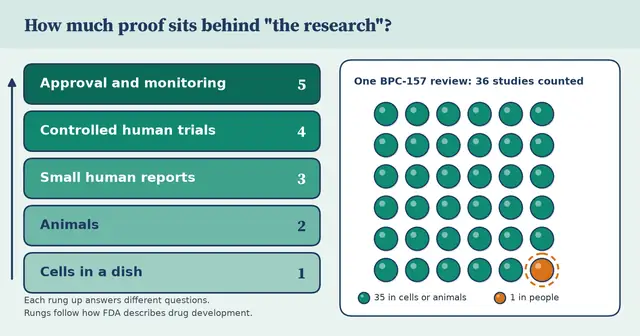
"Studies show" can mean anything from cells in a dish to a randomized trial in people. This hub explains the ladder of evidence so you can tell which rung a claim is standing on.
FDA describes drug development as lab and animal work first, then human trials in phases. Even drugs that reach human trials mostly do not reach approval: FDA's page puts the share moving on at about 70% from Phase 1, about 33% from Phase 2 and about 25 to 30% from Phase 3. [V] Those are general figures, not a forecast for any peptide. In the 2025 BPC-157 review, 35 of 36 studies were preclinical, and its authors wrote that "No clinical safety data were found." A review published online October 8, 2026 counted three human studies and rated the overall certainty of evidence "very low." The counts differ because the reviews searched different dates and used different rules. [V] Personal accounts and social posts sit on the lowest rung: they record what one person reports, not what a controlled study measured.
Evidence labels: [V] verified in a primary document, [S] secondary source. Reviewed October 25, 2026.
Posts in this topic
- Wellness
- Evidence
- FDA
Peptides, in plain English: what they are, and why one word covers so much
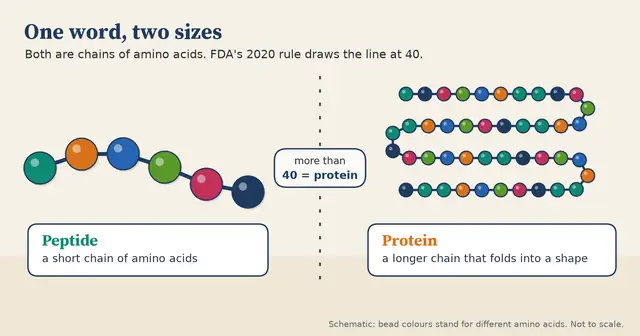
What peptides are, how FDA draws the line between a peptide and a protein, and why the same word covers approved medicines and wellness-market products.
- Evidence
- Fitness and recovery
- Wellness
Everyone in the gym is talking about peptides. Here's what the research actually says
A plain-English evidence ladder, from cells to animals to people, applied to BPC-157: one 2025 review counted 1 human study, a 2026 review counts 3.
- Compounding
- Advisory committee
- Wellness
GHK-Cu is in skincare and on FDA's compounding list. Here's what "except injectable" means
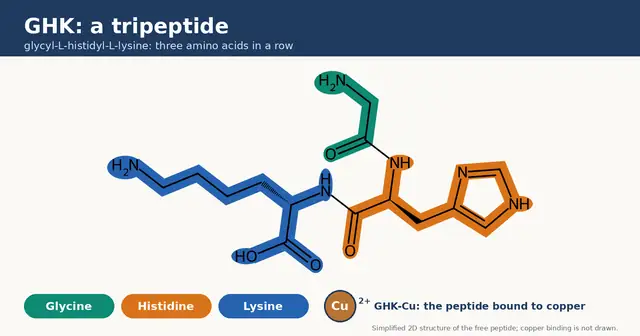
GHK-Cu, the copper peptide in skincare, is on FDA's Category 1 compounding list except for injectables, with an advisory meeting due by February 2027.
Key terms in plain English
- Preclinical
- Lab and animal research done before studies in people. FDA's "Step 2" of drug development. [V]
- Clinical trial phases
- Human studies. Per FDA, they move from small safety-focused studies to larger ones that look at effectiveness and side effects. [V]
- Randomized controlled trial
- A study that assigns people to groups by chance and compares the groups.
- Systematic review
- A review that searches databases by a set method and counts the studies that meet stated criteria.
Primary sources behind this page
- FDA, Drug Development Process, Step 2: Preclinical Research (retrieved Oct. 25, 2026)
- FDA, Drug Development Process, Step 3: Clinical Research (retrieved Oct. 25, 2026)
- Systematic review of BPC-157 research, HSS Journal (PubMed) (2025)
- Systematic review of human BPC-157 evidence, Acta Orthopaedica Belgica (published online Oct. 8, 2026)
Other topics
Image: AI-generated. Image credits