"It's a peptide": three very different things hiding behind one word
Your friend says they're "on a peptide." A skincare label lists "peptides" as a feature. At a checkup, your clinician mentions a peptide-based medicine. Same word every time. So is it the same kind of thing every time? Not even close, and the difference is mostly about paperwork, which is where this post lives.
Take two real examples. Tesamorelin is a peptide with an FDA-approved label, and that label says it "is not indicated for weight loss management." BPC-157, the peptide you hear about most in gym circles, has no FDA approval and so no FDA-approved label. No FDA-reviewed document sets out what it is for, who should avoid it, or what to watch for.
Facts are as of October 25, 2026. Sources, with retrieval dates, are at the bottom.
Three groups, one word
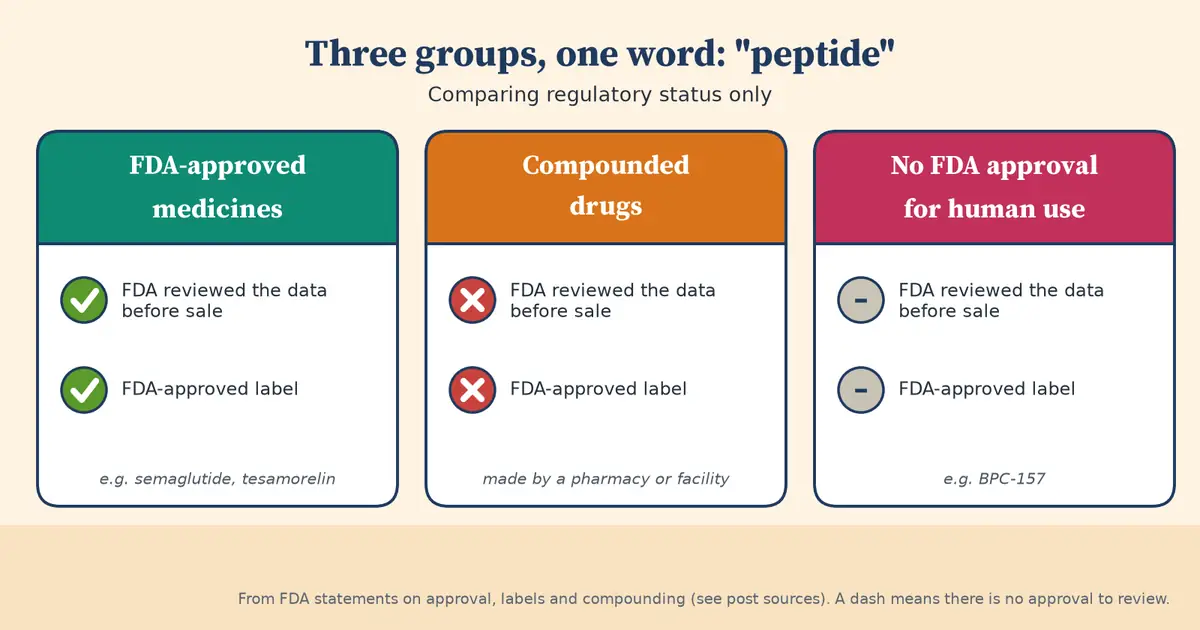
Our peptide explainer showed that "peptide" covers a prescription medicine and a gym-chat compound alike. Here we sort them into groups by regulatory status, which is the part that's written down and checkable.
The first group is FDA-approved peptide medicines: semaglutide (Wegovy), tirzepatide (Zepbound) and tesamorelin (Egrifta WR). Each has a label on DailyMed, the National Library of Medicine's database of drug labels. [V]
The second is compounded drugs, which a pharmacy or outsourcing facility prepares. FDA says they "are not FDA-approved," and that generics, by contrast, are approved through their own pathway. [V]
The third is peptides with no FDA approval for human use. BPC-157 is the best-known example, and a 2025 systematic review describes it as lacking FDA approval. [V]
What changes from group to group
Here are the questions people ask most, one group at a time.
Did FDA look at the evidence before it was sold? For an approved medicine, yes. FDA approves an application after deciding the data are "adequate to show the drug's safety and effectiveness for its proposed use." [V] For a compounded drug, no: FDA does not verify safety, effectiveness or quality before marketing. [V] And for a substance with no FDA approval, there simply isn't an approval. [V]
Is there an official label? Approved medicines have an FDA-approved label that lists approved uses, who shouldn't use the drug and warnings, and it's published on DailyMed. [V] A compounded drug has no FDA-approved label, because the drug isn't FDA-approved. [V] A substance with no approval has none either. [V]
What has FDA said about quality or risk? For approved drugs, risks are set out in the label, for example in boxed warnings and contraindications. [V] For compounded drugs, FDA says "Poor compounding practices can result in serious drug quality problems, such as contamination or a drug that contains too much or too little active ingredient." [V] For BPC-157, FDA cites possible immunogenicity and impurity concerns and "no, or only limited, safety-related information." [V]
What human evidence stands behind it? Behind an approved drug are clinical trials submitted to FDA, because FDA's application must include everything "from preclinical data to Phase 3 trial data." [V] For a compounded drug, it depends on the ingredient, and the compounded product itself isn't reviewed. [V] For BPC-157, published reviews count between 1 human study (a 2025 review, searches to June 2024) and 3 (a 2026 review, searches to June 2026), with most of the research preclinical. [V]
- 1human study counted by a 2025 BPC-157 review (searches to June 2024) [V]
- 3human studies counted by a 2026 review (searches to June 2026) [V]
- "very low"the 2026 review's rating of the overall certainty of evidence [V]
is not indicated for weight loss management as it has a weight neutral effect [V]
What an approved label actually tells you
A label isn't marketing copy. It's the document FDA approved alongside the drug, and it's narrower than most people expect. Take the three approved examples:
Zepbound (tirzepatide) is labeled for weight reduction in certain adults, alongside diet and exercise, and for obstructive sleep apnea of moderate or severe degree in adults who have obesity. Its label advises against pairing it with other tirzepatide products or any GLP-1 receptor agonist ("is not recommended"). [V]
Egrifta WR (tesamorelin) is described on its label as "a human growth hormone-releasing factor (GRF) analog," and it's indicated "for the reduction of excess abdominal fat in HIV-infected adult patients with lipodystrophy." The label adds that it "is not indicated for weight loss management as it has a weight neutral effect." [V]
Wegovy (semaglutide) lists uses including reducing the risk of major cardiovascular events in certain adults, long-term weight reduction, and a liver condition called MASH. [V]
The Wegovy and Zepbound labels both open with a boxed warning about thyroid C-cell tumors seen in rodents. They say it's unknown whether the drug causes these tumors in humans. [V]
Here's the thing to take away: "approved" always comes with "for what, and for whom." An approval for one use in one group isn't an approval for every use you hear about online.
Where the other two groups come from
FDA says compounding can serve "an important patient need," such as a patient with a dye allergy or a young child who can't take a tablet. It also says compounded drugs "should only be used in patients whose medical needs cannot be met by an FDA-approved drug." [V] The rules for which bulk ingredients compounders may use are explained in our Category 1 and 2 explainer. How telehealth firms market compounded drugs is covered in our FTC and FDA telehealth post. For what a recall of a compounded injectable looks like on paper, see our glutathione recall post.
For peptides with no approval, the record is thinner. FDA's compounding-safety page lists BPC-157 among substances whose nominations were withdrawn, and it keeps FDA's description of potential risks. [V] Our evidence ladder walks through what the published BPC-157 research does and doesn't show. For athletes, sport rules are a separate question, covered in our WADA explainer.
What people get wrong
Claim
"If it's called a peptide, it has been through the same checks as a prescription peptide."
What research shows
- None (a question about regulatory status)
FDA says compounded drugs "are not FDA-approved" and that it "does not verify the safety, effectiveness or quality of compounded drugs before they are marketed." For BPC-157, FDA cites possible immunogenicity and impurity concerns and "no, or only limited, safety-related information." [V]
What is unknown
How any one wellness product was made or what it contains. The sources used here describe categories of drugs, not individual products, so this post cannot speak to a specific item.
This card describes the kind of research that exists.
Two more mix-ups are worth naming. Approved doesn't automatically mean "right for you": a label lists who shouldn't use a drug. And a substance without approval hasn't been shown to be harmful just because it lacks approval. FDA's own wording for BPC-157 is that it "lacks sufficient information to know whether the drug would cause harm when administered to humans." [V] "Not reviewed" and "proven unsafe" are different findings.
Why this matters to you
Peptides come up in pharmacies, skincare aisles and gym talk alike, and the word hides which group something sits in. That group decides whether anyone checked the product's quality before it was sold, and whether an official label exists to tell you who should avoid it. Placing something in the right group comes before any question about results.
Questions to bring to a clinician or pharmacist
- Is this an FDA-approved medicine, a compounded drug, or a substance with no FDA approval for human use?
- If it's approved, what is the approved use, and for whom?
- If it's compounded, who made it, and why isn't an approved drug being used?
- If it has no approval, what evidence is being cited: people, animals or cells?
What to watch next
FDA's next compounding advisory committee meeting, expected before the end of February 2027, will consider five substances including GHK-Cu. See our GHK-Cu explainer and the regulation timeline. This week's developments are in our weekly roundup. For the longer story of how approved peptide medicines got here, see our timeline from insulin to GLP-1 drugs.
Sources (all retrieved October 25, 2026)
- FDA, "Compounding and the FDA: Questions and Answers," content current as of 09/16/2025 [V] — https://www.fda.gov/drugs/human-drug-compounding/compounding-and-fda-questions-and-answers
- FDA, "Is It a Cosmetic, a Drug, or Both? (Or Is It Soap?)," content current as of 09/11/2024, for the definition of a drug and the NDA approval standard [V] — https://www.fda.gov/cosmetics/cosmetics-laws-regulations/it-cosmetic-drug-or-both-or-it-soap
- FDA, "Step 4: FDA Drug Review," The Drug Development Process, content current as of 01/04/2018 [V] — https://www.fda.gov/patients/drug-development-process/step-4-fda-drug-review
- DailyMed, ZEPBOUND (tirzepatide) label, set id 487cd7e7-434c-4925-99fa-aa80b1cc776b, version 40, published September 2, 2026 [V] — https://dailymed.nlm.nih.gov/dailymed/services/v2/spls/487cd7e7-434c-4925-99fa-aa80b1cc776b.xml
- DailyMed, EGRIFTA WR (tesamorelin) label, set id 839334d3-8c1d-4c26-9036-2ab524a6ea75, version 2, published August 3, 2026 [V] — https://dailymed.nlm.nih.gov/dailymed/services/v2/spls/839334d3-8c1d-4c26-9036-2ab524a6ea75.xml
- DailyMed, WEGOVY (semaglutide) label, set id ee06186f-2aa3-4990-a760-757579d8f77b, version 19, published June 30, 2026 [V] — https://dailymed.nlm.nih.gov/dailymed/services/v2/spls/ee06186f-2aa3-4990-a760-757579d8f77b.xml
- FDA, "Certain Bulk Drug Substances for Use in Compounding that May Present Significant Safety Risks" (Category 2 page), content current as of 04/22/2026 [V] — https://www.fda.gov/drugs/human-drug-compounding/certain-bulk-drug-substances-use-compounding-may-present-significant-safety-risks
- Vasireddi N, et al., "Emerging Use of BPC-157 in Orthopaedic Sports Medicine: A Systematic Review," HSS Journal, 2025 [V, abstract read on PubMed, retrieved via NCBI] — https://pubmed.ncbi.nlm.nih.gov/40756949/
- FDA, Pharmacy Compounding Advisory Committee meeting page (early announcement), content current as of 04/15/2026 [V] — https://www.fda.gov/advisory-committees/pharmacy-compounding-advisory-committee/meeting-pharmacy-compounding-advisory-committee
- Poolton JT, Minett J, Kazmi A, "Human evidence for BPC-157 in orthopaedic and regenerative medicine: a systematic review of efficacy and safety," Acta Orthopaedica Belgica 92(3), published online October 8, 2026 [V, abstract on the journal page] — https://doi.org/10.52628/92.3.15837
Spot a mistake? See how we source and our corrections policy.