Sermorelin vs. growth hormone: two routes to the same hormone, and what the trials show
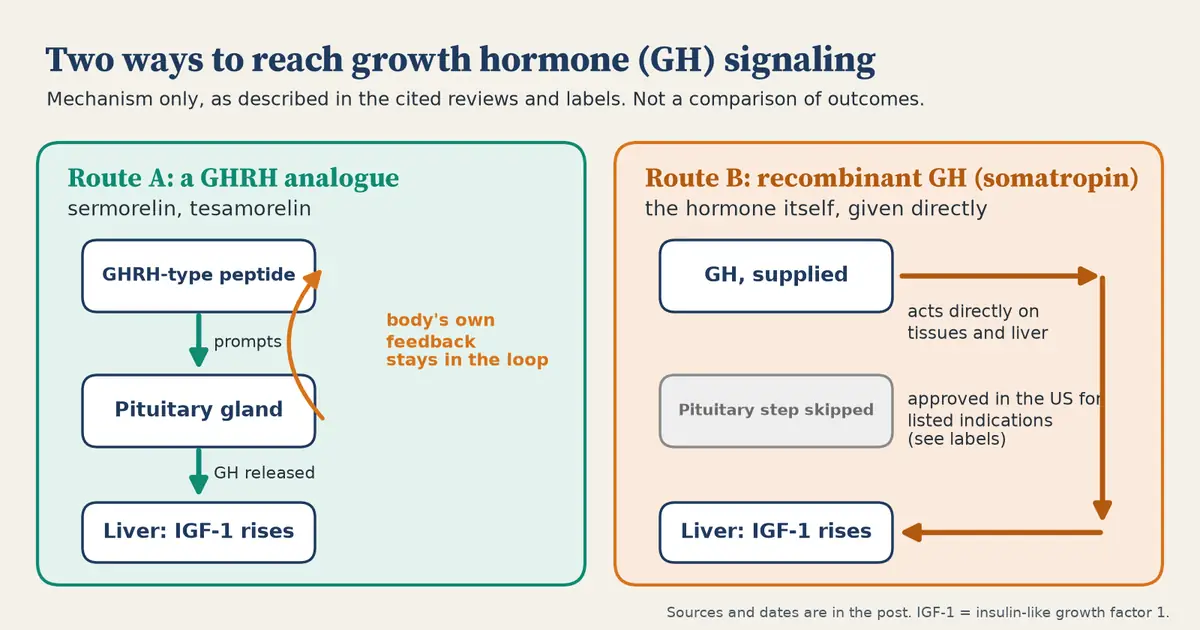
Growth hormone is the hormone. Sermorelin is a message that tells the pituitary gland to make more of it. Same destination, different road, and each road has its own paper trail of trials, approvals and rules.
That difference is one of the best-documented stories in peptide science. It starts with a molecule that FDA approved in 1990, runs through a drug-company decision to stop selling it, and ends with a sibling peptide that went all the way through phase 3 trials and onto a label. This piece lays out both halves of the story, the research and the rulebook, with a date on every claim.
Facts are as of October 26, 2026. Sources, with retrieval dates, are at the bottom.
At a glance
- Sermorelin is a 29-amino-acid analogue of growth hormone-releasing hormone (GHRH). It prompts the pituitary to release GH. Growth hormone (somatropin) is the hormone itself, a 191-amino-acid protein. [V]
- Sermorelin earned FDA approval twice: in 1990 as a diagnostic test and in 1997 for children with idiopathic GH deficiency. The maker stopped selling it in 2008. FDA later found that was not for safety or effectiveness reasons. [V]
- The strongest modern human evidence for the GHRH route comes from tesamorelin, a close relative: two phase 3 trials and an FDA approval in 2010. [V]
- Evidence for GH or GHRH-type peptides in healthy adults is much thinner than evidence in the approved uses. [V]
Two roads to one hormone
Your pituitary gland releases GH in pulses, and the amount is tuned by signals that include GHRH from the hypothalamus. Sermorelin copies the active part of GHRH, so it works upstream: it asks the body's own gland to release. Somatropin skips that step and supplies the hormone directly. A 1999 review in BioDrugs describes sermorelin as the shortest synthetic peptide with the full biological activity of GHRH and says it stimulates GH secretion from the anterior pituitary. [V]
Why does the route matter to researchers? A 2018 review of GH secretagogues in Sexual Medicine Reviews reports that this family promotes pulsatile GH release that stays subject to negative feedback, and that this can prevent supra-therapeutic hormone levels. The same review is blunt about the other side: few long-term, rigorous studies exist. [V] A 2006 editorial in Clinical Interventions in Aging made a similar argument for sermorelin, saying feedback control makes excess hormone levels hard to reach. It's an opinion piece, not a trial. [V]
That's why plenty of readers describe the GHRH route as the gentler or more targeted one. It's a reasonable idea, grounded in how the axis works, and the research to test it over many years in many kinds of people is still being built.
Sermorelin: a peptide with a real regulatory history
Geref (sermorelin acetate) was an FDA-approved product. According to a 2013 Federal Register notice, the version used to evaluate pituitary function was approved on December 28, 1990, and the version for children with idiopathic growth hormone deficiency was approved on September 26, 1997. [V]
What did the trials find? The BioDrugs review, which calls the treatment data limited, reported that most GH-deficient children treated with sermorelin showed catch-up growth, with height-velocity gains that held through 12 months and, in a few children, appeared to last to 36 months. It was well tolerated, and transient facial flushing and discomfort at the site of administration were the most reported events. As a diagnostic test, it was a rapid and relatively specific way to look for GH deficiency. [V]
The same review is candid about the comparison people ask about most. Sermorelin's effects were not directly compared with somatropin's, and the height-velocity gains reported for sermorelin were smaller than those for somatropin in children. [V]
Then the product left the market. The maker told FDA in 2008 that it was discontinuing both Geref products, and FDA withdrew the approvals as of June 18, 2009. In 2013, after a citizen petition, FDA determined that neither product was "withdrawn from sale for reasons of safety or effectiveness." [V]
Growth hormone itself: a landmark medicine, with defined uses
Recombinant human growth hormone is one of biotechnology's great successes. A current somatropin label on DailyMed (Genotropin, published August 6, 2026) describes a 191-amino-acid protein whose sequence matches the pituitary's own, made by recombinant DNA technology. [V] Under FDA's 2020 definition, anything over 40 amino acids counts as a protein, so somatropin is a protein drug and sermorelin is a peptide. (We explain that line in what peptides are.)
The label lists the approved uses: growth failure in children with GH deficiency, Prader-Willi syndrome, small-for-gestational-age status, Turner syndrome and idiopathic short stature, plus replacement in adults with GH deficiency from childhood or adult onset. [V] Those are the settings where trial data went before FDA.
Healthy adults are a different question, and researchers have asked it directly. A 2007 systematic review in Annals of Internal Medicine pooled 18 study populations (220 people given GH). Fat mass fell by about 2.1 kg and lean mass rose by about 2.1 kg compared with no treatment, while bone density and most blood-lipid measures did not change. Fluid retention, joint pain, carpal tunnel syndrome and breast enlargement were more common among the treated, and onset of diabetes and impaired fasting glucose were somewhat more common. The authors concluded that GH cannot be recommended as an anti-aging therapy. [V] A 2008 review of 27 study samples in young, fit adults, with 303 participants given GH, found more lean mass but no clear gain in strength or exercise capacity, and concluded:
Claims that growth hormone enhances physical performance are not supported by the scientific literature. [V]
None of that is a knock on the molecule. It is a reminder that a hormone with clear value in a defined deficiency doesn't automatically help elsewhere, and that is exactly what a good evidence base is for.
The GHRH family's best human data: tesamorelin
For the strongest proof that a GHRH-type peptide can succeed in modern trials, look at tesamorelin, a stabilized GHRH analogue. A 2007 New England Journal of Medicine trial randomized 412 adults with HIV who had abdominal fat accumulation. Over 26 weeks, visceral fat fell 15.2% with tesamorelin and rose 5.0% with placebo. Triglycerides and the cholesterol ratio improved, and IGF-1, the liver's growth signal, rose 81.0% against a 5.0% drop. The authors reported no significant difference in adverse events overall, though more people in the tesamorelin group withdrew because of one. [V]
FDA approved it on November 10, 2010 to reduce abdominal fat accumulation in people with HIV who have lipodystrophy, a fat-redistribution condition. [V] The current label for the newer Egrifta WR version says it is not indicated for weight loss management and that long-term cardiovascular safety has not been established. [V] A 2011 review in Drugs adds that the visceral-fat reduction held through 52 weeks in extension phases, and that fat returned when treatment stopped. [V] A 2014 JAMA trial in 50 people found reduced visceral and liver fat, with an early rise in fasting glucose at two weeks that was no longer significant at six months. [V]
There's also a hint of what comes next. In a 2012 Archives of Neurology trial of 152 older adults, 66 of them with mild cognitive impairment, 20 weeks of tesamorelin had a favorable effect on cognition, with the clearest signal in executive function. Adverse events were mild but reported by more people in the tesamorelin group (68%) than in the placebo group (36%). That is one controlled trial and an early signal, not an approved use. [V]
- 2FDA approvals for sermorelin products, 1990 and 1997 [V]
- 412adults in the 2007 NEJM tesamorelin trial [V]
- 2010year FDA approved tesamorelin [V]
- 220people given GH across 18 populations in the 2007 healthy-elderly review [V]
Where each stands with FDA and WADA
Policy is half of this story, and it has moved on from the research in some interesting ways.
| The question | Answer | What the record shows |
|---|---|---|
| Is there a marketed, FDA-approved sermorelin product? | We found none | A DailyMed search for sermorelin returned no labels. The Geref approvals were withdrawn in 2009. [V] |
| Are approved growth hormone products on the market? | Yes | DailyMed has current labels for brands including Genotropin, Humatrope, Norditropin, Omnitrope and Zomacton. [V] |
| Where is sermorelin on FDA's 503B compounding list? | Category 1 | Sermorelin acetate appears in category 1, under evaluation, with FDA's note that it is a component of a drug FDA approved (list updated March 21, 2025). [V] |
| Is it in the 503A categories? | Not listed | We did not find sermorelin in FDA's 503ASection of federal drug law covering compounding by state-licensed pharmacies and doctors, usually for a prescription written for one patient. category list, updated May 14, 2026. [V] |
| Is it allowed in tested sport? | No | WADA's 2027 list names sermorelin under GH-releasing factors and GH under S2.2.3. [S] |
Category 1An interim FDA group of nominated bulk ingredients that FDA generally does not object to pharmacies using while its review continues. Not an approval. has a specific meaning. FDA says that, while conditions in its guidance are met, it won't take action against an outsourcing facility over compounding with a category 1 substance. [V] That is an enforcement policy during an evaluation, not an approval, and it applies to outsourcing facilities (503BSection of federal drug law for outsourcing facilities: larger compounders that register with FDA and must follow drug-manufacturing quality rules.), not to the state-licensed pharmacies covered by 503A. Our category explainer walks through the three lists.
How clinical practice fits in
Sermorelin is one of the few peptides in this series with a stated compounding pathway in FDA's records. FDA's Q&A page says federal law covers compounding done by licensed pharmacists in state-licensed pharmacies and by physicians, and separately by outsourcing facilities. [V] Licensed clinicians prescribe, and licensed compounding pharmacies prepare, sermorelin and some other peptides within those rules today. That is ordinary clinical practice, and what a given pharmacy may do depends on FDA's category lists and the interim policy. [V]
Two details from the lists. Sermorelin acetate sits in category 1 on the 503B list for outsourcing facilities. It does not appear on the 503A category list for state-licensed pharmacies and physicians that we read. [V] FDA also states that compounded drugs are not FDA-approved, so FDA does not check them for safety, effectiveness or quality ahead of marketing. [V] A White House review of an "Interim Access Policy for Compounding Using Certain Peptides" is pending, and its contents are not public, so the picture could change. [V] Our telehealth post covers the advertising rules for companies that promote compounded drugs.
One more rule that often gets lost: the 2007 review's abstract states that GH is widely used as an anti-aging therapy even though FDA has not approved it for that purpose and distributing it as an anti-aging agent is illegal in the US. [V] And approved medicines are not exempt from sport rules. WADA's 2027 list, which takes effect January 1, 2027, names both GH and GHRH analogues such as sermorelin and tesamorelin. [S]
What people get wrong
Claim
"Sermorelin is just a gentler version of growth hormone."
What research shows
- Comparison claim
The two work by different mechanisms: one prompts the pituitary, the other supplies the hormone. Reviews describe pulsatile release under feedback as a feature of the GHRH route. [V] In children, the one comparison in the literature was indirect, and the height gains reported with sermorelin were smaller. [V]
What is unknown
A long-term, head-to-head trial in adults. "Gentler" is a clinical question that, as far as we found, has not been tested directly.
This card describes the kind of research that exists.
Why it matters
Sermorelin and tesamorelin show that peptides aimed at the body's own signaling can reach FDA approval on trial data, which is one reason the field draws such interest. They also show how much weight the label carries: the approved uses are the ones with trial data behind them, and the rest is a research frontier.
Questions to bring to a clinician or pharmacist
- Is the product you're describing an FDA-approved drug, or something compounded?
- Which published human trials support the specific use you've heard about, and in what kinds of patients?
- What happens to the evidence when the goal is different from the trial's population?
- If I compete in a tested sport, have I checked with my anti-doping organization?
What to watch next
Dates and decisions we're tracking
- No date setFDA's decisions on the 503B bulks list, where sermorelin acetate sits in category 1 [V]
- Date not yet setThe next Pharmacy Compounding Advisory Committee meeting [V]
- Jan. 1, 2027WADA's 2027 Prohibited List takes effect [S]
More science-and-policy explainers are coming. See the evidence ladder for how to read a study, and our approved peptide medicines piece for the group tesamorelin belongs to.
Sources (retrieved October 26, 2026 unless noted)
- Federal Register, "Determination That GEREF (Sermorelin Acetate) Products Were Not Withdrawn From Sale for Reasons of Safety or Effectiveness," 78 FR 14095, March 4, 2013 [V] — https://www.federalregister.gov/d/2013-04827
- Prakash A, Goa KL, "Sermorelin: a review of its use in the diagnosis and treatment of children with idiopathic growth hormone deficiency," BioDrugs, August 1999 (abstract via PubMed) [V] — https://pubmed.ncbi.nlm.nih.gov/18031173/
- Walker RF, "Sermorelin: a better approach to management of adult-onset growth hormone insufficiency?" Clinical Interventions in Aging, December 2006 (editorial) [V] — https://pmc.ncbi.nlm.nih.gov/articles/PMC2699646/
- Sigalos JT, Pastuszak AW, "The Safety and Efficacy of Growth Hormone Secretagogues," Sexual Medicine Reviews, January 2018 (abstract) [V] — https://pubmed.ncbi.nlm.nih.gov/28400207/
- DailyMed, GENOTROPIN (somatropin) label, set id ffebf88b-d257-4542-9808-74d9b7167765, published August 6, 2026 [V] — https://dailymed.nlm.nih.gov/dailymed/lookup.cfm?setid=ffebf88b-d257-4542-9808-74d9b7167765
- DailyMed search results for "somatropin" and "sermorelin" (no sermorelin labels returned), run October 26, 2026 [V] — https://dailymed.nlm.nih.gov/dailymed/services/v2/spls.json?drug_name=sermorelin
- Liu H, et al., "Systematic review: the safety and efficacy of growth hormone in the healthy elderly," Annals of Internal Medicine, January 16, 2007 (abstract) [V] — https://pubmed.ncbi.nlm.nih.gov/17227934/
- Liu H, et al., "Systematic review: the effects of growth hormone on athletic performance," Annals of Internal Medicine, May 20, 2008 (abstract) [V] — https://pubmed.ncbi.nlm.nih.gov/18347346/
- Falutz J, et al., "Metabolic effects of a growth hormone-releasing factor in patients with HIV," New England Journal of Medicine, December 6, 2007 (abstract) [V] — https://pubmed.ncbi.nlm.nih.gov/18057338/
- FDA, NDA 22-505 (Egrifta, tesamorelin) approval package, approval date November 10, 2010 [V] — https://www.accessdata.fda.gov/drugsatfda_docs/nda/2010/022505Orig1s000Approv.pdf
- DailyMed, EGRIFTA WR (tesamorelin) label, set id 839334d3-8c1d-4c26-9036-2ab524a6ea75, published August 3, 2026 (retrieved October 25, 2026) [V] — https://dailymed.nlm.nih.gov/dailymed/lookup.cfm?setid=839334d3-8c1d-4c26-9036-2ab524a6ea75
- Dhillon S, "Tesamorelin: a review of its use in the management of HIV-associated lipodystrophy," Drugs, May 28, 2011 (abstract) [V] — https://pubmed.ncbi.nlm.nih.gov/21668043/
- Stanley TL, et al., tesamorelin effect on visceral and liver fat in HIV, JAMA, July 2014 (abstract) [V] — https://pubmed.ncbi.nlm.nih.gov/25038357/
- Baker LD, et al., effects of growth hormone-releasing hormone on cognitive function in adults with mild cognitive impairment and healthy older adults, Archives of Neurology, November 2012 (abstract) [V] — https://pubmed.ncbi.nlm.nih.gov/22869065/
- FDA, "Bulk Drug Substances Nominated for Use in Compounding Under Section 503B" category list (PDF), updated March 21, 2025 [V] — https://www.fda.gov/media/94164/download
- FDA, 503B bulk drug substances page, describing categories 1 to 3 [V] — https://www.fda.gov/drugs/human-drug-compounding/bulk-drug-substances-used-compounding-under-section-503b-fdc-act
- FDA, 503A bulk drug substances category list (PDF), updated May 14, 2026 (retrieved October 26, 2026) [V] — https://www.fda.gov/media/94155/download
- WADA, 2027 Prohibited List text, read from a copy hosted by FIS (retrieved October 25, 2026) [S] — https://assets.fis-ski.com/f/252177/x/4526d29144/2027list_en_final_clean_26_august_2026_2.pdf
- FDA, Pharmacy Compounding Advisory Committee meeting page (next meeting date not yet set; retrieved October 26, 2026) [V] — https://www.fda.gov/advisory-committees/pharmacy-compounding-advisory-committee/meeting-pharmacy-compounding-advisory-committee
- FDA, "Compounding and the FDA: Questions and Answers," content current as of 09/16/2025 [V] — https://www.fda.gov/drugs/human-drug-compounding/compounding-and-fda-questions-and-answers
- OMB/OIRA, pending EO 12866 regulatory review, RIN 0910-ZD94 [V] — https://www.reginfo.gov/public/do/eoDetails?rrid=1568964
Spot a mistake? See how we source and our corrections policy.