Semax and selank: two peptides from Russian labs, what the research shows, and where FDA stands
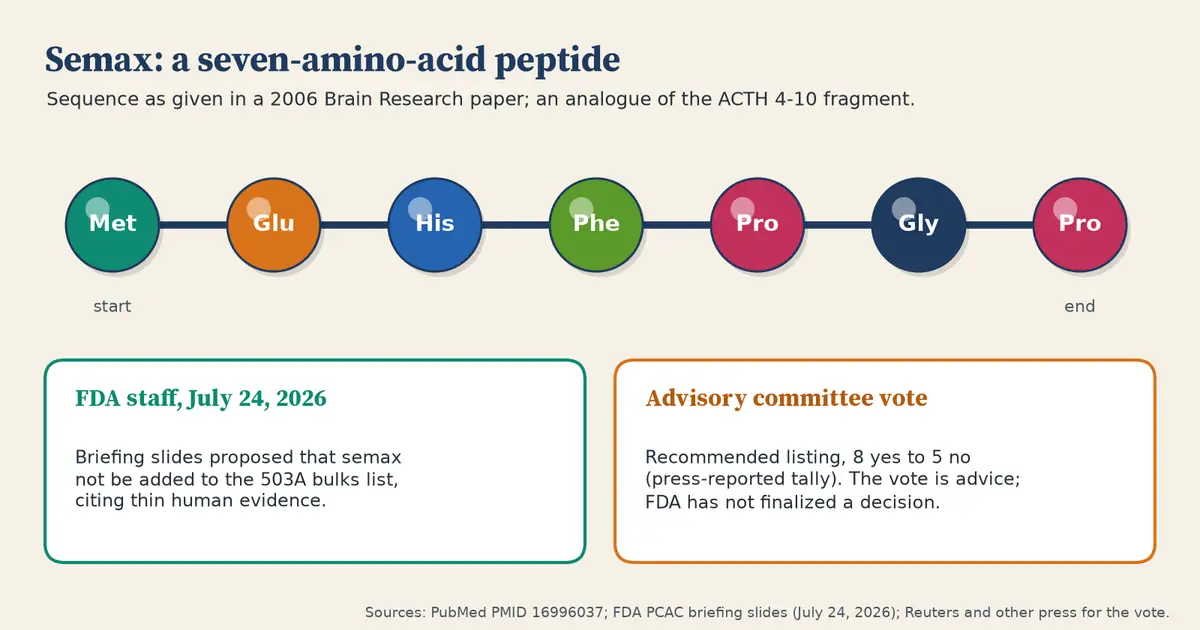
Semax and selank are brain-focused peptides developed in Russia. Semax is a seven-amino-acid chain related to a fragment of ACTH, a pituitary hormone. FDA's staff describe it as registered in Russia as nasal drops. Selank is a separate peptide, also from Russian researchers, that gets discussed alongside it. In the United States, both sit in an unusual spot: widely talked about, little studied in English-language journals, and caught up in FDA's compounding review.
This page leads with what the research reports, then covers the limits and the regulatory record.
Facts are as of October 26, 2026. Sources, with retrieval dates, are at the bottom.
At a glance
- Semax's sequence is known: Met-Glu-His-Phe-Pro-Gly-Pro, an analog of ACTH(4-10) that FDA's staff slides describe as lacking hormone activity. [V]
- In rats, a 2006 Brain Research study reported higher BDNF (a growth-supporting protein in the brain) and increased activation of its receptor in the hippocampus after semax. That is animal evidence. [V]
- A 2018 Russian clinical study of 110 stroke-rehabilitation patients reported higher BDNF and better Barthel-index recovery in semax-treated groups. It was an observational comparison, so it is a small human signal, not a proof. [V]
- A 2008 Russian comparative trial of 62 patients with anxiety disorders reported that selank and the benzodiazepine medazepam had similar anxiolytic effects. It had no placebo arm. [V]
- FDA's advisory committee voted 8 to 5 (one abstention) in July 2026 in favor of semax for compounding, over staff's recommendation against, according to press reports. Votes are non-binding. [S]
Why these two draw attention
Neuroscience has long been interested in BDNF, a protein that supports the growth and survival of neurons. Semax is one of the few peptides in this area with a human drug history of any kind: FDA's staff say it is registered in Russia as nasal drops. [V] That history makes it interesting. It does not make the evidence strong by FDA's standards, and the sections below explain why.
- 7amino acids in semax's chain [V]
- 110stroke-rehabilitation patients in the 2018 Russian semax study [V]
- 62patients in the 2008 Russian selank-versus-medazepam study [V]
- 8-5advisory committee vote on semax, with one abstention [S]
Semax: the promising signals
Animals first. The 2006 Brain Research study from Moscow researchers reported that a single application of semax raised BDNF protein and receptor activation in the rat hippocampus, along with changes in the related genes, and that treated animals showed more conditioned avoidance reactions, a learning measure. The authors suggested semax affects cognitive function by modulating this pathway. [V] This is rat data. It describes a mechanism, not a human cognitive benefit.
A first look in people. The 2018 paper in the Russian journal Zhurnal Nevrologii i Psikhiatrii imeni Korsakova followed 110 people after ischemic stroke, split into early and late rehabilitation groups, with semax-treated and untreated subgroups. The authors reported that plasma BDNF rose with semax and stayed high, and that semax with high BDNF was linked to better final Barthel-index scores, a measure of daily function. [V] The abstract frames the findings as correlations, and it reports nothing about blinding or a placebo. [V]
A staff note on older literature. FDA's staff slides mention a small 1996 open-label study in migraine and a body of Russian-language studies that the staff did not review. They judged the effectiveness evidence for the nominated uses insufficient. [V]
Selank: what the human literature adds
Selank's best-known human study is the 2008 Russian comparison of 62 patients with generalized anxiety disorder and neurasthenia. Thirty received selank and 32 received medazepam. The authors reported similar anxiolytic effects for both, with selank also showing antiasthenic and psychostimulant effects in their assessment, and they measured a change in an enkephalin-related blood marker. [V] PubMed indexes the paper as a randomized controlled trial, but the abstract describes a comparison against another drug with no placebo group, and it is in Russian. [V]
A 2016 Frontiers in Pharmacology paper looked at rats and reported that selank changed expression of several genes involved in GABA signaling, which the authors tied to possible modulation of that system. [V] Again, an early-stage mechanism finding in animals.
Limits and unknowns
- FDA's staff, in the July 24, 2026 meeting slides, recommended against listing semax for compounding. Their reasons included that it is not well characterized, that no human pharmacokinetic data exist, that no safety data cover the routes nominated, and that effectiveness evidence was insufficient. [V]
- The staff also flagged a 2002 abstract hinting at anti-clotting effects as a possible bleeding concern, and a mouse study in which semax potentiated amphetamine-induced dopamine release. [V]
- FDA's category 2 page says semax carries an immunogenicity risk and that FDA has no or limited safety information for the routes proposed. Its note on selank says FDA lacks important information about safety issues in humans, and cites immunogenicity risk. [V]
- The human studies we read are Russian-language, small, and without placebo-controlled results visible in their abstracts. We did not find large, placebo-controlled trials of either peptide. [V]
- Selank was not on the committee's agenda, so there is no FDA staff review or vote to cite for it. [V]
The regulatory record
| The question | Answer | What the record shows |
|---|---|---|
| Is either an FDA-approved drug? | We found none | A DailyMed name search for each returned no labels. FDA staff say semax is registered in Russia as nasal drops. [V] |
| Where is semax on FDA's lists? | Withdrawn from category 2 | Listed in the table of substances nominated but withdrawn (page current as of April 22, 2026). [V] |
| How did the advisory committee vote on semax? | 8 yes, 5 no, 1 abstain | Reported by press on July 24, 2026. The vote is non-binding, and FDA staff had recommended against listing. [S] |
| Where is selank? | Withdrawn from category 2; not reviewed | Selank acetate is in the same withdrawn table and was not on the July agenda. [V] |
| Does WADA name either? | Neither | The 2026 Prohibited List does not name semax or selank. This is not a statement about their status in sport. [V] |
Reading the votes: committee votes are advice, and the listing itself needs a separate rulemaking. Our category explainer explains what that means. Outlets also report vote tallies differently for the July meeting, so we label tallies as press reports. See the status matrix for all 14.
What people get wrong
Claim
"Semax is a proven cognitive enhancer."
What research shows
- Evidence-level claim
Rat studies report BDNF changes, and a small Russian clinical study reports correlations in stroke rehabilitation. [V]
What is unknown
Whether it improves cognition in healthy adults, and whether it is safe by non-nasal routes. FDA staff found the effectiveness evidence insufficient. [V]
This card describes the kind of research that exists.
Why it matters
The semax story shows how a peptide can have a real history in one country and still be hard to evaluate in another. The evidence exists, but much of it sits in Russian-language journals that FDA's staff said they did not review, in studies that would need to be repeated under modern standards. For readers, the practical point is simple: a mechanism and a small clinical signal are the opening chapters. They are not a finished case.
Questions to bring to a clinician or pharmacist
- Is the product I'm asking about an approved drug in any country, or a compounded preparation?
- Which trials tested it in people like me, and what did they measure?
- What does FDA's immunogenicity concern mean for the route in question?
- How would I tell this apart from a product with an unclear label?
What to watch next
Dates and decisions we're tracking
- Date not yet setWhether FDA starts rulemaking on any substance the committee backed, including semax [S]
- Date not yet setWhether FDA schedules a committee review of selank [V]
- PendingThe White House review of FDA's "Interim Access Policy for Compounding Using Certain Peptides" [V]
For how early evidence fits into the bigger picture, see the evidence ladder.
Sources (retrieved October 26, 2026 unless noted)
- Dolotov OV, et al., "Semax, an analog of ACTH(4-10) with cognitive effects, regulates BDNF and trkB expression in the rat hippocampus," Brain Research, October 30, 2006 (abstract on PubMed) [V] — https://pubmed.ncbi.nlm.nih.gov/16996037/
- Gusev EI, et al., semax in patients at different stages of ischemic stroke, Zhurnal Nevrologii i Psikhiatrii imeni S.S. Korsakova, 2018 (Russian; abstract on PubMed) [V] — https://pubmed.ncbi.nlm.nih.gov/29798983/
- Zozulia AA, et al., selank in generalized anxiety disorders and neurasthenia, Zhurnal Nevrologii i Psikhiatrii imeni S.S. Korsakova, 2008 (Russian; abstract on PubMed) [V] — https://pubmed.ncbi.nlm.nih.gov/18454096/
- Volkova A, et al., "Selank Administration Affects the Expression of Some Genes Involved in GABAergic Neurotransmission," Frontiers in Pharmacology, 2016 (abstract on PubMed) [V] — https://pubmed.ncbi.nlm.nih.gov/26924987/
- FDA, staff briefing slides for the July 24, 2026 Pharmacy Compounding Advisory Committee session [V] — https://www.fda.gov/media/193774/download
- FDA, "Certain Bulk Drug Substances for Use in Compounding that May Present Significant Safety Risks" (category 2 page), current as of 04/22/2026 [V] — https://www.fda.gov/drugs/human-drug-compounding/certain-bulk-drug-substances-use-compounding-may-present-significant-safety-risks
- FDA, "July 23-24, 2026: Meeting of the Pharmacy Compounding Advisory Committee," meeting page [V] — https://www.fda.gov/advisory-committees/advisory-committee-calendar/july-23-24-2026-meeting-pharmacy-compounding-advisory-committee-07232026
- AJMC, "FDA Panel Backs 6 Peptides for Compounding," July 31, 2026 [S] — https://www.ajmc.com/view/fda-panel-backs-6-peptides-for-compounding
- RAPS, "FDA Advisory Committee Backs Two More Peptides, Rejects One for Compounding List" [S] — https://www.raps.org/resource/fda-advisory-committee-backs-two-more-peptides-rejects-one-for-compounding-list.html
- WADA, 2026 Prohibited List (in force January 1, 2026), text read in full [V] — https://www.wada-ama.org/sites/default/files/2025-09/2026list_en_final_clean_september_2025.pdf
- OMB/OIRA, pending EO 12866 regulatory review, RIN 0910-ZD94 [V] — https://www.reginfo.gov/public/do/eoDetails?rrid=1568964
- DailyMed name search for "semax" and "selank" (no labels returned; a search for tesamorelin returned labels as a control), run October 26, 2026 [V] — https://dailymed.nlm.nih.gov/dailymed/services/v2/spls.json?drug_name=semax
Spot a mistake? See how we source and our corrections policy.