KPV: a three-amino-acid fragment with a lively lab record, and what FDA's staff and committee said in July 2026
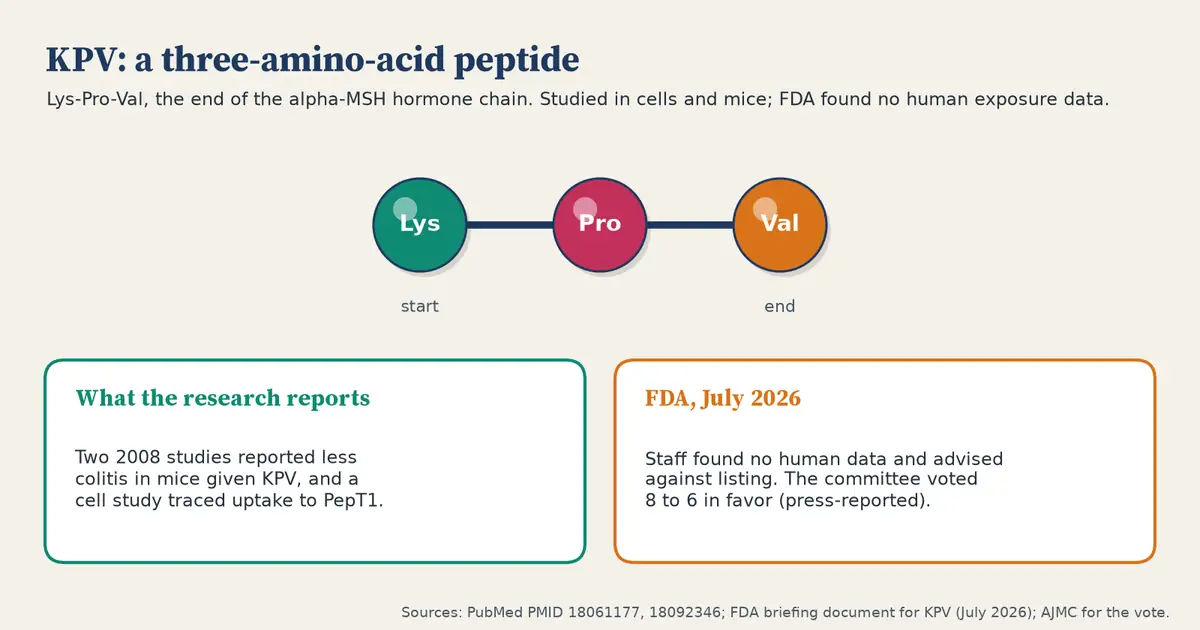
KPV is a tiny peptide, just three amino acids long: lysine, proline and valine. It is the tail end of alpha-MSH, a hormone the body makes that helps dial inflammation up and down. Researchers have studied KPV in cell cultures, in mice with colitis and in rabbit eyes, and the results they report are encouraging for an early-stage compound. In July 2026 it was also one of six peptides on an FDA advisory committee agenda.
This page leads with what the research reports, then covers the regulatory record. Both get equal room.
Facts are as of October 26, 2026. Sources, with retrieval dates, are at the bottom.
At a glance
- KPV is the C-terminal tripeptide of alpha-MSH, which researchers have linked to anti-inflammatory activity. [V]
- In a 2008 Gastroenterology study, KPV entered human intestinal and immune cells through a transporter called PepT1, reduced inflammatory signaling in those cells, and reduced colitis in two mouse models. [V]
- A second 2008 mouse study found KPV treatment led to earlier recovery and weight regain in DSS colitis and in a transfer colitis model. [V]
- In a 2006 rabbit study, 8 of 8 KPV-treated corneas had fully re-epithelialized 60 hours after abrasion, while none of the placebo-treated corneas had. [V]
- FDA's staff found no human studies of KPV, and its advisory committee voted 8-6 (one abstention) in July 2026 in favor of listing it for compounding, according to press reports. [S]
Where the interest comes from
Alpha-MSH is best known for pigmentation, but it also acts on immune cells. Its last three amino acids, KPV, appear to carry much of the anti-inflammatory signal without the pigment-inducing activity, an attractive feature for a candidate. [V] A 2019 review in Experimental Dermatology described melanocortin-derived peptides such as KPV as promising future candidates for wound and skin-ulcer research. [V]
- 3amino acids in KPV: lysine, proline, valine [V]
- 8 of 8KPV-treated rabbit corneas re-epithelialized at the 60-hour check, versus 0 of the placebo group [V]
- 2mouse colitis models where KPV reduced inflammation in the 2008 Gastroenterology study [V]
- 8-6advisory committee vote, with one abstention [S]
The science: what the research reports
Cells and mice, gut inflammation. The Gastroenterology study from 2008 tested KPV on human intestinal epithelial cells and human T cells. Nanomolar concentrations reduced activation of the NF-kappaB and MAP kinase inflammatory pathways and lowered inflammatory cytokine release, and the effect depended on PepT1, a transporter that is normally low in healthy colon but rises in inflammatory bowel disease. In mice, KPV given in drinking water reduced the incidence of both DSS- and TNBS-induced colitis. [V] A separate 2008 paper in Inflammatory Bowel Diseases tested KPV in two mouse models, reporting earlier recovery, regained weight and reduced inflammatory changes. In mice lacking a working melanocortin-1 receptor, KPV treatment rescued all treated animals from death during DSS colitis. [V]
Mice, colitis-associated cancer. A 2016 paper in Cellular and Molecular Gastroenterology and Hepatology found that PepT1 is higher in human colorectal tumor samples, and that KPV, a PepT1-transported tripeptide, prevented carcinogenesis in normal mice in a colitis-associated cancer model. The effect did not appear in mice lacking PepT1, which fits the transporter story. [V] This is mouse research, the usual first step in drug development.
Rabbit eyes. The 2006 Experimental Eye Research study abraded the corneas of rabbits and compared KPV drops with placebo. Corneas on KPV healed faster, with all eight treated corneas fully re-epithelialized at 60 hours versus none on placebo. A nitric oxide synthase inhibitor blocked the effect, pointing the authors toward nitric oxide as part of the mechanism. In cultured rabbit corneal cells, KPV also raised cell viability. [V]
Skin delivery work. A 2017 study measured how KPV moves through human skin in the lab. Plain diffusion gave levels below the detection limit, while microneedles and iontophoresis, a small-current technique, raised the amount that crossed and the amount retained. [V] That kind of delivery study is a normal early step for any topical candidate.
What FDA staff found. The staff's July 2026 briefing document reviewed what has been published and reported that the nominated uses were wound healing and inflammatory conditions. Its pharmacology section summarizes the anti-inflammatory and wound-healing findings from laboratory studies, and notes that several lines of evidence suggest the effect does not run through the melanocortin receptors that alpha-MSH itself uses. [V]
The regulatory record
| The question | Answer | What the record shows |
|---|---|---|
| Is it an FDA-approved drug? | None found | A DailyMed name search for KPV returned no labels, and FDA's staff say it is not an ingredient in an FDA-approved drug. [V] |
| Where is it on FDA's lists? | Withdrawn from category 2 | KPV sits in the table of substances nominated but withdrawn on FDA's category 2 page (current as of April 22, 2026). FDA chose to evaluate it on its own initiative. KPV is not named on the 503ASection of federal drug law covering compounding by state-licensed pharmacies and doctors, usually for a prescription written for one patient. category list updated May 14, 2026. [V] |
| Has the advisory committee reviewed it? | Yes, July 2026 | Press reports put the vote at 8 in favor, 6 against, 1 abstaining, over the staff recommendation. Votes are advice, and listing needs a separate rulemaking. [S] |
| Is it on WADA's prohibited list? | Not named | The 2026 Prohibited List does not name KPV. [V] |
What staff recommended. FDA's staff recommended against adding KPV to the 503A bulks list. Their stated reasons: the substance was not well characterized (inconsistent naming and no quality-control attributes in the published literature), the extent of compounding use is unknown, and they identified no human data on effectiveness or safety by any route. [V] The single nomination was later withdrawn, and FDA evaluated the substance on its own initiative. [V]
How clinical practice fits in. Licensed practitioners prescribe, and state-licensed pharmacies compound, under section 503A. For bulk ingredients, FDA's rules allow three routes: a USP monograph, being an ingredient in an FDA-approved drug, or appearing on the 503A bulks list. FDA's staff note that KPV has no USP monograph and is not an ingredient in an approved drug. [V] So today FDA's lists do not describe a stated compounding pathway for KPV; the committee's vote and FDA's decision on the bulks list are what would change that. [V] FDA also states that compounded drugs are not FDA-approved. [V]
What is pending. The White House's Office of Information and Regulatory Affairs is reviewing FDA's "Interim Access Policy for Compounding Using Certain Peptides," which will help decide what pharmacies may do for substances in each category. [V] The committee considered KPV at its July meeting, so FDA's next steps on the bulks list are the thing to follow. [V]
Limits and unknowns
- FDA's staff reported finding no human studies of KPV by any route, and no pharmacokinetic, acute toxicity, repeat-dose toxicity, genotoxicity, or developmental and reproductive toxicity studies. [V]
- FDA's staff wrote that they were particularly concerned about the lack of human data, including no information from which to judge immune-response or clumping (aggregation) risk. [V]
- A search of FDA's adverse event database through December 3, 2025 found no reports for KPV. FDA adds that this database has limits, and compounders often do not report events. [V]
- The 2017 skin study found that KPV does not pass through intact skin by plain diffusion, which FDA's staff note could limit systemic exposure and also its usefulness as a topical drug. [V]
- The 2006 rabbit authors noted it is not known whether the effect reflects a direct repair action. [V]
What people get wrong
Claim
"KPV has been shown to heal the gut in people."
What research shows
- Cell and animal research
Mouse colitis studies and cell work report reduced inflammation. FDA's staff found no human studies. [V]
What is unknown
Whether the mouse results carry over to people, which routes behave the same way, and what the safety profile looks like. [V]
This card describes the kind of research that exists.
Why it matters
KPV is a good example of a clean early-stage story: a small molecule with a clear lab hypothesis, several consistent animal results and a plausible transporter-based mechanism. The next step for any such compound is a human study, and a committee vote, as in July, is a sign that regulators are paying attention to the category. A page like this is a snapshot of where it stands.
Questions to bring to a clinician or pharmacist
- Is the product I'm asking about an approved drug, a compounded preparation, or sold under a research label?
- Which published studies tested it in people?
- What does FDA's immunogenicity concern mean for the form and route involved?
- Which regulatory list is it on, and what has changed since the July meeting?
What to watch next
Dates and decisions we're tracking
- Date not yet setWhether FDA starts rulemaking on any substance the committee backed, including KPV [S]
- PendingAny first registered human study of KPV [V]
- PendingThe White House review of FDA's "Interim Access Policy for Compounding Using Certain Peptides" [V]
For all 14 peptides side by side, see the status table. The evidence ladder explains how to read cell, animal and human stages.
Sources (retrieved October 26, 2026 unless noted)
- Dalmasso G, et al., "PepT1-mediated tripeptide KPV uptake reduces intestinal inflammation," Gastroenterology, 2008 (abstract on PubMed) [V] — https://pubmed.ncbi.nlm.nih.gov/18061177/
- Kannengiesser K, et al., KPV in murine models of inflammatory bowel disease, Inflammatory Bowel Diseases, 2008 (abstract on PubMed) [V] — https://pubmed.ncbi.nlm.nih.gov/18092346/
- Viennois E, et al., PepT1 and the tripeptide KPV in a murine model of colitis-associated cancer, Cellular and Molecular Gastroenterology and Hepatology, 2016 (abstract on PubMed) [V] — https://pubmed.ncbi.nlm.nih.gov/27458604/
- Bonfiglio V, et al., alpha-MSH(11-13) and corneal epithelial wound healing, Experimental Eye Research, 2006 (abstract on PubMed) [V] — https://pubmed.ncbi.nlm.nih.gov/16965771/
- Pawar K, et al., transdermal iontophoretic delivery of KPV across microporated human skin, Journal of Pharmaceutical Sciences, 2017 (abstract on PubMed) [V] — https://pubmed.ncbi.nlm.nih.gov/28343991/
- Böhm M, Luger T, "Are melanocortin peptides future therapeutics for cutaneous wound healing?", Experimental Dermatology, 2019 (abstract on PubMed) [V] — https://pubmed.ncbi.nlm.nih.gov/30661264/
- FDA, briefing document on KPV-related bulk drug substances for the July 23-24, 2026 Pharmacy Compounding Advisory Committee, dated 5/12/2026 [V] — https://www.fda.gov/media/193346/download
- FDA, "July 23-24, 2026: Meeting of the Pharmacy Compounding Advisory Committee," meeting page [V] — https://www.fda.gov/advisory-committees/advisory-committee-calendar/july-23-24-2026-meeting-pharmacy-compounding-advisory-committee-07232026
- FDA, "Certain Bulk Drug Substances for Use in Compounding that May Present Significant Safety Risks" (category 2 page), current as of 04/22/2026 [V] — https://www.fda.gov/drugs/human-drug-compounding/certain-bulk-drug-substances-use-compounding-may-present-significant-safety-risks
- FDA, 503A bulk drug substances category list (PDF), updated May 14, 2026 [V] — https://www.fda.gov/media/94155/download
- FDA, "Bulk Drug Substances Used in Compounding Under Section 503A of the FD&C Act," current as of 05/14/2026 [V] — https://www.fda.gov/drugs/human-drug-compounding/bulk-drug-substances-used-compounding-under-section-503a-fdc-act
- FDA, "Compounding and the FDA: Questions and Answers," current as of 09/16/2025 [V] — https://www.fda.gov/drugs/human-drug-compounding/compounding-and-fda-questions-and-answers
- AJMC, "FDA Panel Backs 6 Peptides for Compounding," July 31, 2026 [S] — https://www.ajmc.com/view/fda-panel-backs-6-peptides-for-compounding
- WADA, 2026 Prohibited List, text read in full [V] — https://www.wada-ama.org/sites/default/files/2025-09/2026list_en_final_clean_september_2025.pdf
- OMB/OIRA, pending EO 12866 regulatory review, RIN 0910-ZD94 [V] — https://www.reginfo.gov/public/do/eoDetails?rrid=1568964
- DailyMed name search for KPV, run October 26, 2026 (no labels returned) [V] — https://dailymed.nlm.nih.gov/dailymed/services/v2/spls.json?drug_name=KPV
Spot a mistake? See how we source and our corrections policy.