GHK-Cu: a copper peptide with a long lab record and a growing set of human studies, and where FDA's lists stand
GHK-Cu is the copper complex of a three-amino-acid peptide that researchers isolated from human plasma. It is one of the few peptides in this conversation with controlled human studies already in print, mostly small ones on skin. It is also one of the few with a stated place on FDA's pharmacy-compounding lists, and it is on the agenda for an FDA advisory committee meeting expected before the end of February 2027.
This page leads with what the research reports, then covers the regulatory record. Both get equal room.
Facts are as of October 26, 2026. Sources, with retrieval dates, are at the bottom.
At a glance
- A 1988 cell study found that GHK-Cu stimulated collagen production in cultured fibroblasts, the cells that build connective tissue. That is cell research, the usual first step for any medicine. [V]
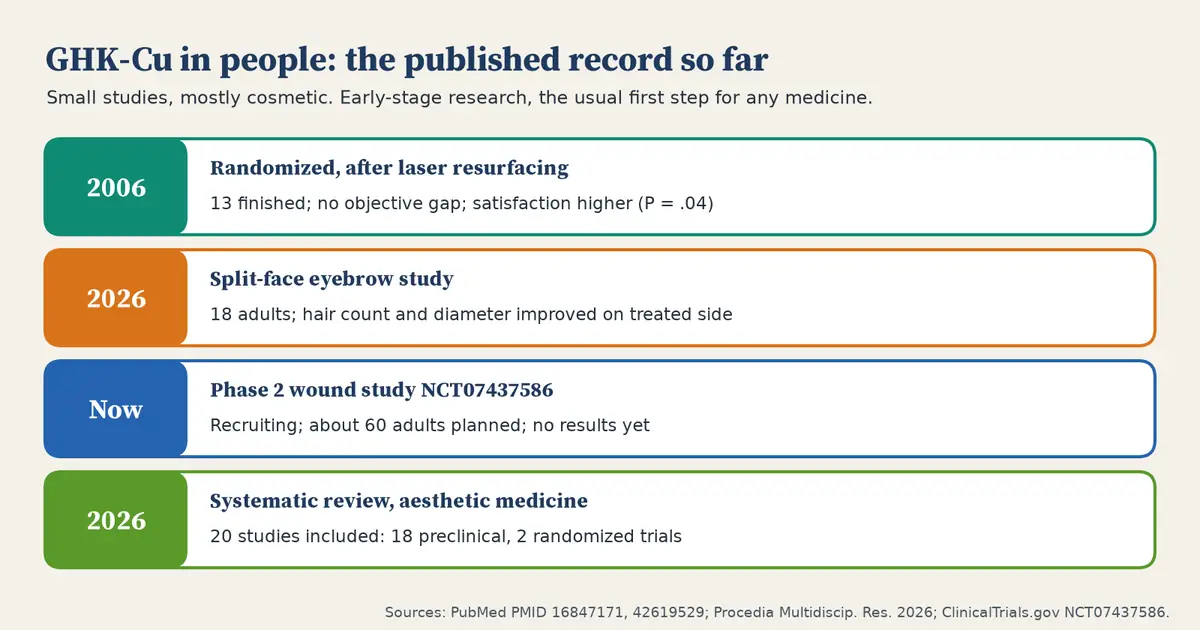
- A 2026 systematic review found 20 studies: 18 preclinicalResearch done before any testing in people, such as lab-dish and animal studies. and 2 randomized controlled trials. Its authors report consistent preclinical effects on matrix building, angiogenesis (new blood-vessel growth) and cell proliferation, and say there is a reasonable biological basis for the ingredient. [V]
- In the human studies we read, patients rated results higher after laser resurfacing in a 2006 trial, and a small 2026 split-face study reported better eyebrow hair counts. Each had fewer than 20 participants. [V]
- FDA's 503ASection of federal drug law covering compounding by state-licensed pharmacies and doctors, usually for a prescription written for one patient. list places GHK-Cu (except injectable routes) in category 1. A separate entry for injectable routes sits in the withdrawn table of the category 2 page. A committee review is expected by the end of February 2027. [V]
- GHK-Cu is not named on WADA's 2026 Prohibited List, and we found no FDA-approved drug product containing it. [V]
Where the interest comes from
GHK is a naturally occurring tripeptide: glycine, histidine, lysine. It has a strong attraction to copper, and the copper complex is the form researchers study most. [V] The sequence also appears inside the alpha-2 chain of type I collagen, which led a French group to propose in 1988 that the fragment might be released at a wound site and help the repair process along. [V] That is a tidy hypothesis, and it is why the first experiments looked at fibroblasts and collagen.
- 20studies in the 2026 systematic review (18 preclinical, 2 randomized trials) [V]
- 13participants who finished the 2006 laser-resurfacing study [V]
- 18healthy adults in the 2026 split-face eyebrow study [V]
- 1registered phase 2 wound-healing trial, recruiting with no results yet [V]
The science: lab, animal and human findings
Cells. The 1988 FEBS Letters study reported that GHK-Cu stimulated collagen synthesis in fibroblast cultures without changing cell number, which the authors read as a specific effect on the cells' matrix output. [V] A 2005 study in the Archives of Facial Plastic Surgery grew fibroblasts taken from normal and from irradiated tissue. Both grew faster with GHK-Cu, and treated irradiated cells made more basic fibroblast growth factor and VEGF early on. [V] Cell work like this identifies a signal worth following. It does not show what happens in a person.
Animals. A 2015 rat study of ACL reconstruction reported that weekly intra-articular GHK-Cu transiently improved healing at the six-week mark. [V] Skin-penetration work on human tissue samples in the lab (2010) measured how copper from the tripeptide moved through layers of skin, which matters for the way skin products are studied. [V]
People. Two randomized trials sit in the 2026 systematic review. In the 2006 laser-resurfacing study, 13 volunteers finished a split-face design. Objective evaluation did not separate the two sides, but the patient questionnaire scored higher on the GHK-Cu side (P = .04). [V] The same review reports that GHK-Cu raised satisfaction scores after laser resurfacing and cut wrinkle volume and depth more than the control treatment did. [V] In 2026 a Thai team published a randomized, double-blind, split-face study of 18 healthy adults using a copper-peptide serum for eyebrow hypotrichosis. Hair count and diameter improved on the treated side, and global assessment and satisfaction scores were higher; the authors reported no serious adverse effects. [V]
Where reviewers land. The 2026 Aesthetic Surgery Journal review concluded there is a reasonable biological basis for GHK-Cu supported by preclinical data. [V] A second 2026 systematic review (64 records retained) describes a mechanistically coherent preclinical record and calls for well-designed human trials on delivery platforms such as microneedles. [V] A third, an evidence map through August 12, 2026, says the translation question is now mostly about product definition, such as how copper and peptide are held together, rather than about biological plausibility. [V]
A trial in progress. ClinicalTrials.gov lists a phase 2, randomized, quadruple-masked study of topical GHK-Cu gel for acute skin wounds in healthy adults (NCT07437586), with a punch-biopsy wound model. It is recruiting, targets about 60 participants, and has no results posted. [V] A registration shows a study is underway. It is not a result.
The regulatory record
| The question | Answer | What the record shows |
|---|---|---|
| Is it an FDA-approved drug? | None found | Our DailyMed name search and an openFDA Drugs@FDA search found no approved product containing GHK-Cu, copper tripeptide or prezatide. It appears as a cosmetic ingredient name in the European CosIng database. [V] |
| Where is it on FDA's 503A list? | Category 1, except injectable routes | FDA's list updated May 14, 2026 carries GHK-Cu in category 1 with the injectable routes carved out of the interim policy. [V] |
| What about injectable routes? | Separate entry, withdrawn table | FDA's category 2 page lists "GHK-Cu (for injectable routes of administration)" among substances nominated but withdrawn, citing immunogenicity risk from aggregation and impurities and limited human data on safety. [V] |
| Has the advisory committee reviewed it? | Not yet | FDA says it intends to consult its Pharmacy Compounding Advisory Committee before the end of February 2027. We found no meeting notice with a date. [V] |
| Is it on WADA's prohibited list? | Not named | The 2026 Prohibited List does not name GHK-Cu. [V] |
What category 1 means. Under FDA's interim policy, FDA says it will hold off on enforcement against a compounder that uses a category 1 substance and meets the stated conditions. Category 1An interim FDA group of nominated bulk ingredients that FDA generally does not object to pharmacies using while its review continues. Not an approval. is an enforcement posture while FDA evaluates nominations. It is not an approval. [V]
How clinical practice fits in. State-licensed pharmacies and licensed physicians compound under section 503A, and licensed practitioners prescribe what those pharmacies prepare, within FDA's rules. [V] FDA's rules for 503A bulk ingredients include three routes: the ingredient has a USP monograph, it is an ingredient in an FDA-approved drug, or it appears on FDA's 503A bulks list. Substances in category 1 are covered by the interim policy while the list is built. [V] FDA also states that compounded drugs are not FDA-approved and that it does not verify their safety, effectiveness or quality before marketing. [V] GHK-Cu's category 1 entry is the stated compounding pathway for non-injectable forms; the injectable route has no such pathway on FDA's lists today. [V]
What is pending. The White House's Office of Information and Regulatory Affairs is reviewing FDA's "Interim Access Policy for Compounding Using Certain Peptides." Its final text will help decide what pharmacies may do for substances in each category. [V] The advisory committee's GHK-Cu review is the next scheduled step for this peptide. [V]
Limits and unknowns
- In the 2006 laser-resurfacing trial, the objective measures (erythema, wrinkles, skin quality) did not differ between the two sides. [V]
- In a 2013 rat study of irradiated skin flaps, the treated flaps averaged a larger ischemic area than controls (5.0 versus 3.8 cm²). Using their stricter significance threshold, the authors reported no difference in ischemia, vessel number or VEGF staining. [V]
- The eyebrow study enrolled 18 healthy adults, and an evidence-map review notes that it did not define the form or local exposure of GHK-Cu. [V]
- A 2025 review of topical GHK noted a lack of clinical studies despite widespread use in cosmetic products. [V]
- FDA's category 2 page states that its injectable entry reflects limited human data on safety. [V]
What people get wrong
Claim
"GHK-Cu has been shown to work in humans."
What research shows
- Cell
- animal and small human studies
Two randomized trials and a small split-face study report patient-rated or cosmetic improvements, and preclinical work is consistent across many labs. [V]
What is unknown
Whether larger, independent trials confirm the findings and which product forms and routes behave the same way. [V]
This card describes the kind of research that exists.
Why it matters
GHK-Cu shows what the early part of a medicine's path looks like: a consistent lab record, a few small human studies, and one phase 2 trial underway. The record is moving in a direction researchers can follow, with each new trial adding to it. For anyone reading product claims, the useful question is which stage a particular statement rests on.
Questions to bring to a clinician or pharmacist
- Is the product I'm asking about an approved drug, a compounded preparation, or a cosmetic?
- Which published studies tested this form in people, and what did they measure?
- How does FDA's separate treatment of injectable routes apply to the product in question?
- What would change if the advisory committee meets and FDA updates its lists?
What to watch next
Dates and decisions we're tracking
- Before end of February 2027FDA advisory committee review of GHK-Cu for the 503A bulks list [V]
- PendingResults from NCT07437586, the phase 2 wound-healing trial [V]
- PendingThe White House review of FDA's "Interim Access Policy for Compounding Using Certain Peptides" [V]
For the overall picture of the 14 peptides in the news, see the status table. Our earlier GHK-Cu explainer covers the skincare versus drug question, and the evidence ladder shows how to read each stage.
Sources (retrieved October 26, 2026 unless noted)
- Maquart FX, et al., GHK-Cu and collagen synthesis in fibroblast cultures, FEBS Letters, 1988 (abstract on PubMed) [V] — https://pubmed.ncbi.nlm.nih.gov/3169264/
- Pollard JD, et al., copper tripeptide and normal and irradiated fibroblasts, Archives of Facial Plastic Surgery, 2005 (abstract on PubMed) [V] — https://pubmed.ncbi.nlm.nih.gov/15655171/
- Fu SC, et al., GHK-Cu in a rat model of ACL reconstruction, Journal of Orthopaedic Research, 2015 (abstract on PubMed) [V] — https://pubmed.ncbi.nlm.nih.gov/25731775/
- Hostynek JJ, et al., human skin retention and penetration of a copper tripeptide in vitroDone in a dish or test tube, using cells or tissue outside a living body., Inflammation Research, 2010 (abstract on PubMed) [V] — https://pubmed.ncbi.nlm.nih.gov/20703511/
- Miller TR, et al., GHK-Cu in laser-resurfaced skin, Archives of Facial Plastic Surgery, 2006 (abstract on PubMed) [V] — https://pubmed.ncbi.nlm.nih.gov/16847171/
- Mokhtar et al., systematic review of GHK-Cu, Aesthetic Surgery Journal, 2026 (abstract on PubMed) [V] — https://pubmed.ncbi.nlm.nih.gov/42619529/
- Systematic review of GHK-Cu delivery and surgical-wound evidence, Archives of Internal Medicine Research, 2026 (abstract on PubMed) [V] — https://pubmed.ncbi.nlm.nih.gov/42787770/
- Mateescu DM, et al., "GHK-Cu as a Bioactive Metallopeptide and Drug-Delivery Cargo," Pharmaceutics, August 27, 2026 (abstract on PubMed; full text on PMC) [V] — https://pubmed.ncbi.nlm.nih.gov/42797253/
- Mortazavi SM, et al., topically applied GHK as an anti-wrinkle peptide, BioImpacts, 2025 (abstract on PubMed) [V] — https://pubmed.ncbi.nlm.nih.gov/39963574/
- Irradiated rat dorsal-flap study of topical GHK-Cu, 2013 (abstract on PubMed) [V] — https://pubmed.ncbi.nlm.nih.gov/23744835/
- Randomized split-face study of a copper-peptide serum for eyebrow hypotrichosis, Procedia of Multidisciplinary Research 4(5), May 22, 2026 (journal abstract page) [V] — https://so09.tci-thaijo.org/index.php/PMR/article/view/9318
- ClinicalTrials.gov record NCT07437586 [V] — https://clinicaltrials.gov/study/NCT07437586
- FDA, 503A bulk drug substances category list (PDF), updated May 14, 2026 [V] — https://www.fda.gov/media/94155/download
- FDA, "Certain Bulk Drug Substances for Use in Compounding that May Present Significant Safety Risks" (category 2 page), current as of 04/22/2026 [V] — https://www.fda.gov/drugs/human-drug-compounding/certain-bulk-drug-substances-use-compounding-may-present-significant-safety-risks
- FDA, "Bulk Drug Substances Used in Compounding Under Section 503A of the FD&C Act," current as of 05/14/2026 [V] — https://www.fda.gov/drugs/human-drug-compounding/bulk-drug-substances-used-compounding-under-section-503a-fdc-act
- FDA, "FD&C Act Provisions that Apply to Human Drug Compounding," current as of 08/13/2021 [V] — https://www.fda.gov/drugs/human-drug-compounding/fdc-act-provisions-apply-human-drug-compounding
- FDA, "Compounding and the FDA: Questions and Answers," current as of 09/16/2025 [V] — https://www.fda.gov/drugs/human-drug-compounding/compounding-and-fda-questions-and-answers
- WADA, 2026 Prohibited List, text read in full [V] — https://www.wada-ama.org/sites/default/files/2025-09/2026list_en_final_clean_september_2025.pdf
- OMB/OIRA, pending EO 12866 regulatory review, RIN 0910-ZD94 [V] — https://www.reginfo.gov/public/do/eoDetails?rrid=1568964
- European Commission, CosIng database, COPPER TRIPEPTIDE-1 [V] — https://ec.europa.eu/growth/tools-databases/cosing/details/55687
Spot a mistake? See how we source and our corrections policy.