Thymosin alpha-1: a thymus peptide with approvals abroad, a long trial record, and a new chapter at FDA
Most of the peptides in the headlines have almost no human trial history. Thymosin alpha-1 is the exception. It has been studied in people for decades, it carries a prescription label in several countries, and its most recent trials landed in leading journals within the last two years. It is also on FDA's radar, in a way that surprises people: it is not approved there at all.
This page puts the two halves side by side. First, what the research shows, starting with the most encouraging results. Then where the regulators have put it, which is a different and more complicated story.
Facts are as of October 26, 2026. Sources, with retrieval dates, are at the bottom.
At a glance
- Thymosin alpha-1 (Ta1) is a peptide that was first described as a product of the thymus gland. It has a human trial record that includes randomized trials in hepatitis B, sepsis and COVID-19. [V]
- It is registered as a prescription medicine in at least three jurisdictions we checked directly: Singapore, Hong Kong and Indonesia. [V]
- A September 2026 Cochrane review of 10 randomized trials in chronic hepatitis B found the peptide "may reduce" all-cause death and serious adverse events, with low to very low certainty. [V]
- A large 2025 BMJ trial in sepsis found no difference in the main result. That is the headline limit, and it is covered in its own section below. [V]
- In the United States it is not an FDA-approved drug. FDA lists it in a compounding category for substances nominated without enough support, and it has not been on a committee agenda. [V]
A peptide with a real clinical record
The thymus is where T cells mature, and Ta1 was first studied as a signal from that gland. A 2004 review in the Journal of Gastroenterology and Hepatology describes it as a peptide involved in T-cell differentiation and maturation, and reports that it was tested in animal models of hepatitis, influenza, melanoma and colorectal carcinoma. [V] That is the animal-level foundation: encouraging, and a long way from proven benefit in people.
The human side is much richer than for most peptides. A 2009 review in Expert Opinion on Biological Therapy said Ta1 had been approved in over 35 countries for hepatitis B and C and as an immune stimulant and vaccine adjuvant. It was approved by regulators, in other words, years before the current wave of interest. [V] A university technology-transfer case study traces the first approval to China in the mid-1990s. [S]
We checked three regulators directly, and each lists a product with Ta1 as the active ingredient:
- SIN07483PSingapore registration; prescription-only; entry updated October 9, 2026 [V]
- HK-50907Hong Kong registration, dated March 21, 2003; prescription-only [V]
- Aug. 2024Indonesia's regulator posts an assessment document for the product, stamped approved August 2, 2024 [V]
- >35countries with approval, as reported in a 2009 review [V]
The labeled use in those documents is chronic hepatitis B. Singapore's entry also covers chronic hepatitis C when combined with interferon. [V] The Indonesian document says the label evidence is a pooled analysis of three randomized trials with 223 patients. In that pooled table, 36% of the Ta1 group were free of detectable hepatitis B virus DNA and e-antigen a year after treatment ended, versus 19% on placebo or no treatment. [V] That is regulator-posted label data from small human trials, and it is the reason the label exists.
What the hepatitis B evidence looks like today
The strongest modern summary is a Cochrane review published September 9, 2026. It pooled 10 randomized trials with 1,349 participants who had chronic hepatitis B. The authors concluded that Ta1 may reduce all-cause mortality (risk ratio 0.53) and serious adverse events (risk ratio 0.72) compared with control, and rated the certainty of the evidence as very low to low. [V]
Read that sentence the way Cochrane intends it: a signal that favors the peptide, in randomized human trials, with a clear note that more and better trials could change the picture.
Sepsis and infection: the promising signals
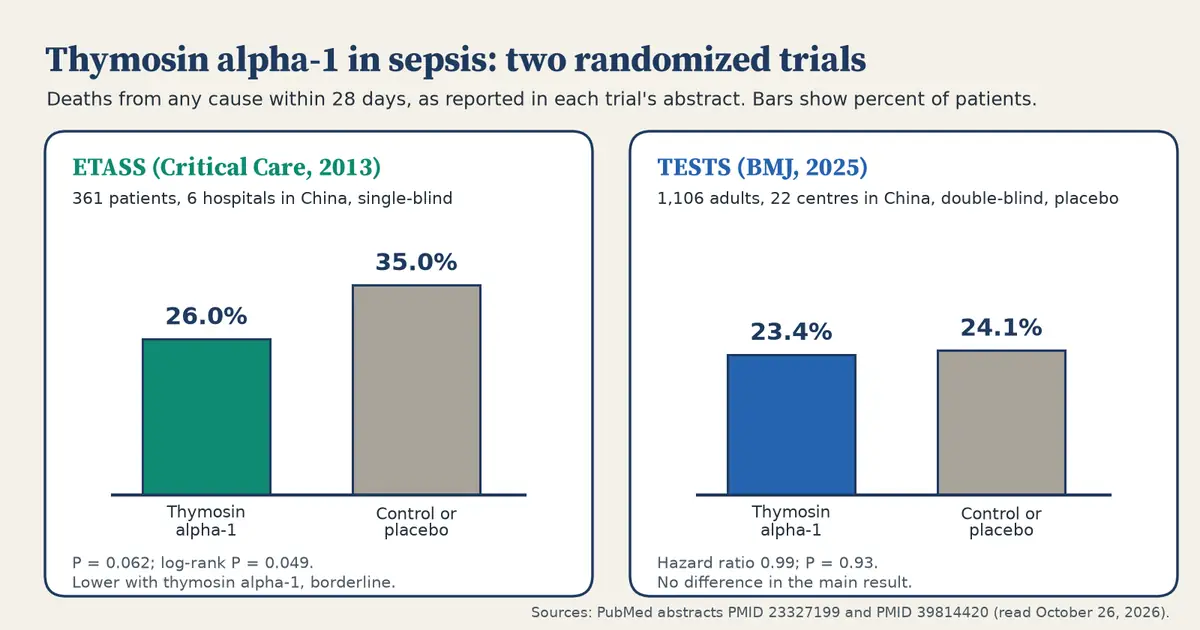
Sepsis is one of the hardest conditions in medicine, and Ta1 was tested there because of its role in immune function. The ETASS trial, published in Critical Care in 2013, was a single-blind randomized trial of 361 patients across six Chinese hospitals. 28-day mortality was 26.0% with Ta1 versus 35.0% with control. The result was borderline on the primary comparison (P of 0.062 on the primary comparison, and 0.049 on a log-rank test), and the group given Ta1 also showed a greater recovery of an immune marker (monocyte HLA-DR) at days 3 and 7. No serious drug-related adverse event was reported. [V] That is a small randomized human trial, and a hypothesis-building one.
COVID-19 added another set of studies. A 2023 meta-analysis in Inflammopharmacology pooled 8 studies and found lower mortality with Ta1 (risk ratio 0.59; 95% CI 0.37 to 0.93), though the studies disagreed with each other substantially (I² of 84%). The same analysis found no difference in need for ventilation or length of stay. [V] Pooled observational and small randomized studies are the middle of the evidence ladder, and the authors' own numbers show why.
Limits and unknowns
This is where the larger, newer trial belongs. TESTS, published in the BMJ in 2025, was a double-blind, placebo-controlled phase 3 trial of 1,106 adults with sepsis at 22 centres in China. 28-day mortality was 23.4% with Ta1 and 24.1% with placebo (hazard ratio 0.99, with a 95% interval running from 0.77 up to 1.27, and a P value of 0.93). No secondary or safety outcome differed between groups. [V] The trial authors also reported subgroup patterns: in patients under 60, the hazard ratio was 1.67 (95% CI 1.04 to 2.67), while in those 60 and older it was 0.81 (interaction P=0.01). Patients with diabetes had a hazard ratio of 0.58 against 1.16 in those without (interaction P=0.04). [V] Subgroups are exploratory and should not be over-read, but the under-60 finding points in the unfavorable direction and belongs in the record.
Other limits worth stating plainly:
- The Cochrane hepatitis B result carries very low to low certainty, and the older hepatitis B trials were small. [V]
- The COVID-19 meta-analysis had high heterogeneity and no effect on ventilation or length of stay. [V]
- The label for the approved product notes that a transient rise in liver enzymes (an ALT flare) can occur during treatment. [V]
- Sepsis results in two trials point different ways. ETASS was single-blind and smaller; TESTS was larger, double-blind and placebo-controlled. [V]
- The trial and label data describe specific pharmaceutical products. They do not tell us about other preparations, which is the gap FDA's own listing, below, addresses. [V]
Where regulators have put it
The regulatory half of this story is as interesting as the science, because the status in the United States differs from the status elsewhere.
| The question | Answer | What the record shows |
|---|---|---|
| Is there an FDA-approved Ta1 drug? | We found none | A DailyMed search returned no thymosin alpha-1 label. [V] |
| Is it approved elsewhere? | Yes | Singapore, Hong Kong and Indonesia list a prescription product; a 2009 review reported more than 35 countries. [V] |
| What did FDA say about compounding it? | Withdrawn from category 2 | Ta1 sits in FDA's table of nominated substances that were withdrawn from category 2. The page's earlier entry cited immunogenicity risk, characterization complexity and inadequate safety information (page current as of April 22, 2026). [V] |
| Where is it on the 503B list? | Category 3 | The 503BSection of federal drug law for outsourcing facilities: larger compounders that register with FDA and must follow drug-manufacturing quality rules. list (updated March 21, 2025) puts thymosin alpha-1 in category 3, nominated without enough supporting information. [V] |
| Has the advisory committee reviewed it? | Not yet | It was not among the substances on the July 23-24, 2026 agenda or the later agenda FDA announced. [V] |
| Is it on WADA's list? | Not named | We did not find Ta1 named on WADA's 2026 list. [V] |
Two things to understand about those lines. First, FDA's withdrawn table does not mean the safety questions were resolved; it means the nominators withdrew the nominations, so FDA's interim policy no longer places the substance in category 2. FDA's earlier wording about immunogenicity and incomplete safety information is public, and we report it as written. Our category explainer covers the mechanics. Second, category 3 for the 503B list is a holding place, not a decision.
In July 2026 the FDA advisory committee voted narrowly in favor of six peptides on the 503ASection of federal drug law covering compounding by state-licensed pharmacies and doctors, usually for a prescription written for one patient. bulks list. Ta1 was not one of them, so there is no committee view on it yet. [S] See our status matrix for the 14 peptides for how the whole group compares.
What people get wrong
Claim
"Thymosin alpha-1 is an FDA-approved drug."
What research shows
- Regulatory status claim
We found no FDA-approved Ta1 product in DailyMed. [V] It is approved in several other countries as a prescription product. [V] Both statements are true at once.
What is unknown
Whether a U.S. sponsor will bring a new application. We found no announcement.
This card describes the kind of research that exists.
Why it matters
Ta1 is a useful case study for anyone following the peptide policy debate. It shows that a peptide can have a real, regulator-reviewed record abroad and still have a modest, mixed record in the newest and largest trials. It also shows that "approved somewhere" and "approved here" are different questions with different evidence behind them.
Questions to bring to a clinician or pharmacist
- Which Ta1 products are legally prescribed where I live, and for what conditions?
- How do the sepsis and hepatitis B trial results apply, if at all, to my situation?
- What does the "age under 60" subgroup result in the 2025 trial mean for a patient like me?
- How would I know the product I am given is the same as the product tested?
What to watch next
Dates and decisions we're tracking
- No date setAny FDA decision moving thymosin alpha-1 out of 503B category 3 [V]
- Date not yet setThe next Pharmacy Compounding Advisory Committee meeting [V]
- PendingThe White House review of FDA's "Interim Access Policy for Compounding Using Certain Peptides" [V]
- Jan. 1, 2027WADA's 2027 Prohibited List takes effect [S]
For how to weigh a study like these, see the evidence ladder. For other peptides with approved medicines behind them, see approved peptide medicines.
Sources (retrieved October 26, 2026 unless noted)
- Wu J, et al., "The efficacy of thymosin alpha 1 for severe sepsis (ETASS)," Critical Care, January 17, 2013 (abstract on PubMed) [V] — https://pubmed.ncbi.nlm.nih.gov/23327199/
- Wu J, et al., "The efficacy and safety of thymosin alpha 1 for sepsis (TESTS)," BMJ, January 15, 2025 (abstract on PubMed) [V] — https://pubmed.ncbi.nlm.nih.gov/39814420/
- Naing C, et al., "Thymosin-alpha 1 for people with chronic hepatitis B," Cochrane Database of Systematic Reviews, September 9, 2026 (abstract on PubMed) [V] — https://pubmed.ncbi.nlm.nih.gov/42713852/
- Soeroto AY, et al., thymosin alpha-1 in moderate to critical COVID-19, systematic review and meta-analysis, Inflammopharmacology, December 2023 (abstract on PubMed) [V] — https://pubmed.ncbi.nlm.nih.gov/37845598/
- Sjogren MH, "Thymalfasin: an immune system enhancer for the treatment of liver disease," Journal of Gastroenterology and Hepatology, December 2004 (abstract on PubMed) [V] — https://pubmed.ncbi.nlm.nih.gov/15641207/
- Goldstein AL, et al., "From lab to bedside: emerging clinical applications of thymosin alpha 1," Expert Opinion on Biological Therapy, 2009 (abstract on PubMed) [V] — https://pubmed.ncbi.nlm.nih.gov/19392576/
- Singapore National Drug Formulary, ZADAXIN INJECTION [SIN07483P], last updated October 9, 2026 [V] — https://www.ndf.gov.sg/about-drugs/product-information/sin07483p/
- Hong Kong Drug Office, ZADAXIN registration HK-50907, page updated October 23, 2026 [V] — https://www.drugoffice.gov.hk/eps/drug/productDetail2/en/consumer/155704
- Indonesia BPOM, public assessment document for thymosin alfa 1, approved 02/08/2024 [V] — https://registrasiobat.pom.go.id/files/assesment-reports/01751602483.pdf
- AUTM Better World Project, technology-transfer case study on thymosin alpha 1 [S] — https://autm.net/about-tech-transfer/better-world-project/bwp-stories/zadaxin
- FDA, "Certain Bulk Drug Substances for Use in Compounding that May Present Significant Safety Risks" (category 2 page), current as of 04/22/2026 [V] — https://www.fda.gov/drugs/human-drug-compounding/certain-bulk-drug-substances-use-compounding-may-present-significant-safety-risks
- FDA, 503B bulk drug substances category list (PDF), updated March 21, 2025 [V] — https://www.fda.gov/media/94164/download
- FDA, "July 23-24, 2026: Meeting of the Pharmacy Compounding Advisory Committee," meeting page [V] — https://www.fda.gov/advisory-committees/advisory-committee-calendar/july-23-24-2026-meeting-pharmacy-compounding-advisory-committee-07232026
- AJMC, "FDA Panel Backs 6 Peptides for Compounding," July 31, 2026 [S] — https://www.ajmc.com/view/fda-panel-backs-6-peptides-for-compounding
- WADA, 2026 Prohibited List (in force January 1, 2026), text read in full [V] — https://www.wada-ama.org/sites/default/files/2025-09/2026list_en_final_clean_september_2025.pdf
- WADA, 2027 Prohibited List text, read from a copy hosted by FIS (retrieved October 25, 2026) [S] — https://assets.fis-ski.com/f/252177/x/4526d29144/2027list_en_final_clean_26_august_2026_2.pdf
- DailyMed name search for "thymalfasin" (no labels returned; a search for tesamorelin returned labels as a control), run October 26, 2026 [V] — https://dailymed.nlm.nih.gov/dailymed/services/v2/spls.json?drug_name=thymalfasin
Spot a mistake? See how we source and our corrections policy.