The "Wolverine stack": what the research on BPC-157 and TB-500 shows, and how each is regulated
The nickname comes from a comic-book character famous for fast recovery, and it's attached to two unrelated molecules: BPC-157, a 15-amino-acid peptide first isolated from gastric juice, and TB-500, a short piece of a larger protein called thymosin beta-4. Online, they're often talked about as a pair. In the journals, they have separate histories, and the story of each is more interesting than the nickname.
Here's a plain tour of both: what the science really contains, from rat tendons to eye-drop trials in people, and what the rulebook says about each, with dates on all of it.
Facts are as of October 26, 2026. Sources, with retrieval dates, are at the bottom.
At a glance
- "Wolverine" is a nickname for BPC-157 plus TB-500, per Healthline (updated October 14, 2026). [S] The two were not developed together. [V]
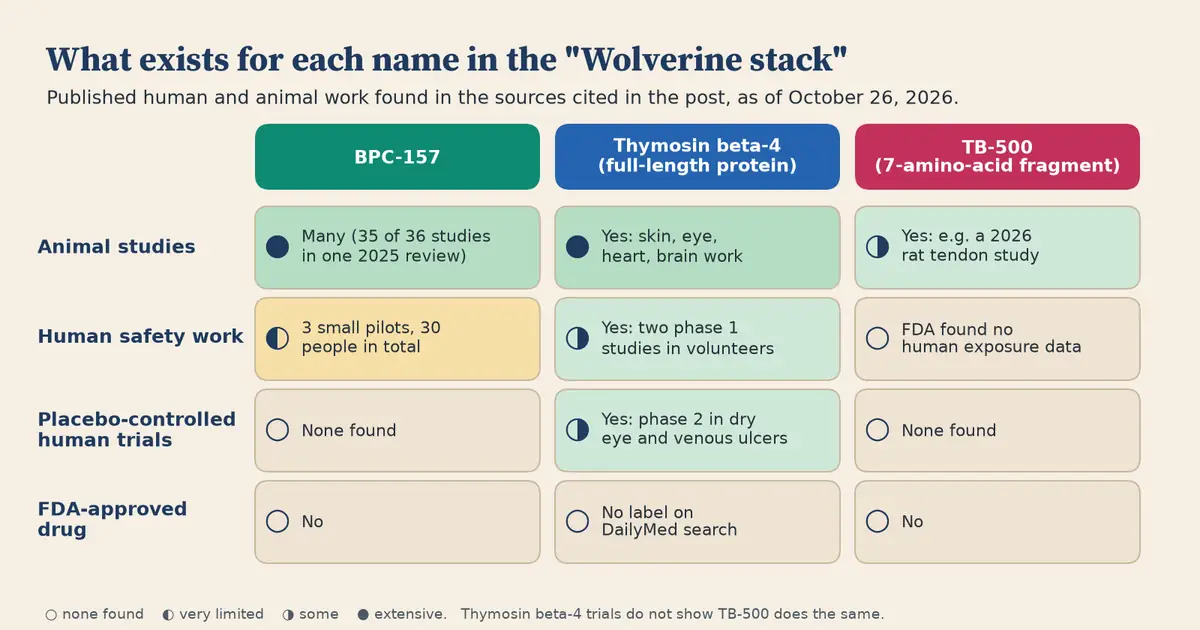
- BPC-157 has a large animal literature (35 of 36 studies in a 2025 systematic review) and a human record that is just beginning: three small pilots, 30 people in all, rated very low certainty. [V]
- Full-length thymosin beta-4, the protein TB-500 comes from, has real human trials: two phase 1 studies in volunteers and phase 2 trials in dry eye and venous ulcers. TB-500 itself is a fragment, and FDA says it found no human exposure data for it. [V]
- Neither is an FDA-approved drug. Both sit in the "nominated but withdrawn" section of FDA's Category 2An interim FDA group of nominated bulk ingredients that FDA has flagged for possible significant safety risks while its review continues. page, and both are on WADA's prohibited list. [V] [S]
First, two different molecules
A 2025 narrative review in Current Reviews in Musculoskeletal Medicine describes BPC-157 as a synthetic pentadecapeptide, meaning 15 amino acids, originally isolated from gastric juice. [V] TB-500 is something else: FDA's Category 2 page identifies it as a fragment of thymosin beta-4 with the sequence LKKTETQ, seven amino acids. [V] Thymosin beta-4 itself is a naturally occurring protein of 43 amino acids. [V]
That matters for reading studies. A trial of full-length thymosin beta-4 tells you about that protein. It doesn't tell you what a seven-amino-acid piece of it does. We flag the difference each time it comes up below.
The BPC-157 science: a deep animal record, a thin human one
If you like preclinicalResearch done before any testing in people, such as lab-dish and animal studies. biology, BPC-157 is a rich story. The 2025 systematic review in HSS Journal searched three databases through June 3, 2024 and included 36 studies, 35 of them preclinical. Across animal models, the authors summarized better functional, structural and biomechanical results for muscle, tendon, ligament and bone injuries. [V] That consistency across injury types is why researchers keep studying it.
The human side is much shorter. The same review found one clinical study and wrote that "No clinical safety data were found." [V] A review published online October 8, 2026 in Acta Orthopaedica Belgica counted three human studies with 30 participants in total, called their methods poor, and rated the overall certainty of evidence very low. [V] Two sports-medicine reviews from August 2026 reached a similar place: one found 67% of identified publications used animal models and human studies were a handful, mostly without robust controls, [V] and another said unapproved peptides show favorable tissue-repair outcomes in animals while rigorous human safety data are scarce. [V]
The thymosin beta-4 science: the surprise is how much human data exists
Here's the part people tend to miss. Thymosin beta-4 has been through proper clinical development, mostly in drug forms very different from anything sold as TB-500. A 2012 review in Expert Opinion on Biological Therapy describes it as released by platelets and other cells after injury, and lays out lab evidence for roles in cell migration, new blood vessel growth and less scarring, in skin, eye, heart and brain tissue. [V]
Then come the people:
- Volunteer safety studies. A 2010 placebo-controlled study in 40 healthy volunteers and a 2021 first-in-human study of a recombinant version in Chinese volunteers each found the protein well tolerated, with no limiting toxicity or serious adverse events reported in the abstracts. Both gave it intravenously. [V]
- Venous ulcers. A 2010 phase 2 trial randomized 73 patients to a topical form. Its authors said the findings suggest it may have potential to accelerate wound healing. [V]
- Dry eye. A 2015 phase 2 trial in 72 people using the controlled adverse environment model found no significant difference in either primary endpoint, though some secondary endpoints differed. [V] A second 2015 phase 2 trial in nine patients with severe dry eye reported statistically significant improvements in symptoms and signs. [V]
That mix, a clean miss on primary endpoints in one trial and positive signals in a small one, is how drug development looks while it's still working things out. It's real human data, and none of it is about TB-500. FDA's page says plainly that it has not identified any human exposure data for drug products containing the fragment. [V]
What about the two together?
There are two published pieces, both small. In a 2021 retrospective chart review from a Florida clinic, 16 of 17 people with knee pain were reached by phone after peptide treatment; four had received BPC-157 plus thymosin beta-4, and three of those four reported improvement. The authors called it small, it had no comparison group, and it used no specific tools to measure function. [V]
The other is a controlled animal study. A rat Achilles tendon trial published July 23, 2026 in Joint Diseases and Related Surgery compared BPC-157, TB-500 and the combination against controls in 32 rats. TB-500 showed a significant advantage in the load tendons carried before failing, BPC-157 showed numerically lower damage scores without reaching significance, and the authors reported that the combination "did not confer additional benefits compared to either agent alone." [V] They called it exploratory.
- 35 of 36studies in the 2025 BPC-157 review were preclinical [V]
- 3small human BPC-157 studies, 30 people total (2026 review) [V]
- 4patients who received both peptides in the 2021 chart review [V]
- 32rats in the 2026 tendon study that tested the combination [V]
Where each stands with FDA and WADA
The rulebook has its own story, and it's changed this year.
| The question | Answer | What the record shows |
|---|---|---|
| Are they FDA-approved drugs? | No | We found no FDA approval or label for either. A DailyMed search for "thymosin" returned no labels. [V] |
| Are they on FDA's Category 2 risk page? | Listed as withdrawn | Both appear in the section for nominations that were withdrawn (page current as of 04/22/2026), and FDA's concerns stay on the page. [V] |
| Are they in FDA's 503A or 503B category lists? | Not found | We did not find BPC-157 or TB-500 in the 503ASection of federal drug law covering compounding by state-licensed pharmacies and doctors, usually for a prescription written for one patient. list (May 14, 2026) or the 503BSection of federal drug law for outsourcing facilities: larger compounders that register with FDA and must follow drug-manufacturing quality rules. list (March 21, 2025). [V] |
| Are they allowed in tested sport? | No | BPC-157 falls in WADA's S0 class; TB-500 is named under S2.3 growth factors. [S] |
On BPC-157, FDA's text says compounded drugs containing it "may pose risk for immunogenicity for certain routes of administration" and that the agency lacks enough information to know whether it would cause harm in people. For TB-500, FDA says it has not identified human exposure data and lacks important safety information. [V] Those are statements about missing information, which is different from a finding of harm and also different from a clearance. Our BPC-157 status explainer covers the July 2026 advisory committee discussion and the pending White House review.
Sport has its own rules. WADA's 2027 list, effective January 1, 2027, prohibits substances without government approval for human therapeutic use under S0, and names thymosin-beta-4 and its derivatives such as TB-500 in S2.3. [S] Approval status doesn't change that: WADA lists approved medicines, too, and our WADA explainer walks through how.
What people get wrong
Claim
"Thymosin beta-4 has been through human trials, so TB-500 has too."
What research shows
- Evidence claim
Human trials exist for full-length thymosin beta-4 in other forms (volunteer safety studies and phase 2 trials in dry eye and venous ulcers). [V] FDA says it has found no human exposure data for the TB-500 fragment. [V]
What is unknown
Whether the fragment behaves like the full protein in people. We found no published answer.
This card describes the kind of research that exists.
The mirror-image error also shows up. "No human trials" isn't accurate for BPC-157, where three small pilots exist, or for thymosin beta-4, where phase 1 and 2 trials do. The accurate statement is narrower: none of them is a large, controlled trial in the setting people talk about, and the combination hasn't been tested that way.
Why it matters
A healthy research field is one where you can say exactly where the evidence stands. For this pair, that's: a lot of animal biology, a few small human reports, a real clinical program for the parent protein and an unanswered question about the fragment. That also marks where good trials could make a difference.
Questions to bring to a clinician or pharmacist
- Is the product you're describing an FDA-approved drug, or something else?
- Which human studies support the use being suggested, and was the form studied the same as the one offered?
- What would a controlled trial of this question need to measure?
- If I compete in a tested sport, have I checked with my anti-doping organization?
What to watch next
Dates and decisions we're tracking
- No date setFDA's decision on adding BPC-157 to the 503A bulks list after the July 2026 committee discussion [V]
- Pending since Oct. 14, 2026White House review of the interim access policy for certain peptides [V]
- Jan. 1, 2027WADA's 2027 Prohibited List takes effect [S]
- Date not yet setThe next Pharmacy Compounding Advisory Committee meeting [V]
For how to weigh a study like these, see our evidence ladder. The sermorelin piece, sermorelin vs. growth hormone, shows what a peptide with a full approval record looks like.
Sources (retrieved October 26, 2026 unless noted)
- Healthline, "What's in the Wolverine Peptide Stack? Research and Safety," updated October 14, 2026 (used only for the nickname and its popular description) [S] — https://www.healthline.com/health/wolverine-peptides
- McGuire et al., BPC-157 narrative review, Current Reviews in Musculoskeletal Medicine, published August 12, 2025 (full text, retrieved October 25, 2026) [V] — https://pmc.ncbi.nlm.nih.gov/articles/PMC12446177/
- Vasireddi N, et al., "Emerging Use of BPC-157 in Orthopaedic Sports Medicine: A Systematic Review," HSS Journal, 2025 (abstract on PubMed, retrieved October 25, 2026) [V] — https://pubmed.ncbi.nlm.nih.gov/40756949/
- Poolton JT, Minett J, Kazmi A, "Human evidence for BPC-157 in orthopaedic and regenerative medicine," Acta Orthopaedica Belgica 92(3), online October 8, 2026 (abstract, retrieved October 25, 2026) [V] — https://doi.org/10.52628/92.3.15837
- Tewari et al., "Peptide Supplements and Their Therapeutic Applications in Sports Medicine," American Journal of Sports Medicine, August 11, 2026 (abstract) [V] — https://pubmed.ncbi.nlm.nih.gov/42578445/
- Mendias et al., "Safety and Efficacy of Approved and Unapproved Peptide Therapies for Musculoskeletal Injuries and Athletic Performance," Sports Medicine, August 2026 (abstract) [V] — https://pubmed.ncbi.nlm.nih.gov/41966639/
- Luansritisakul et al., "Peptides in Regenerative Medicine: A Comprehensive Review of Clinical Applications in Tissue Repair and Chronic Pain Management," Current Pain and Headache Reports, August 24, 2026 (abstract) [V] — https://pubmed.ncbi.nlm.nih.gov/42635865/
- Goldstein AL, et al., "Thymosin β4: a multi-functional regenerative peptide. Basic properties and clinical applications," Expert Opinion on Biological Therapy, January 2012 (abstract) [V] — https://pubmed.ncbi.nlm.nih.gov/22074294/
- Ruff D, et al., randomized placebo-controlled study of intravenous thymosin beta4 in healthy volunteers, Annals of the New York Academy of Sciences, April 2010 (abstract) [V] — https://pubmed.ncbi.nlm.nih.gov/20536472/
- Wang et al., first-in-human phase I study of recombinant human thymosin beta4 in healthy Chinese volunteers, Journal of Cellular and Molecular Medicine, September 2021 (abstract) [V] — https://pubmed.ncbi.nlm.nih.gov/34346165/
- Guarnera G, et al., "The effect of thymosin treatment of venous ulcers," Annals of the New York Academy of Sciences, April 2010 (abstract) [V] — https://pubmed.ncbi.nlm.nih.gov/20536470/
- Sosne G, et al., "Thymosin beta 4 ophthalmic solution for dry eye: a randomized, placebo-controlled, Phase II clinical trial conducted using the controlled adverse environment (CAE) model," Clinical Ophthalmology, 2015 (abstract) [V] — https://pubmed.ncbi.nlm.nih.gov/26056426/
- Sosne G, et al., "Thymosin beta 4 significantly improves signs and symptoms of severe dry eye in a phase 2 randomized trial," Cornea, May 2015 (abstract) [V] — https://pubmed.ncbi.nlm.nih.gov/25826322/
- Lee E, Padgett B, "Intra-Articular Injection of BPC 157 for Multiple Types of Knee Pain," Alternative Therapies in Health and Medicine, July 2021 (abstract) [V] — https://pubmed.ncbi.nlm.nih.gov/34324435/
- Biçer et al., "Effects of BPC-157 and TB-500 on Achilles tendon healing in rats: A histopathological and biomechanical study," Joint Diseases and Related Surgery, July 23, 2026 (abstract) [V] — https://pubmed.ncbi.nlm.nih.gov/42542926/
- FDA, "Certain Bulk Drug Substances for Use in Compounding that May Present Significant Safety Risks" (Category 2 page), content current as of 04/22/2026 [V] — https://www.fda.gov/drugs/human-drug-compounding/certain-bulk-drug-substances-use-compounding-may-present-significant-safety-risks
- FDA, 503A bulk drug substances category list (PDF), updated May 14, 2026 [V] — https://www.fda.gov/media/94155/download
- FDA, 503B bulk drug substances category list (PDF), updated March 21, 2025 [V] — https://www.fda.gov/media/94164/download
- DailyMed search results for "thymosin," run October 26, 2026 (no labels returned) [V] — https://dailymed.nlm.nih.gov/dailymed/services/v2/spls.json?drug_name=thymosin
- WADA, 2027 Prohibited List text, read from a copy hosted by FIS (retrieved October 25, 2026) [S] — https://assets.fis-ski.com/f/252177/x/4526d29144/2027list_en_final_clean_26_august_2026_2.pdf
- FDA, Pharmacy Compounding Advisory Committee meeting page (next meeting date not yet set; retrieved October 26, 2026) [V] — https://www.fda.gov/advisory-committees/pharmacy-compounding-advisory-committee/meeting-pharmacy-compounding-advisory-committee
- OMB/OIRA, pending EO 12866 regulatory review, RIN 0910-ZD94 [V] — https://www.reginfo.gov/public/do/eoDetails?rrid=1568964
Spot a mistake? See how we source and our corrections policy.