AOD-9604: a growth hormone fragment with rodent, rabbit and early human research, and where FDA and WADA list it
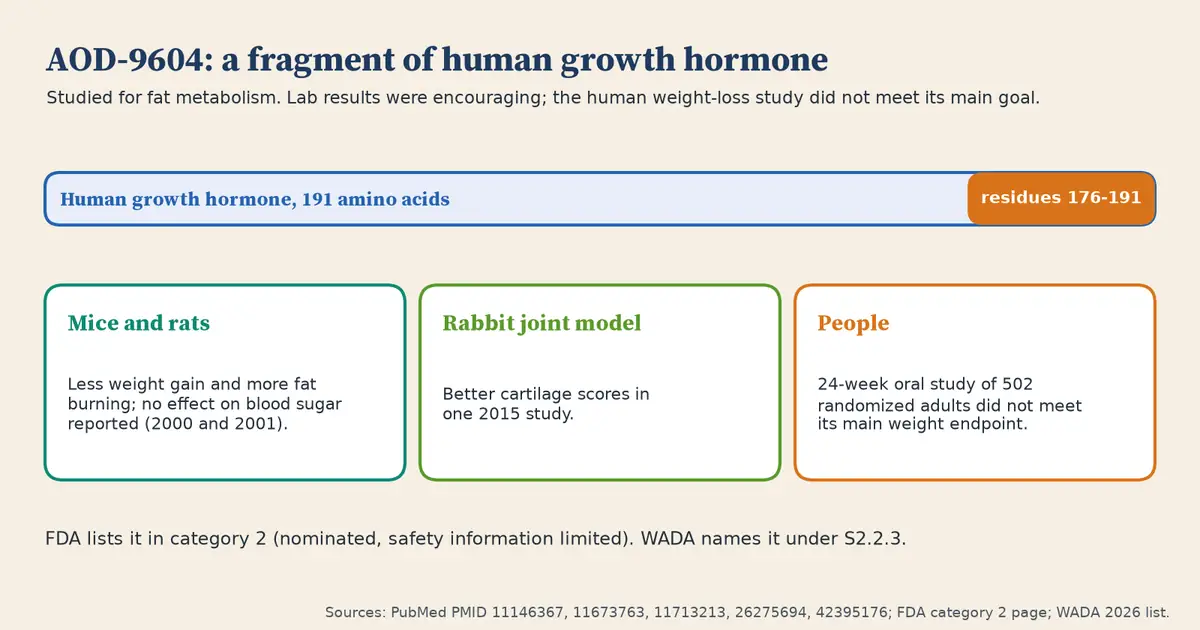
AOD-9604 is a laboratory-made peptide based on the tail end of human growth hormone (hGH 176-191), a stretch of the hormone that researchers linked to fat metabolism. It was designed to keep that signal and leave out the parts of growth hormone that drive growth and raise blood sugar. It has been tested in obese rodents, in a rabbit model of knee osteoarthritis and in a human weight-loss program.
This page leads with what the research reports, then covers the regulatory record. Both get equal room.
Facts are as of October 26, 2026. Sources, with retrieval dates, are at the bottom.
At a glance
- In obese Zucker rats, a 2000 study reported that AOD9604 given by mouth for 19 days cut body weight gain by more than half, increased lipolytic activity in fat tissue, and did not impair insulin sensitivity. [V]
- In obese mice, 2001 studies reported reduced weight gain and increased fat oxidation. Unlike growth hormone, AOD9604 did not raise blood sugar, did not compete for the growth hormone receptor and did not drive cell proliferation in a cell assay. [V]
- In a 2015 rabbit osteoarthritis model, joint-space treatment with AOD9604 was associated with better cartilage scores than saline, and the combination with hyaluronic acid scored best. [V]
- In humans, a 24-week study of an oral form (534 enrolled, 502 randomized) did not meet its main weight-loss goal, according to a 2026 review that notes the information comes from sponsor-reported phase 2 outcomes. [V]
- FDA lists AOD-9604 in its table of substances nominated but withdrawn, and WADA names it in the 2026 Prohibited List. [V]
Where the interest comes from
Growth hormone does two broad things: it supports growth, and it helps the body break down fat. Researchers asked whether a small piece of the hormone could do the second without the first. AOD9604 is the result of that design, a fragment with an extra amino acid at the start, and a series of early papers describe its behavior in animals. [V]
- >50%reduction in weight gain in obese rats over 19 days, 2000 study [V]
- 24 weekslength of the human weight-loss study described in a 2026 review [V]
- 502people randomized in that study [V]
- S2.2.3WADA 2026 list section naming growth hormone fragments [V]
The science: what the research reports
Rats. The 2000 Hormone Research paper treated obese Zucker rats with AOD9604 by mouth for 19 days. Treated animals gained less than half the weight of controls, and their fat tissue showed more lipolytic activity. In contrast to long-term treatment with intact growth hormone, the fragment did not impair insulin sensitivity in clamp testing. The authors concluded it may have potential as an oral therapeutic agent for obesity. [V]
Mice. A 2001 study in International Journal of Obesity compared growth hormone and AOD9604 in obese and lean mice over 14 days. Both reduced weight gain and raised fat oxidation and plasma glycerol, a marker of lipolysis. Unlike growth hormone, AOD9604 did not cause high blood sugar or reduced insulin secretion, did not compete for the growth hormone receptor and did not induce cell proliferation. [V] A second 2001 study in Endocrinology found both compounds lowered both weight and fat mass in obese mice and raised expression of the beta-3 adrenergic receptor gene to levels comparable with lean mice. In mice lacking that receptor, long-term treatment did not produce the same weight change, while an acute measurement still showed higher energy expenditure and fat oxidation. [V]
Rabbits. A 2015 study in Annals of Clinical and Laboratory Science used a collagenase-induced knee osteoarthritis model in 32 rabbits. Groups given AOD9604, hyaluronic acid, or both had better gross and microscopic cartilage scores than the saline group, and the combination group scored best, with the shortest lameness period. [V] This is animal research, an early stage for a joint indication.
People. The 2026 Frontiers in Endocrinology review describes the human record as limited and mostly short-term. It reports a 24-week oral-form weight-loss study with 534 participants (502 randomized) that did not meet its main weight-loss goal, and notes this conclusion rests on sponsor-reported phase 2 outcomes rather than peer-reviewed randomized trials. The review places AOD9604 in a middle-to-lower evidence tier, a compound with short human trials that gave limited clear signals, and notes it does not appear to activate the growth hormone axis the way other peptides in its review do. [V]
The regulatory record
| The question | Answer | What the record shows |
|---|---|---|
| Is it an FDA-approved drug? | None found | A DailyMed name search returned no labels for AOD-9604, and the 2026 review states major regulators have approved it for no use. [V] |
| Where is it on FDA's lists? | Withdrawn from category 2 | AOD-9604 appears in the table of substances nominated but withdrawn on FDA's category 2 page (current as of April 22, 2026). It is not named on the 503ASection of federal drug law covering compounding by state-licensed pharmacies and doctors, usually for a prescription written for one patient. category list updated May 14, 2026. [V] |
| Has the advisory committee reviewed it? | No | FDA's meeting pages show it was not on the July 23-24, 2026 agenda, and no date has been announced for it. [V] |
| Is it on WADA's prohibited list? | Yes, named | The 2026 Prohibited List names AOD-9604 and hGH 176-191 under S2.2.3, at all times. Athletes in tested sport are subject to it. [V] |
How clinical practice fits in. Licensed practitioners prescribe, and state-licensed pharmacies compound, under section 503A. For bulk ingredients FDA's rules allow three routes: a USP monograph, being an ingredient in an FDA-approved drug, or appearing on the 503A bulks list. [V] AOD-9604 is not on the 503A category list or the 503BSection of federal drug law for outsourcing facilities: larger compounders that register with FDA and must follow drug-manufacturing quality rules. list; its only appearance is in the withdrawn-nomination table on the category 2 page. So FDA's lists show no stated compounding pathway for it today. [V] FDA also states that compounded drugs are not FDA-approved. [V]
What is pending. The White House's Office of Information and Regulatory Affairs is reviewing FDA's "Interim Access Policy for Compounding Using Certain Peptides," which will help decide what pharmacies may do for each category. [V]
Limits and unknowns
- FDA's category 2 page says FDA says compounded products with AOD-9604 carry a notable immune-response risk by certain routes, and that impurities and identity checks are complicated for peptides. FDA reports no, or only limited, safety-related information. [V]
- The same page says FDA notes reports of serious adverse events that could be linked to AOD-9604, without a clear causal link. [V] The 2026 review describes the category 2 listing as relating to vasodilatory reactions and tachycardia reports. [V]
- The human weight-loss result rests on sponsor-reported phase 2 outcomes, not a peer-reviewed randomized trial. [V]
- The joint-health findings come from one rabbit model. The review found no convincing human trial evidence for osteoarthritis or tissue regeneration. [V]
- A 2014 case report in Drug Testing and Analysis identified AOD9604 in unknown preparations seized by Belgian authorities, a product-quality note rather than a research finding. [V]
- Under S2.2.3, AOD-9604 is prohibited in tested sport at all times. [V]
What people get wrong
Claim
"AOD-9604 burns fat in people."
What research shows
- Animal research
- early human study
Rats and mice showed reduced weight gain and increased fat oxidation. In humans, a 24-week study did not meet its main weight-loss goal, per a 2026 review. [V]
What is unknown
Whether any human use shows a benefit, and how the sponsor-reported results compare with a published randomized trial. [V]
This card describes the kind of research that exists.
Why it matters
AOD-9604 is a clear example of a rational design that reached people. The animal findings were specific, and the human program tested the idea in a large group, which is the standard step after animal results. The outcome gives a concrete reference point for the field. It also sits at the crossing of three different rulebooks: FDA's compounding lists, drug approval and sports anti-doping, which treat the same molecule differently.
Questions to bring to a clinician or pharmacist
- Is the product I'm asking about an approved drug, a compounded preparation, or sold under a research label?
- Which published studies tested it in people, and what was their main result?
- What does FDA's immunogenicity note mean for the form and route involved?
- If I compete in tested sport, how does the WADA listing apply to me?
What to watch next
Dates and decisions we're tracking
- Date not yet setWhether FDA schedules an advisory committee review for AOD-9604 [V]
- PendingThe White House review of FDA's "Interim Access Policy for Compounding Using Certain Peptides" [V]
- January 1, 2027The next WADA list takes effect [S]
For all 14 peptides side by side, see the status table. The evidence ladder explains how to read each stage.
Sources (retrieved October 26, 2026 unless noted)
- Ng FM, et al., "Metabolic studies of a synthetic lipolytic domain (AOD9604) of human growth hormone," Hormone Research, 2000 (abstract on PubMed) [V] — https://pubmed.ncbi.nlm.nih.gov/11146367/
- Heffernan MA, et al., "Increase of fat oxidation and weight loss in obese mice caused by chronic treatment with human growth hormone or a modified C-terminal fragment," International Journal of Obesity, 2001 (abstract on PubMed) [V] — https://pubmed.ncbi.nlm.nih.gov/11673763/
- Heffernan M, et al., "The effects of human GH and its lipolytic fragment (AOD9604) on lipid metabolism following chronic treatment in obese mice and beta(3)-AR knock-out mice," Endocrinology, 2001 (abstract on PubMed) [V] — https://pubmed.ncbi.nlm.nih.gov/11713213/
- Kwon DR, Park GY, "Effect of intra-articular AOD9604 with or without hyaluronic acid in a rabbit osteoarthritis model," Annals of Clinical and Laboratory Science, 2015 (abstract on PubMed) [V] — https://pubmed.ncbi.nlm.nih.gov/26275694/
- Dominikowski A, et al., "The emerging landscape of performance-enhancing peptides modulating GH-IGF1 axis," Frontiers in Endocrinology, 2026 (open-access full text read) [V] — https://pubmed.ncbi.nlm.nih.gov/42395176/
- Vanhee C, et al., identification of AOD9604 in unknown pharmaceutical preparations seized by Belgian authorities, Drug Testing and Analysis, 2014 (PubMed record) [V] — https://pubmed.ncbi.nlm.nih.gov/24976118/
- FDA, "Certain Bulk Drug Substances for Use in Compounding that May Present Significant Safety Risks" (category 2 page), current as of 04/22/2026 [V] — https://www.fda.gov/drugs/human-drug-compounding/certain-bulk-drug-substances-use-compounding-may-present-significant-safety-risks
- FDA, 503A bulk drug substances category list (PDF), updated May 14, 2026 [V] — https://www.fda.gov/media/94155/download
- FDA, 503B bulk drug substances list [V] — https://www.fda.gov/media/94164/download
- FDA, "Bulk Drug Substances Used in Compounding Under Section 503A of the FD&C Act," current as of 05/14/2026 [V] — https://www.fda.gov/drugs/human-drug-compounding/bulk-drug-substances-used-compounding-under-section-503a-fdc-act
- FDA, "July 23-24, 2026: Meeting of the Pharmacy Compounding Advisory Committee," meeting page [V] — https://www.fda.gov/advisory-committees/advisory-committee-calendar/july-23-24-2026-meeting-pharmacy-compounding-advisory-committee-07232026
- FDA, "Compounding and the FDA: Questions and Answers," current as of 09/16/2025 [V] — https://www.fda.gov/drugs/human-drug-compounding/compounding-and-fda-questions-and-answers
- WADA, 2026 Prohibited List, text read in full [V] — https://www.wada-ama.org/sites/default/files/2025-09/2026list_en_final_clean_september_2025.pdf
- WADA, 2027 Prohibited List text, read from a copy hosted by FIS (retrieved October 25, 2026) [S] — https://assets.fis-ski.com/f/252177/x/4526d29144/2027list_en_final_clean_26_august_2026_2.pdf
- OMB/OIRA, pending EO 12866 regulatory review, RIN 0910-ZD94 [V] — https://www.reginfo.gov/public/do/eoDetails?rrid=1568964
- DailyMed name search for AOD-9604, run October 26, 2026 (no labels returned) [V] — https://dailymed.nlm.nih.gov/dailymed/services/v2/spls.json?drug_name=AOD-9604
Spot a mistake? See how we source and our corrections policy.