Epitalon: telomerase and melatonin research from Russian labs, and where FDA's committee review left it
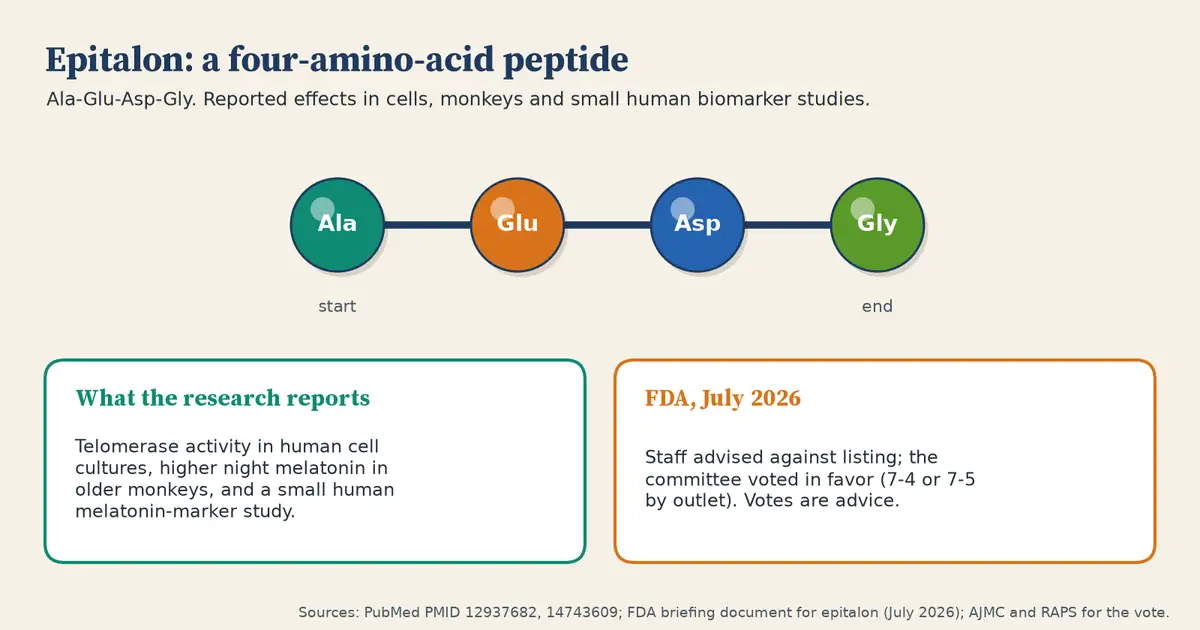
Epitalon (also spelled epithalon) is a four-amino-acid peptide, alanine-glutamate-aspartate-glycine, developed in St. Petersburg from the composition of epithalamin, an extract of the pineal gland. Its studies center on two themes: telomerase, the enzyme that maintains the protective caps on chromosomes, and melatonin, the pineal hormone that follows the day-night rhythm. In July 2026 an FDA advisory committee reviewed it, and the panel voted in its favor by a narrow margin, per press reports [S].
This page leads with what the research reports, then covers the regulatory record. Both get equal room.
Facts are as of October 26, 2026. Sources, with retrieval dates, are at the bottom.
At a glance
- In cultured human fetal fibroblasts, a 2003 study reported that epitalon induced telomerase activity and telomere elongation, and a 2004 follow-up reported that treated cells made 10 extra divisions. That is cell research, the usual first step. [V]
- A 2025 Biogerontology study in human cell lines reported telomere extension in normal cells through telomerase upregulation, and through a different mechanism in cancer cells. [V]
- In a 2003 study of rhesus monkeys, epitalon raised night-time melatonin in older animals but not younger ones. [V]
- FDA's staff identified three human studies of epitalon and recommended against listing epitalon. The advisory committee voted in favor in July 2026 by a narrow margin. [V] [S]
- A 2026 narrative review describes the human evidence as a few small studies of body-function markers plus an older controlled retinitis pigmentosa trial. [V]
Where the interest comes from
The research program behind epitalon grew from a long line of work on pineal peptides at the Institute of Bioregulation and Gerontology in St. Petersburg. [V] The question it asks is a classic one in aging biology: does a short, defined peptide influence how cells maintain their chromosome ends, or how the pineal gland's melatonin output changes with age? Both lines of work are early-stage research, the usual starting point for any new compound.
- 10extra cell divisions reported in treated aging fibroblasts in 2004 [V]
- 3human studies FDA's staff identified [V]
- 4amino acids in epitalon [V]
- 7-4 or 7-5July 24 committee vote, tally varies by outlet [S]
The science: what the research reports
Cells and telomeres. The 2003 paper in Bulletin of Experimental Biology and Medicine added epitalon to telomerase-negative human fetal fibroblasts and reported induced expression of telomerase's catalytic subunit, enzymatic activity, and telomere elongation. [V] The 2004 follow-up used fibroblasts from a fetal lung that had stopped dividing by its 34th passage. Epitalon elongated their telomeres to lengths comparable to early passages, and the treated cells made 10 extra divisions. [V] In 2025, a Biogerontology study tested epitalon in normal epithelial cells, fibroblasts and breast cancer cell lines. It reported longer telomeres in normal cells, linked to higher hTERT and telomerase activity. [V]
Monkeys and melatonin. A 2003 study of 38 female rhesus monkeys found that melatonin follows a clear daily rhythm and drops with age. Epitalon given to old monkeys significantly raised night-time melatonin, with no change in young animals. [V] FDA's briefing document describes related monkey work, in which older animals' evening melatonin rose more than four-fold after treatment, while younger animals showed no significant change. [V]
Mice. FDA's briefing document describes mouse studies from the same Russian group in which intermittent epitalon treatment was reported to suppress the development of spontaneous tumors and to lengthen lifespan in several strains. In one strain, treated mice also had fewer chromosome abnormalities in bone marrow cells (a 17% lower frequency) than vehicle-treated mice, which the staff read as no sign of mutagenicity at the tested level. [V] These are rodent findings, an early stage of research, and the staff note the studies used a single fixed level, female mice only and short exposures. [V]
People. FDA's staff identified three human studies. Two gave epitalon under the tongue to night-shift workers: one measured circadian gene expression, the other the urinary excretion of a melatonin metabolite. The third, a 2002 study, was in patients with congenital retinitis pigmentosa. [V] None of the three is reported to have used a compounded formulation, or the staff could not tell. [V] According to FDA's briefing, epitalon received an orphan drug designation for retinitis pigmentosa in September 2010. [V] A 2026 narrative review summarized the human evidence the same way: small physiological or biomarker studies plus an older controlled retinitis pigmentosa study. [V]
What the review adds. The 2026 International Journal of Molecular Sciences review, which searched through September 22, 2026, reports that epitalon has been studied for effects on telomere upkeep, day-night and hormone regulation, oxidative stress and markers of cell aging, and that preclinicalResearch done before any testing in people, such as lab-dish and animal studies. studies suggest biological activity. [V]
The regulatory record
| The question | Answer | What the record shows |
|---|---|---|
| Is it an FDA-approved drug? | None found | A DailyMed name search returned no labels for epitalon. [V] |
| Where is it on FDA's lists? | Withdrawn from category 2 | Epitalon is in the table of substances nominated but withdrawn on FDA's category 2 page (current as of April 22, 2026), which notes the lack of human safety information for the proposed route. It is not named on the 503ASection of federal drug law covering compounding by state-licensed pharmacies and doctors, usually for a prescription written for one patient. category list updated May 14, 2026. [V] |
| Has the advisory committee reviewed it? | Yes, July 24, 2026 | Press reports show it was backed by a narrow margin, over the staff recommendation. Outlets report the tally as 7-4 or 7-5. Votes are advice, and listing needs a separate rulemaking. [S] |
| Is it on WADA's prohibited list? | Not named | The 2026 Prohibited List does not name epitalon. [V] |
What staff recommended. FDA's staff recommended against adding epitalon to the 503A bulks list. The nominated use was insomnia. Staff wrote that epitalon was not well characterized, that no studies in patients with insomnia were found, and that no human safety data support the proposed route. [V] They also noted that the retinitis pigmentosa orphan designation was withdrawn or revoked on January 6, 2016. [V]
How clinical practice fits in. Licensed practitioners prescribe, and state-licensed pharmacies compound, under section 503A. FDA's rules allow three routes for bulk ingredients: a USP monograph, being an ingredient in an FDA-approved drug, or inclusion on the 503A bulks list. [V] Epitalon has no stated pathway on FDA's lists today, and staff noted it has no monograph and is not part of an approved drug. [V] The committee's vote and FDA's decision on the bulks list are what could change that. [V] FDA states that compounded drugs are not FDA-approved. [V]
What is pending. The White House's Office of Information and Regulatory Affairs is reviewing FDA's "Interim Access Policy for Compounding Using Certain Peptides," which will help decide what pharmacies may do for each category. [V]
Limits and unknowns
- FDA's staff wrote that the available nonclinical record is too narrow and too short to say much about safety, and that they do not adequately inform genotoxic or carcinogenic potential. [V]
- Because epitalon is reported to activate telomerase and lengthen telomeres, FDA's staff described a mechanistic carcinogenicity concern: longer telomeres are generally associated with increased cancer risk, and they found no two-year carcinogenicity studies. [V]
- The 2025 Biogerontology study reported telomere extension in breast cancer cell lines through a different mechanism, ALT activation. The journal later published a correction notice for the paper; we did not review its contents. [V]
- FDA's staff found no pharmacokinetic data and no human safety data for epitalon. A search of FDA's adverse event database through December 8, 2025 returned no reports; FDA notes that reporting is voluntary and the database has limits. [V]
- FDA raised an immunogenicity concern for injection routes, related to aggregation and peptide-related impurities. [V]
- A 2015 analysis found epitalon in two illegal pharmaceutical preparations, which is a product-quality note rather than a research finding. [V]
- The 2026 narrative review notes that data on how the body handles it, on testing different amounts, and on long-term safety remain thin, and that no adequately powered randomized trial has been run. [V]
What people get wrong
Claim
"Epitalon lengthens telomeres, so it slows aging."
What research shows
- Cell and monkey research
Cell studies report telomerase induction and telomere elongation, and a monkey study reports higher night-time melatonin in older animals. [V]
What is unknown
Whether telomere changes in cultured cells translate to any health effect in people, and what the cancer-related questions mean in practice. [V]
This card describes the kind of research that exists.
Why it matters
Epitalon shows how a single mechanism can anchor a decades-long research program. The cell and monkey findings are specific and repeatable in the lab. A committee voting in its favor in July signals that regulators see a reason to look again. What the next chapters need are human studies with standard designs, which the 2026 review also calls for.
Questions to bring to a clinician or pharmacist
- Is the product I'm asking about an approved drug, a compounded preparation, or sold under a research label?
- Which published studies tested it in people, and what did they measure?
- How do the telomerase findings in cells relate to any outcome that matters in daily life?
- Which regulatory list is it on, and what has changed since the July meeting?
What to watch next
Dates and decisions we're tracking
- Date not yet setWhether FDA starts rulemaking on any substance the committee backed, including epitalon [S]
- PendingA first adequately powered randomized trial in people [V]
- PendingThe White House review of FDA's "Interim Access Policy for Compounding Using Certain Peptides" [V]
For all 14 peptides side by side, see the status table. The evidence ladder explains how to read each stage.
Sources (retrieved October 26, 2026 unless noted)
- Khavinson VKh, et al., "Epithalon peptide induces telomerase activity and telomere elongation in human somatic cells," Bulletin of Experimental Biology and Medicine, 2003 (abstract on PubMed) [V] — https://pubmed.ncbi.nlm.nih.gov/12937682/
- Khavinson VKh, et al., "Peptide promotes overcoming of the division limit in human somatic cell," Bulletin of Experimental Biology and Medicine, 2004 (abstract on PubMed) [V] — https://pubmed.ncbi.nlm.nih.gov/15455129/
- Al-Dulaimi S, et al., "Epitalon increases telomere length in human cell lines through telomerase upregulation or ALT activity," Biogerontology, 2025 (abstract on PubMed) [V] — https://pubmed.ncbi.nlm.nih.gov/40908429/
- Correction notice for the Al-Dulaimi paper, Biogerontology, November 2025 (PubMed record; contents not reviewed) [V] — https://pubmed.ncbi.nlm.nih.gov/41240216/
- Goncharova ND, et al., peptide correction of age-related pineal disturbances in monkeys, Advances in Gerontology, 2003 (abstract on PubMed) [V] — https://pubmed.ncbi.nlm.nih.gov/14743609/
- Jain A, et al., "Epitalon and Epithalamin: A Narrative Review of Mechanistic, Preclinical, and Clinical Evidence," International Journal of Molecular Sciences, 2026 (abstract on PubMed) [V] — https://pubmed.ncbi.nlm.nih.gov/42884164/
- Vanhee C, et al., identification of epitalon in two illegal pharmaceutical preparations, Drug Testing and Analysis, 2015 (abstract on PubMed) [V] — https://pubmed.ncbi.nlm.nih.gov/25535022/
- FDA, briefing document on epitalon-related bulk drug substances for the July 23-24, 2026 Pharmacy Compounding Advisory Committee [V] — https://www.fda.gov/media/193345/download
- FDA, staff briefing slides for the July 24, 2026 session [V] — https://www.fda.gov/media/193774/download
- FDA, "July 23-24, 2026: Meeting of the Pharmacy Compounding Advisory Committee," meeting page [V] — https://www.fda.gov/advisory-committees/advisory-committee-calendar/july-23-24-2026-meeting-pharmacy-compounding-advisory-committee-07232026
- FDA, "Certain Bulk Drug Substances for Use in Compounding that May Present Significant Safety Risks" (category 2 page), current as of 04/22/2026 [V] — https://www.fda.gov/drugs/human-drug-compounding/certain-bulk-drug-substances-use-compounding-may-present-significant-safety-risks
- FDA, 503A bulk drug substances category list (PDF), updated May 14, 2026 [V] — https://www.fda.gov/media/94155/download
- FDA, "Bulk Drug Substances Used in Compounding Under Section 503A of the FD&C Act," current as of 05/14/2026 [V] — https://www.fda.gov/drugs/human-drug-compounding/bulk-drug-substances-used-compounding-under-section-503a-fdc-act
- FDA, "Compounding and the FDA: Questions and Answers," current as of 09/16/2025 [V] — https://www.fda.gov/drugs/human-drug-compounding/compounding-and-fda-questions-and-answers
- AJMC, "FDA Panel Backs 6 Peptides for Compounding," July 31, 2026 [S] — https://www.ajmc.com/view/fda-panel-backs-6-peptides-for-compounding
- RAPS, "FDA Advisory Committee Backs Two More Peptides, Rejects One for Compounding List" [S] — https://www.raps.org/resource/fda-advisory-committee-backs-two-more-peptides-rejects-one-for-compounding-list.html
- WADA, 2026 Prohibited List, text read in full [V] — https://www.wada-ama.org/sites/default/files/2025-09/2026list_en_final_clean_september_2025.pdf
- OMB/OIRA, pending EO 12866 regulatory review, RIN 0910-ZD94 [V] — https://www.reginfo.gov/public/do/eoDetails?rrid=1568964
- DailyMed name search for epitalon, run October 26, 2026 (no labels returned) [V] — https://dailymed.nlm.nih.gov/dailymed/services/v2/spls.json?drug_name=epitalon
Spot a mistake? See how we source and our corrections policy.