MOTS-c: a peptide written in mitochondrial DNA, and what the research and the FDA review show so far
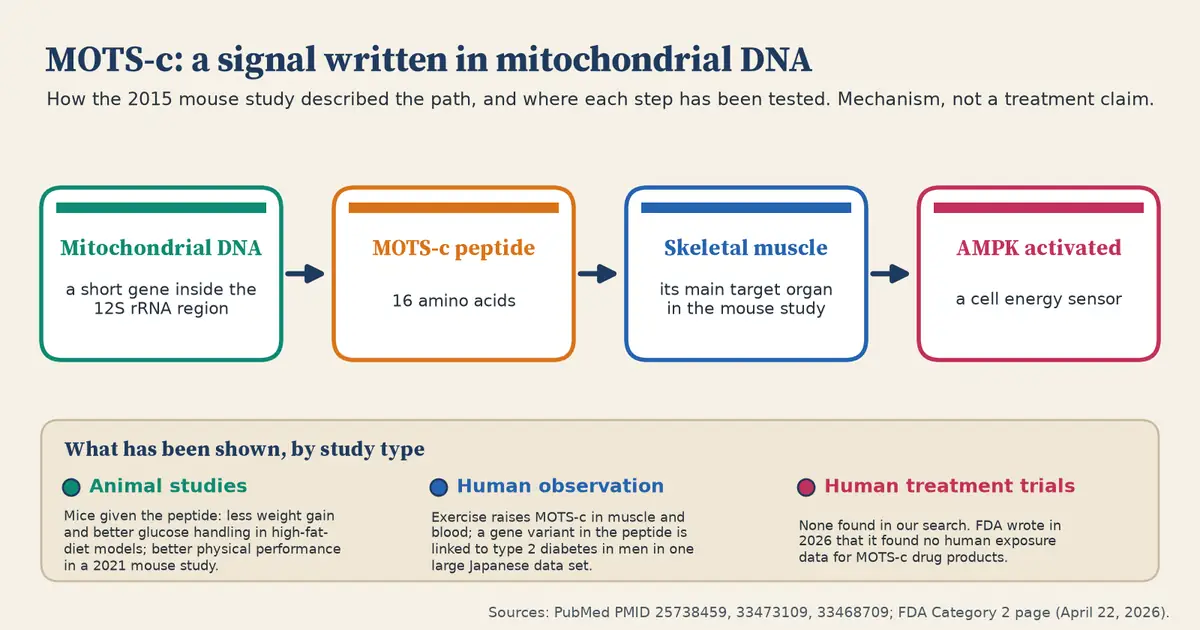
Nearly all of your genes sit in the nucleus of the cell. A small handful sit in the mitochondria, the structures that make cellular energy. In 2015, a research team reported that one stretch of that mitochondrial DNA also encodes a short peptide, and that the peptide seemed to talk to the rest of the body about metabolism. It was named MOTS-c. A decade on, it is among the most discussed peptides in the FDA's current review, and one of the few that an advisory committee voted on this summer.
This page covers both halves: the science, which is a fascinating and fast-moving story, and the regulatory path, which is moving faster than the human evidence.
Facts are as of October 26, 2026. Sources, with retrieval dates, are at the bottom.
At a glance
- MOTS-c is a 16-amino-acid peptide encoded in mitochondrial DNA. In a 2015 mouse study it prevented diet-induced obesity and insulin resistance. That is animal evidence. [V]
- A 2021 mouse study reported that it improved physical performance, and that exercise raises the body's own MOTS-c in people. Mice for the first claim; humans for the second. [V]
- A natural gene variant in the peptide has been linked to type 2 diabetes in males and to muscle traits in a separate study. These are observational human findings. [V]
- The newest research keeps expanding, with 2026 papers on kidney, reproductive and lung biology, all preclinicalResearch done before any testing in people, such as lab-dish and animal studies. in the records we read. [V]
- Regulatory: FDA staff proposed against listing it for compounding. An advisory committee voted 7 to 5 in favor, with 2 abstentions, on July 23, 2026. FDA has not acted. [S]
A new kind of biology
Biology textbooks used to say mitochondria make energy and little else. The MOTS-c story is part of a change in that picture. In the 2015 paper in Cell Metabolism, the authors describe a peptide of 16 amino acids encoded in the mitochondrial 12S rRNA gene. They report that its main target is skeletal muscle, where it blocks the folate cycle and de novo purine synthesis and, as a result, activates the energy-sensing enzyme AMPK. In mice, MOTS-c treatment blocked the insulin resistance that otherwise came with aging or a high-fat diet, and it blocked diet-induced obesity. [V]
That mechanism, a signal from the mitochondria to the muscle, is a big reason researchers got excited. A naturally occurring peptide that engages an energy-sensing switch like AMPK is a compelling idea. It is also an idea whose first support came from mice.
From mice to people: the signals so far
A 2021 paper in Nature Communications followed up in mice. It reported that exercise switches MOTS-c on and that the peptide helps regulate muscle upkeep and the physical decline that comes with age. The authors also reported that exercise raises MOTS-c in humans, which supports the idea that the body uses the peptide as one of its exercise signals. [V] The animal result and the human observation are separate findings, and we label them separately here.
Human genetics adds a third thread. A 2021 study in Aging examined a variant called K14Q (m.1382A>C) in the MOTS-c gene. Pooling three cohorts totaling 27,527 people, it found that males carrying the C allele had a higher prevalence of type 2 diabetes, with an interaction with low physical activity. The authors back this with mouse and cell data, and they report that female mice were unaffected. [V] A 2022 follow-up in Biochimica et Biophysica Acta reported that the same variant is linked to differences in muscle fiber makeup and in muscle performance. [V] These are associations in observational data. They suggest the peptide matters to human metabolism, but they do not test whether giving the peptide changes anything.
- 16amino acids in MOTS-c, encoded in mitochondrial DNA [V]
- 2015year of the first mouse study on obesity and insulin resistance [V]
- 27,527people across three cohorts in the 2021 variant study [V]
- 7-5committee vote on July 23, 2026, with 2 abstentions [S]
Limits and unknowns
Here is the plain statement that readers deserve: we did not find a published human trial that tested MOTS-c as a treatment. When we searched PubMed for MOTS-c records tagged as clinical or randomized trials, we found five, and from their titles each measures the body's own MOTS-c levels in people, for example after exercise, during heat stress or in patients taking metformin. We read titles and publication types, not every full text. [V]
FDA's own review reaches the same place. Its listing for MOTS-c states that the agency found no information about people being exposed to drug products containing it, by any route, and that it lacks important information about safety, including whether it would cause harm in humans. The listing also notes significant immunogenicity risk for certain routes and complexities in characterizing the active ingredient and its impurities. [V]
Other open questions are straightforward. The mouse findings may not translate. The gene-variant data link a lower-function peptide to risk and do not show that more of it is better. The variant result was seen in males and not in female mice. And the peptide's long-term behavior in people, over any length of time, is not described in the sources we found. [V]
Where regulators have put it
| The question | Answer | What the record shows |
|---|---|---|
| Is there an FDA-approved MOTS-c drug? | We found none | A DailyMed search for MOTS-c returned no labels, and FDA states it has no human exposure data for the substance. [V] |
| Where is it on FDA's compounding lists? | Withdrawn from category 2 | MOTS-c now appears in FDA's table of substances nominated but withdrawn from category 2 (page current as of April 22, 2026). [V] |
| Did FDA's advisory committee review it? | Yes, on July 23, 2026 | FDA staff proposed against listing it; the committee voted 7 yes, 5 no, 2 abstentions, according to a trade report. [S] |
| Has FDA acted on that vote? | Not yet | Committee votes are not binding, and a listing would need rulemaking. [S] |
| Is it allowed in tested sport? | No | WADA's 2026 list names MOTS-c under S4.4.1, metabolic modulators. [V] |
The July meeting is the clearest sign of how quickly policy is moving. AJMC reported that FDA scientists opposed adding any of the seven substances reviewed, that the committee recommended six anyway, and that MOTS-c passed 7-5 with two abstentions. The same article reported scrutiny of the committee's reconstituted roster. [S] Our explainer on FDA's compounding categories covers what the categories mean, and the BPC-157 status page shows how the same meeting played out for another peptide.
One more regulatory fact is practical. WADA's list is a rule for tested athletes, whatever the peptide's legal status. For the broader picture, see our piece on peptides and the WADA list. [V]
What people get wrong
Claim
"MOTS-c has been shown to burn fat in people."
What research shows
- Evidence-level claim
The metabolic results in the sources we opened are from mice and cells, and the human data are observational. [V]
What is unknown
Whether giving the peptide to people changes weight, glucose or muscle in a controlled trial. We found none.
This card describes the kind of research that exists.
Why it matters
MOTS-c matters for reasons beyond the headlines. It is a clean example of the field's open questions: a credible discovery, a plausible mechanism, supportive human genetics, and an evidence gap exactly where a treatment claim would need it. It is also a case where policy moved before a human trial was published, so what happens next is a story about regulators as much as researchers.
Questions to bring to a clinician or pharmacist
- Is there any human trial of MOTS-c given as a treatment, or only studies of the body's own levels?
- How do mouse results like the 2015 and 2021 studies usually translate to people in metabolism research?
- What does FDA's statement of "no human exposure data" mean for how a product would be evaluated?
- If I compete in a tested sport, have I checked MOTS-c with my anti-doping organization?
What to watch next
Dates and decisions we're tracking
- No date setFDA's decision on the committee's July 23, 2026 recommendation for MOTS-c [S]
- PendingThe White House review of FDA's "Interim Access Policy for Compounding Using Certain Peptides" [V]
- Jan. 1, 2027WADA's 2027 Prohibited List takes effect [S]
- Any timeThe first published human trial in which MOTS-c is the treatment [U]
More on how to weigh animal and human findings is in the evidence ladder.
Sources (retrieved October 26, 2026 unless noted)
- Lee C, et al., "The mitochondrial-derived peptide MOTS-c promotes metabolic homeostasis and reduces obesity and insulin resistance," Cell Metabolism, March 3, 2015 (abstract on PubMed) [V] — https://pubmed.ncbi.nlm.nih.gov/25738459/
- Reynolds JC, et al., "MOTS-c is an exercise-induced mitochondrial-encoded regulator of age-dependent physical decline and muscle homeostasis," Nature Communications, January 20, 2021 (abstract on PubMed) [V] — https://pubmed.ncbi.nlm.nih.gov/33473109/
- Zempo H, et al., "A pro-diabetogenic mtDNA polymorphism in the mitochondrial-derived peptide, MOTS-c," Aging, January 19, 2021 (abstract on PubMed) [V] — https://pubmed.ncbi.nlm.nih.gov/33468709/
- Kumagai H, et al., "The MOTS-c K14Q polymorphism in the mtDNA is associated with muscle fiber composition and muscular performance," Biochimica et Biophysica Acta, February 2022 (abstract on PubMed) [V] — https://pubmed.ncbi.nlm.nih.gov/34728329/
- PubMed search, "MOTS-c" with clinical-trial or randomized-trial publication types (5 records, titles reviewed), run October 26, 2026 [V] — https://pubmed.ncbi.nlm.nih.gov/?term=MOTS-c+AND+%28Clinical+Trial%5Bpt%5D+OR+Randomized+Controlled+Trial%5Bpt%5D%29
- Biochemical Pharmacology, MOTS-c and diabetic nephropathy, October 23, 2026 (abstract on PubMed) [V] — https://pubmed.ncbi.nlm.nih.gov/42918312/
- FDA, "Certain Bulk Drug Substances for Use in Compounding that May Present Significant Safety Risks" (category 2 page), current as of 04/22/2026 [V] — https://www.fda.gov/drugs/human-drug-compounding/certain-bulk-drug-substances-use-compounding-may-present-significant-safety-risks
- FDA, "July 23-24, 2026: Meeting of the Pharmacy Compounding Advisory Committee," meeting page [V] — https://www.fda.gov/advisory-committees/advisory-committee-calendar/july-23-24-2026-meeting-pharmacy-compounding-advisory-committee-07232026
- AJMC, "FDA Panel Backs 6 Peptides for Compounding," July 31, 2026 [S] — https://www.ajmc.com/view/fda-panel-backs-6-peptides-for-compounding
- WADA, 2026 Prohibited List (in force January 1, 2026), text read in full [V] — https://www.wada-ama.org/sites/default/files/2025-09/2026list_en_final_clean_september_2025.pdf
- WADA, 2027 Prohibited List text, read from a copy hosted by FIS (retrieved October 25, 2026) [S] — https://assets.fis-ski.com/f/252177/x/4526d29144/2027list_en_final_clean_26_august_2026_2.pdf
- OMB/OIRA, pending EO 12866 regulatory review, RIN 0910-ZD94 [V] — https://www.reginfo.gov/public/do/eoDetails?rrid=1568964
- DailyMed name search for "mots-c" (no labels returned; a search for tesamorelin returned labels as a control), run October 26, 2026 [V] — https://dailymed.nlm.nih.gov/dailymed/services/v2/spls.json?drug_name=mots-c
Spot a mistake? See how we source and our corrections policy.