
Anti-aging and longevity peptide claims: what FDA and FTC rules actually say

Scroll long enough and someone will promise you younger skin, sharper energy or "cellular renewal" from a peptide. Some of that excitement comes from real, early research into how cells age, and it's fair to be curious about it. What's less obvious is that the exact words on a jar, a bottle or an ad decide which federal rules apply. Here's how regulators sort aging claims, so you can read the next one with a clearer eye.
Facts are as of November 2, 2026. Sources, with retrieval dates, are at the bottom.
Overheard in the group chat
"This peptide cream rebuilds collagen, so it's basically a treatment you don't need a prescription for."
What we can confirm: FDA's anti-aging page says a product meant to increase the skin's collagen production is a drug or a medical device, even when it's sold as skincare. [V]
"The bottle says FDA didn't evaluate it, so anything goes."
What we can confirm: that sentence is required on supplement labels that make structure/function claims. FTC staff guidance says a disclaimer like it won't rescue an ad that's otherwise misleading. [V]
"It's clinically proven to make skin act younger."
What we can confirm: in 2014 the FTC settled with L'Oréal USA over "clinically proven" claims about boosting genes for younger-looking skin. The order bars such claims without competent and reliable scientific evidence. [V]
The word that decides everything: intended use
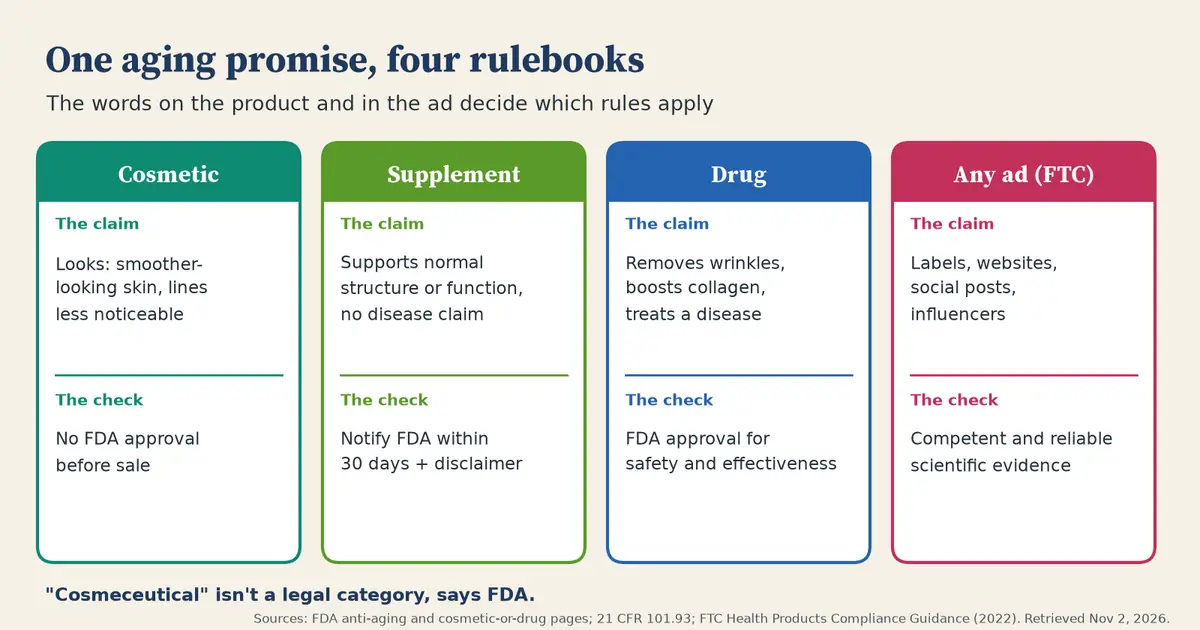
Federal law doesn't sort products by ingredient. It sorts them by what they're meant to do. FDA says it reads intended use from the claims a company makes on labels, in ads and online, from what buyers expect based on reputation, and sometimes from ingredients with a well-known therapeutic use. [V] The same peptide can land in different lanes depending on the promise attached to it.
For aging claims, FDA draws the line plainly. Products meant to make you look more attractive, including moisturizers that make fine lines less visible and makeup that covers them, are cosmetics. [V] Products meant to change the body's structure or function, such as removing wrinkles or increasing collagen production, are drugs or devices, even if the result shows up as a change in appearance. [V] FDA adds that it's concerned about drug-type anti-aging claims on products sold as cosmetics. [V]
There's also no legal middle category. FDA says the popular term "cosmeceutical" has no meaning under the law. [V] Our page on skincare peptides as cosmetic or drug walks through how that plays out for creams and serums.
Three lanes, side by side
| Lane | What the claim is about | Who checks it, and when |
|---|---|---|
| Cosmetic | How you look: smoother-looking skin, lines that are less noticeable | No FDA approval before sale; the product must be safe as labeled or as customarily used [V] |
| Dietary supplement | Supporting normal structure or function, with no disease claim | No pre-approval, but the company needs substantiation and must notify FDA within 30 days of marketing, plus a fixed disclaimer [V] |
| Drug | Treating, preventing or mitigating disease, or changing the body's structure or function | FDA approval for safety and effectiveness before marketing [V] |
The supplement lane has its own fine print. Under 21 CFR 101.93, a disease claim is one that says or implies an effect on a disease, its characteristic signs or symptoms, or an abnormal condition tied to a natural state or process when that condition is rare or can do serious or lasting harm. [V] Names, pictures and cited studies can count, too, if they imply treating a disease. [V] A supplement label that makes a disease claim is regulated as a drug unless it's an authorized health claim. [V]
- 30days after marketing for a supplement maker to notify FDA of a structure/function claim [V]
- 2014the year the FTC settled over "younger skin" gene claims [V]
- 1phrase FDA says has no legal meaning: "cosmeceutical" [V]
Advertising has its own referee
FDA governs labels. The Federal Trade Commission covers advertising, and its definition is broad. FTC staff's December 2022 health products guidance says advertising includes packaging, websites, social media and influencer posts, press interviews, trade shows and promotion through healthcare practitioners. [V]
The FTC's yardstick for health claims is "competent and reliable scientific evidence." For health benefits, that generally means randomized, controlled human clinical trials, and the agency looks at sample size, duration and outcome measures. [V] The guidance also covers lab studies. One of its examples faults an advertiser for leaning on animal and test-tube work that didn't match the product or how people use it. [V]
“the DSHEA disclaimer or similar statements won't cure an otherwise deceptive ad”
Testimonials get the same treatment. The guidance says glowing customer stories don't count as substantiation on their own. [V] For readers, that's a handy filter: before-and-after photos and reviews can show what people experienced, but they aren't the kind of evidence regulators ask for.
The L'Oréal case shows how this works in skincare. FTC said the company advertised its Génifique and Youth Code products with claims about boosting gene activity and "youth proteins" for visibly younger skin, and that it couldn't back them up. [V] The 2014 settlement didn't ban the products. It required evidence for those kinds of claims going forward. [V]
One hormone gets special treatment
Growth hormone is the one aging-adjacent product that federal law names outright. Under 21 U.S.C. 333(e), knowingly distributing human growth hormone for use in people outside the treatment of a disease or recognized medical condition authorized by HHS, and pursuant to a doctor's order, is a federal crime. [V] The statute defines "human growth hormone" as somatrem, somatropin, or an analogue of either. [V] Peptides that signal the body to release its own growth hormone are a separate topic; our sermorelin page explains how they differ from the hormone itself.
Where longevity peptides fit right now
Research into aging peptides is active and genuinely interesting. Epitalon, a short peptide studied for effects tied to telomeraseAn enzyme that rebuilds the protective caps (telomeres) on the ends of chromosomes. Glossary entry and melatonin, is one of the six peptides in HHS's October 2026 interim policy that lets licensed 503ASection of federal drug law covering compounding by state-licensed pharmacies and doctors, usually for a prescription written for one patient. Glossary entry pharmacies compound them under conditions. [V] That's an access step, and it's a compounding policy, not an approval of any aging claim. Our epitalon research page covers what has been studied, much of it early-stage research, the usual first step for any medicine.
Collagen peptides sit in the supplement lane, where structure/function rules apply. Our collagen research page covers that evidence.
The National Institute on Aging offers older adults a simple reminder: ads sometimes promise that supplements will help you live longer, and the institute says there is often little science behind those promises. [V] That fits the FTC's approach: a promise needs evidence that matches it.
Peptide Policy Watch
Anti-aging and longevity peptide claims: what FDA and FTC rules actually say
Printable checklist
Questions for your clinician
A short list built from this article, for a conversation with a clinician or pharmacist who knows you.
- Is this sold as a cosmetic, a supplement or a drug, and does the claim on the label fit that lane?
- What human studies support this specific product's claim, and how long and how large were they?
- Is the evidence about the product itself, or about a related ingredient tested in cells or animals?
- Could this interact with medicines I already take?
Print view Select it, then use your browser’s Print command to print only this box.
Limits and unknowns
These rules describe how claims are regulated, not whether any peptide slows aging; we're not judging that here. FDA's anti-aging page dates from 2022 and its cosmetic-or-drug page from 2024, so newer enforcement priorities may not show up in them. [V] FTC's December 2022 document is staff guidance, not a regulation, and each case turns on its own facts. [V] We found no FDA page that lists anti-aging peptide warning letters by name, so this piece doesn't count enforcement actions. [U]
What to watch
HHS's six-peptide policy, which includes epitalon, is open for public comment until 11:59 PM Eastern on November 13, 2026. [V] Our red flags guide and label decoder pair well with this page.
Next time a jar promises to turn back the clock, try reading it the way a regulator would: what's the claim, which lane is it in, and where's the evidence?
Common questions
Is an anti-aging peptide cream a cosmetic or a drug?
It depends on the claim. FDA says products meant to improve appearance, such as making fine lines less noticeable, are cosmetics, while products meant to remove wrinkles or increase collagen production are drugs or devices. Source: FDA, Wrinkle Treatments and Other Anti-aging Products
What is a cosmeceutical?
It's a marketing word. FDA says the term has no meaning under the law; a product is a cosmetic, a drug, or both. Source: FDA guide to cosmetic vs. drug status
What does the FDA disclaimer on supplement labels mean?
Supplements that make structure/function claims must say FDA has not evaluated the claim and that the product isn't for diagnosing, treating, curing or preventing disease. The company must have substantiation and notify FDA within 30 days of marketing. Source: FDA, Structure/Function Claims
What evidence does the FTC expect for health claims in ads?
Competent and reliable scientific evidence, which for health benefits generally means randomized, controlled human trials. FTC staff guidance says testimonials alone are not substantiation and a disclaimer won't cure a deceptive ad. Source: FTC Health Products Compliance Guidance
Sources (retrieved November 2, 2026 unless noted)
- FDA, "Wrinkle Treatments and Other Anti-aging Products," content current as of 02/25/2022 [V] — https://www.fda.gov/cosmetics/cosmetic-products/wrinkle-treatments-and-other-anti-aging-products
- FDA, "Is It a Cosmetic, a Drug, or Both? (Or Is It Soap?)," content current as of 09/11/2024 [V] — https://www.fda.gov/cosmetics/cosmetics-laws-regulations/it-cosmetic-drug-or-both-or-it-soap
- FDA, "Structure/Function Claims," content current as of 03/28/2024 [V] — https://www.fda.gov/food/nutrition-food-labeling-and-critical-foods/structurefunction-claims
- 21 CFR 101.93, certain types of statements for dietary supplements (eCFR, version dated October 1, 2026) [V] — https://www.ecfr.gov/current/title-21/chapter-I/subchapter-B/part-101/subpart-F/section-101.93
- FTC staff, "Health Products Compliance Guidance," December 2022 [V] — https://www.ftc.gov/business-guidance/resources/health-products-compliance-guidance
- FTC, "L'Oréal Settles FTC Charges Alleging Deceptive Advertising for Anti-Aging Cosmetics," June 30, 2014 [V] — https://www.ftc.gov/news-events/news/press-releases/2014/06/loreal-settles-ftc-charges-alleging-deceptive-advertising-anti-aging-cosmetics
- 21 U.S.C. 333(e), prohibited distribution of human growth hormone (Cornell LII copy of the US Code) [V] — https://www.law.cornell.edu/uscode/text/21/333
- National Institute on Aging, "Dietary Supplements for Older Adults" [V] — https://www.nia.nih.gov/health/vitamins-and-supplements/dietary-supplements-older-adults
- HHS, "Enforcement Discretion Policy Regarding 503A Compounding Using Certain Peptide Bulk Drug Substances," with appendices (retrieved October 29, 2026) [V] — https://www.hhs.gov/sites/default/files/hhs-503a-peptide-enforcement-discretion-policy-appendix-b.pdf
- Regulations.gov, docket HHS-OASH-2026-0496 (comment close 11:59 PM Eastern, November 13, 2026) [V] — https://www.regulations.gov/docket/HHS-OASH-2026-0496
- Khavinson VKh, et al., "Epithalon peptide induces telomerase activity and telomere elongation in human somatic cells," Bulletin of Experimental Biology and Medicine, 2003 (abstract on PubMed; retrieved October 26, 2026) [V] — https://pubmed.ncbi.nlm.nih.gov/12937682/
Spot a mistake? See how we source and our corrections policy.
Image: AI-generated. Image credits