Are peptides legal in the US? Five things "legal" can mean
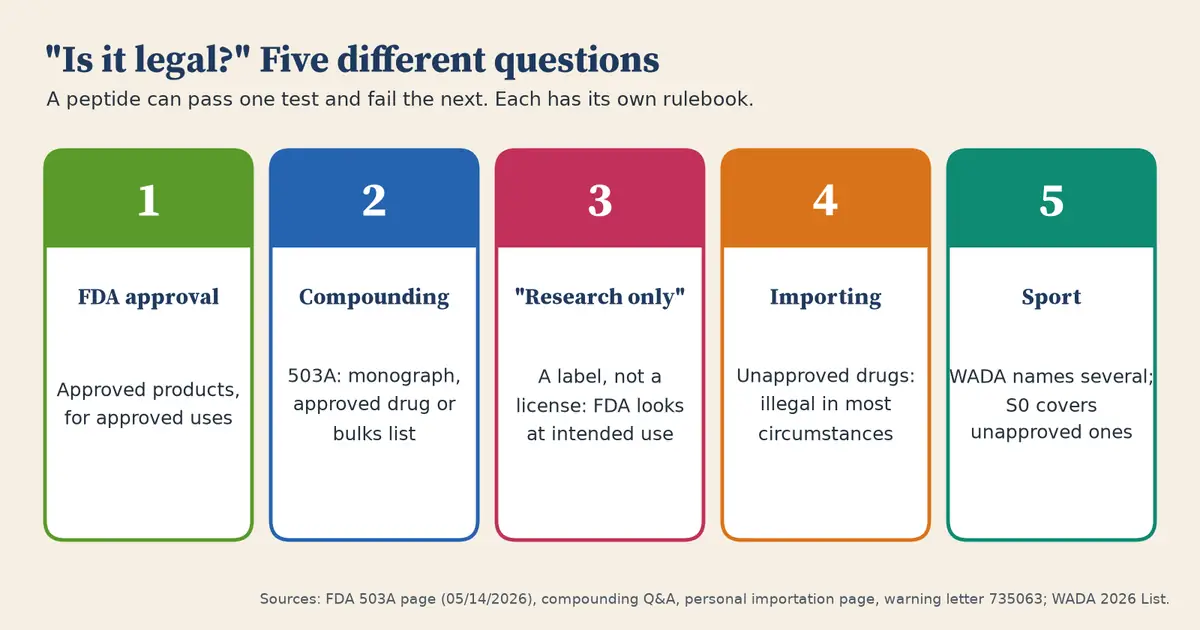
It's one of the most common questions about peptides, and it rarely gets a straight answer, because "legal" is doing several jobs at once. Is the peptide an approved medicine? Can a pharmacy make it? What about a vial labeled "for research use only," a package shipped from overseas, or a drug test at a weightlifting meet? Each has its own rulebook, and a peptide can pass one test and fail the next. Here are the five meanings, one at a time, using FDA's and WADAWorld Anti-Doping Agency: it publishes the yearly Prohibited List for tested sport. Glossary entry's own documents.
Facts are as of October 27, 2026. Sources, with retrieval dates, are at the bottom.
At a glance
- Plenty of peptides are fully approved prescription medicines in the U.S., including semaglutide (Wegovy), tirzepatide (Zepbound) and tesamorelin (Egrifta WR). [V]
- Compounding is a separate track. FDA states that compounded drugs are not FDA-approved, and pharmacies can only use bulk ingredients that meet one of three conditions. [V]
- A "for research use only" label doesn't settle anything. In 2026 warning letters, FDA treated research-labeled peptides as drugs for human use based on how they were marketed. [V]
- FDA says that in most circumstances it's illegal for individuals to import unapproved drugs for personal use. [V]
- Sport runs on its own list. WADA's 2026 Prohibited List names BPC-157, TB-500 and several growth-hormone signals. [V]
| The question | Answer | What the record shows |
|---|---|---|
| Is it an FDA-approved drug? | Depends on the peptide | Many peptide medicines carry FDA approvals and labels on DailyMed. Most wellness-discussed peptides, such as BPC-157, have none. [V] |
| Can a pharmacy compound it? | Only within FDA's lists | 503ASection of federal drug law covering compounding by state-licensed pharmacies and doctors, usually for a prescription written for one patient. Glossary entry pharmacies need the ingredient to meet a USP or NF monograph, be part of an approved drug, or be on the 503A bulks list. [V] |
| Does a "research use only" label make sales lawful? | Not by itself | FDA looks at intended use, and it has cited research-labeled peptides as unapproved new drugs. [V] |
| Can I bring it in from abroad? | Generally not, if unapproved | FDA says importing unapproved drugs for personal use is illegal in most circumstances. [V] |
| Is it allowed in tested sport? | Many are named | WADA's list names several peptides and also bans unapproved substances under S0. [V] |
1. Approved medicine: the clearest "yes"
The cleanest version of "legal" is an FDA approval. That covers a big and growing group of peptide medicines. Semaglutide, sold as Wegovy, and tirzepatide, sold as Zepbound, both have current FDA labels on DailyMed. [V] Tesamorelin, a growth-hormone-releasing peptide, was approved as Egrifta on November 10, 2010. [V] Insulin, the original peptide medicine, went from lab experiments in 1921 to its first human studies by January 1922, according to FDA's history office. [V] Our approved peptide medicines page covers that group in more detail.
An approval covers a specific product for specific uses. It doesn't stretch to other products sold under the same ingredient name, which is why FDA warned a seller in August 2026 about a research-labeled tesamorelin product even though Egrifta is approved. [V]
There's also a size rule worth knowing. Under 21 CFR 600.3, FDA defines a protein as an amino acid chain of more than 40 amino acids, and proteins are regulated as biologics. [V] FDA's compounding Q&A says biologics can't use the compounding exemptions at all. [V] Most peptides in the wellness conversation are well under 40 amino acids, so they're treated as ordinary drugs. Our peptide basics page explains the 40-amino-acid line.
2. Compounding: legal within a list
Compounding is when a licensed pharmacist or physician makes a drug for a patient instead of dispensing a mass-produced approved one. FDA's Q&A says plainly that "Compounded drugs are not FDA-approved," meaning FDA doesn't check their safety, effectiveness or quality before they're sold. [V] State boards of pharmacy handle most day-to-day oversight of regular pharmacies, according to the same page. [V]
For traditional (503A) pharmacies, a bulk ingredient has to clear one of three bars: it meets a USP or NF monograph, it's an ingredient in a drug FDA has already approved, or it's on FDA's 503A bulks list. [V] Most wellness peptides clear none of these, so their status runs through FDA's interim category system while the agency reviews nominations:
- Category 1An interim FDA group of nominated bulk ingredients that FDA generally does not object to pharmacies using while its review continues. Not an approval. Glossary entry substances can be compounded while FDA evaluates them, as long as the guidance conditions are met. FDA says it doesn't intend to take action in those cases. [V]
- Category 2An interim FDA group of nominated bulk ingredients that FDA has flagged for possible significant safety risks while its review continues. Glossary entry substances raised significant safety risks in FDA's view, so that policy doesn't apply to them. [V]
- Category 3 substances were nominated with too little information to evaluate, and FDA would consider action under its general policies. [V]
That's why a single peptide can be compoundable today and not tomorrow. GHK-Cu, for example, is in category 1 on the 503A list except for injectable routes, while 13 of 14 widely discussed peptides appear in FDA's category 2 table of withdrawn nominations. [V] FDA's July 2026 advisory committee voted in favor of six peptides, according to press reports, but those votes are advice to FDA, not changes to the lists. [S] A separate FDA "Interim Access Policy for Compounding Using Certain Peptides" has been under White House review since October 14, 2026, and its text isn't public. [V] Our category explainer walks through the categories, and the 14-peptide status table shows where each name sits.
Compounded drugs are not FDA-approved. [V]
3. "Research use only": a label, not a license
A lot of peptides online come with a line like "for research use only" or "not for human use." It's easy to read that as a legal category. FDA doesn't treat it as one. What matters is intended use, and FDA reads that from the whole picture: product pages, claims and what's sold alongside. [V]
In an August 24, 2026 warning letter, FDA wrote that despite "for research use only" and "not for human or veterinary use" statements, evidence from the seller's website showed the products were intended as drugs for human use. FDA called them unapproved new drugs. [V] Earlier 2026 letters made the same point about other research-labeled peptides. [V] Our marketing red flags page covers the patterns FDA cites.
4. Importing: generally not, for unapproved drugs
FDA's personal importation page says that in most circumstances bringing drugs into the U.S. for your own use is illegal for individuals, since drugs bought abroad often lack FDA approval. It adds that a drug approved in another country but not in the U.S. is still an unapproved new drug here. [V] That matters for peptides like thymosin alpha-1, which has approvals in several other countries but none in the U.S., as our thymosin alpha-1 page documents. [V] The page also describes limited situations where FDA may use discretion, which we leave to its own wording.
5. Sport: a separate rulebook
Anti-doping rules don't care about FDA approval in the same way. WADA's 2026 Prohibited List names BPC-157 under S0, the class for substances with no current government approval for human therapeutic use. It names TB-500 under S2.3, and CJC-1295, ipamorelin, sermorelin and tesamorelin under S2.2.4, all prohibited at all times. [V] So approval and sport status are separate questions: an approved medicine can still be banned, and S0 is defined by approval status rather than by a list of names. Our athletes page has a quick filter for 15 names, and it covers strict liability and medical exemptions.
What people get wrong
"It's sold openly online, so it must be legal." Being for sale and being lawful to sell are different things. FDA has sent warning letters to online sellers of research-labeled peptides in 2026. [V]
"Category 1 means FDA approved it." Category 1 means FDA doesn't intend to take action against compounding while it evaluates the substance. It's not an approval, and compounded drugs are not FDA-approved. [V]
"If my pharmacy makes it, it's an FDA-approved drug." FDA's own Q&A says compounded drugs are not FDA-approved. A pharmacy-made peptide is legal only within the compounding rules above. [V]
Limits and unknowns
This page describes federal FDA rules and the WADA list, not state law, and it isn't legal advice. Whether a specific product, purchase or use is lawful depends on the facts and on where you live. [U] FDA's interim category system can change at any time, and the interim access policy under White House review could change how some peptides are handled once it's published. [V] We haven't seen its text. [V]
Peptide Policy Watch
Are peptides legal in the US? Five things "legal" can mean
Printable checklist
Questions for your clinician
General questions drawn from this page, to take to a clinician or pharmacist who knows your health history.
- Is this an FDA-approved product, a compounded drug or something sold outside pharmacies?
- If it's compounded, which of FDA's three routes does the ingredient use?
- Has anything changed on FDA's category lists for this peptide this year?
- If I compete in tested sport, is it named on WADA's list or covered by S0?
Print view Select it, then use your browser’s Print command to print only this box.
What to watch next
Dates and decisions we're tracking
- PendingThe White House review of FDA's "Interim Access Policy for Compounding Using Certain Peptides" (RIN 0910-ZD94) [V]
- Before end of February 2027FDA's next compounding advisory committee meeting, with GHK-Cu and dihexa on the agenda [V]
- January 1, 2027WADA's 2027 Prohibited List takes effect [S]
For how these rules came together, see our regulation timeline. For a worked example of one peptide across every list, see Is BPC-157 FDA-approved?, and for the research side, BPC-157 in people.
Sources (retrieved October 27, 2026 unless noted)
- FDA, "Compounding and the FDA: Questions and Answers," current as of 09/16/2025 [V] — https://www.fda.gov/drugs/human-drug-compounding/compounding-and-fda-questions-and-answers
- FDA, "Bulk Drug Substances Used in Compounding Under Section 503A of the FD&C Act," current as of 05/14/2026 [V] — https://www.fda.gov/drugs/human-drug-compounding/bulk-drug-substances-used-compounding-under-section-503a-fdc-act
- FDA, 503A bulk drug substances category list (PDF), updated May 14, 2026 [V] — https://www.fda.gov/media/94155/download
- FDA, "Certain Bulk Drug Substances for Use in Compounding that May Present Significant Safety Risks" (category 2 page), current as of 04/22/2026 [V] — https://www.fda.gov/drugs/human-drug-compounding/certain-bulk-drug-substances-use-compounding-may-present-significant-safety-risks
- eCFR, 21 CFR 600.3, definitions, paragraph (h)(6) [V] — https://www.ecfr.gov/current/title-21/chapter-I/subchapter-F/part-600/subpart-A/section-600.3
- FDA, "Personal Importation," current as of 08/18/2025 [V] — https://www.fda.gov/industry/import-basics/personal-importation
- FDA, warning letter MARCS-CMS 735063, August 24, 2026 (retrieved October 26, 2026) [V] — https://www.fda.gov/inspections-compliance-enforcement-and-criminal-investigations/warning-letters/peptide-partners-llc-735063-08242026
- FDA, approval package for NDA 22-505, Egrifta (tesamorelin), approval date November 10, 2010 (retrieved October 26, 2026) [V] — https://www.accessdata.fda.gov/drugsatfda_docs/nda/2010/022505Orig1s000TOC.cfm
- DailyMed, WEGOVY (semaglutide) label, published June 30, 2026 (retrieved October 25, 2026) [V] — https://dailymed.nlm.nih.gov/dailymed/services/v2/spls/ee06186f-2aa3-4990-a760-757579d8f77b.xml
- DailyMed, ZEPBOUND (tirzepatide) label, set id 487cd7e7-434c-4925-99fa-aa80b1cc776b, published September 2, 2026 (retrieved October 25, 2026) [V] — https://dailymed.nlm.nih.gov/dailymed/services/v2/spls/487cd7e7-434c-4925-99fa-aa80b1cc776b.xml
- AJMC, "FDA Panel Backs 6 Peptides for Compounding," July 31, 2026 (retrieved October 26, 2026) [S] — https://www.ajmc.com/view/fda-panel-backs-6-peptides-for-compounding
- OMB/OIRA, pending EO 12866 regulatory review, RIN 0910-ZD94, received October 14, 2026 [V] — https://www.reginfo.gov/public/do/eoDetails?rrid=1568964
- FDA, "Meeting of the Pharmacy Compounding Advisory Committee," current as of 04/15/2026 [V] — https://www.fda.gov/advisory-committees/pharmacy-compounding-advisory-committee/meeting-pharmacy-compounding-advisory-committee
- FDA History Office, "100 Years of Insulin" (retrieved October 25, 2026) [V] — https://www.fda.gov/about-fda/fda-history-exhibits/100-years-insulin
- FDA, warning letter MARCS-CMS 721806, March 31, 2026 (retrieved October 26, 2026) [V] — https://www.fda.gov/inspections-compliance-enforcement-and-criminal-investigations/warning-letters/gram-peptides-721806-03312026
- FDA, warning letter MARCS-CMS 721600, March 31, 2026 (retrieved October 26, 2026) [V] — https://www.fda.gov/inspections-compliance-enforcement-and-criminal-investigations/warning-letters/mile-high-compounds-llc-721600-03312026
- WADA, 2026 Prohibited List [V] — https://www.wada-ama.org/sites/default/files/2025-09/2026list_en_final_clean_september_2025.pdf
Spot a mistake? See how we source and our corrections policy.