BPC-157 in people: the three published pilots and the first placebo-controlled trials
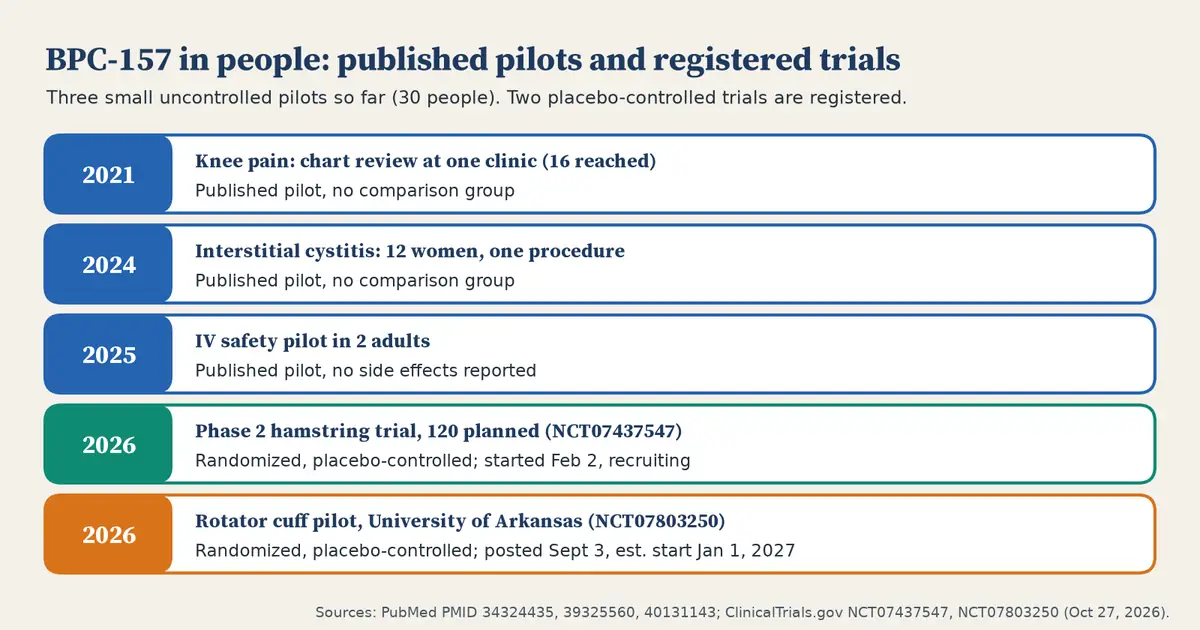
Ask how much human research there is on BPC-157 and you'll hear everything from "none" to "plenty." The honest count is small but no longer zero, and it's about to change shape. Three small pilot studies in people have been published since 2021, and two randomized, placebo-controlled trials are now on the federal trial registry, one of them already recruiting. Here's what each study did, what it reported and what the new trials are set up to measure.
Facts are as of October 27, 2026. Sources, with retrieval dates, are at the bottom.
At a glance
- The newest systematic reviewA review that collects studies on one question by a stated search method, often pooling their numbers. Glossary entry, published online October 8, 2026, counts three human studies of BPC-157 with 30 participants in total. [V]
- Those three pilots looked at knee pain, a painful bladder condition and short-term safety. Each reported mostly favorable results, and none had a placebo group. [V]
- A phase 2 randomized, double-blind, placebo-controlled trial in acute hamstring strains is recruiting, with 120 participants planned. [V]
- A university pilot trial after rotator cuff surgery, also randomized and placebo-controlled, is registered but not yet recruiting. [V]
- FDA has not approved BPC-157, and its safety concerns stay on the agency's category 2 page. [V]
How the human record has grown, one dot per study
- 1 clinical study among 36 in a 2025 systematic review (searches to June 3, 2024); the other 35 were cell or animal studies [V]
- 3 human studies, 30 people in total, in a 2026 systematic review (searches to June 1, 2026) [V]
- 2 randomized, placebo-controlled trials registered on ClinicalTrials.gov as of October 27, 2026, neither with results yet [V]
Dots count studies, not their quality or safety. Sources: Vasireddi and colleagues, HSS Journal, 2025; Poolton, Minett and Kazmi, Acta Orthopaedica Belgica, online October 8, 2026; ClinicalTrials.gov records NCT07437547 and NCT07803250.
Why the human count matters
Most of what's known about BPC-157 comes from cells and animals, which is early-stage research, the usual first step for any medicine. A 2025 systematic review in HSS Journal included 36 studies, and 35 of them were preclinicalResearch done before any testing in people, such as lab-dish and animal studies. Glossary entry. [V] Its authors wrote that the evidence "suggests that BPC-157 shows promise for promoting recovery from musculoskeletal injuries." [V] The step that turns promise into knowledge is a controlled human trial. That's the step BPC-157 is only now reaching. For how those rungs fit together, see our evidence ladder.
The three published pilots
All three appeared in the journal Alternative Therapies in Health and Medicine, and all three came from private clinics in Florida. [V] They are small human reports: useful for raising questions, not built to answer whether something works. A 2025 narrative review in Current Reviews in Musculoskeletal Medicine counted the same three pilots. [V]
Knee pain, 2021. Lee and Padgett reviewed one year of charts (2019 to 2020) at an Orlando clinic where patients had been given BPC-157 into the knee joint, some of them alongside thymosin beta-4. The team reached 16 of 17 patients by phone. Of the 12 who had BPC-157 alone, 11 reported significant improvement in knee pain, and 14 of the 16 overall reported relief. [V] The authors note that no specific tools were used to measure function or quality of life. [V] Evidence level: a retrospective chart review with phone follow-up, no comparison group.
Interstitial cystitis, 2024. Lee, Walker and Ayadi enrolled 12 women aged 39 to 76 with bladder pain syndrome who had not responded to pentosan polysulfate, an approved treatment. Each received BPC-157 around the inflamed area of the bladder during a single cystoscopy. Ten of the 12 reported complete resolution of symptoms, the other two rated their success at 80%, no one dropped out and no adverse events were reported. [V] The abstract says the BPC-157 was made by a 503ASection of federal drug law covering compounding by state-licensed pharmacies and doctors, usually for a prescription written for one patient. Glossary entry compounding pharmacy. [V] Evidence level: a small uncontrolled pilot study.
IV safety, 2025. Lee and Burgess gave BPC-157 by IV infusion to two adults, a 58-year-old man and a 68-year-old woman, both of whom had received it intravenously before. Blood work and vital signs were taken around each infusion. The authors reported no measurable effects on heart, liver, kidney or thyroid markers or on blood sugar, and no side effects. [V] Evidence level: a two-person safety pilot.
should not be used clinically in humans outside ethically approved, regulated, high-quality clinical trials [V]
Taken together, the newest review reports that the three studies found no treatment-related adverse events. The same authors judged the studies to be of poor methodological quality and rated the overall certainty of the evidence "very low." [V] Both things are true at once, and the second explains why the trials below matter.
The trials now on the registry
Hamstring strains, phase 2 (NCT07437547). This is the most ambitious BPC-157 study we've found on ClinicalTrials.gov. It's randomized, placebo-controlled and blinded for participants, clinicians, investigators and outcome assessors. Adults with an MRI-confirmed grade II hamstring strain get either BPC-157 or placebo, and both groups follow the same standardized rehab program. [V] The two main outcomes are days to return to unrestricted sport and the change in injury volume on MRI at Day 14, read by blinded central radiologists. [V] An industry sponsor runs it at a site in Shenzhen, China. It started February 2, 2026, plans to enroll 120 people and lists February 14, 2027 as the estimated primary completion date. [V]
Rotator cuff repair, phase 1 pilot (NCT07803250). The University of Arkansas registered a randomized, double-blind, placebo-controlled pilot in people recovering from arthroscopic rotator cuff surgery. Its main outcome is shoulder strength, and the team also plans MRI checks of tendon healing, patient-reported outcomes, range of motion and blood markers of collagen turnover and inflammation. [V] The record was first posted September 3, 2026, shows "not yet recruiting" and estimates a January 1, 2027 start. Its summary describes 20 patients, while the enrollment field lists an estimate of 30. [V] The study description says BPC-157 "has not yet been studied in formal human clinical trials." [V]
An older safety study (NCT02637284). A 2015 phase 1 record from a company sponsor describes a safety and pharmacokinetics study in healthy volunteers in Tijuana, Mexico, with adverse events as its main outcome. Its status is listed as unknown, the record was last updated in December 2015 and no results are posted. [V]
Claim
"There are no human studies of BPC-157."
What research shows
- Research record
A 2026 systematic review counts three published human studies with 30 participants, and two randomized, placebo-controlled trials are registered. [V]
What is unknown
How BPC-157 performs against placebo. None of the published studies had a placebo group, and neither registered trial has posted results. [V]
This card describes the kind of research that exists.
Where it stands with FDA and in sport
| The question | Answer | What the record shows |
|---|---|---|
| Is it FDA-approved? | No | We found no U.S. approval for BPC-157 in FDA's records. [V] |
| Where is it on FDA's compounding lists? | Category 2 page | The 503A nomination was withdrawn, and BPC-157 stays listed on FDA's page of substances that may present significant safety risks. [V] |
| Has the advisory committee reviewed it? | Yes, July 2026 | The Pharmacy Compounding Advisory Committee voted in favor, 8-6 with 1 abstention, according to press reports; votes are advice only. [S] |
| Is a new FDA policy pending? | Under White House review | FDA's "Interim Access Policy for Compounding Using Certain Peptides" was received for review on October 14, 2026. [V] |
| Is it on WADA's list? | Yes, S0 | The 2026 Prohibited List names BPC-157 in S0, prohibited at all times. [V] |
Running a trial is its own regulatory path. FDA explains that federal law requires an approved marketing application before a drug ships across state lines, and that an investigational new drug application (IND) is how a study sponsor gets an exemption from that rule. That route is separate from the compounding lists above. [V] We have not checked FDA filings for either registered trial, and ClinicalTrials.gov records don't by themselves show FDA clearance. For the full list-by-list story, see Is BPC-157 FDA-approved?.
Limits and unknowns
- None of the three published studies had a placebo or untreated comparison group, so none can show what would have happened without BPC-157. [V]
- The three pilots came from Florida clinics with overlapping authors, and the knee study relied on patients' phone recall rather than measured outcomes. [V]
- FDA's category 2 page lists concerns about possible immune reactions, peptide-related impurities and limited safety information, and says FDA "lacks sufficient information to know whether the drug would cause harm when administered to humans." [V]
- The HSS Journal review's authors flagged possible harms "due to unregulated manufacturing, contamination, or unknown clinical safety." [V]
- Registered trials can change design, slip their dates or end without publishing. The 2015 safety record is an example: no results have appeared on the registry. [V]
What people get wrong
"Ten of 12 patients were cured, so it works." That figure comes from an uncontrolled pilot in which patients rated their own symptoms. A placebo-controlled trial is what can test it. [V]
"The registered trials mean FDA is about to approve it." A registry entry describes a planned study. Approval requires an application and FDA review, and we found no BPC-157 application. [V]
Peptide Policy Watch
BPC-157 in people: the three published pilots and the first placebo-controlled trials
Printable checklist
Questions for your clinician
General questions drawn from this page, to take to a clinician or pharmacist who knows your health history.
- Which human studies support the use being discussed, and did any of them have a placebo group?
- Is the product part of a registered trial, a compounded prescription or something sold outside pharmacies?
- What does FDA's category 2 listing mean for how a pharmacy can handle BPC-157 today?
- If I compete in tested sport, what does an S0 listing mean for me?
Print view Select it, then use your browser’s Print command to print only this box.
What to watch next
Dates and decisions we're tracking
- February 14, 2027Estimated primary completion of the phase 2 hamstring trial, NCT07437547 [V]
- January 1, 2027Estimated start of the rotator cuff pilot, NCT07803250 [V]
- PendingThe White House review of FDA's interim access policy for compounding certain peptides [V]
- PendingWhether FDA acts on the July 2026 advisory committee votes [V]
BPC-157 is often discussed alongside TB-500, and our Wolverine stack page covers that pairing. The 14-peptide status table sets BPC-157 beside the other names in FDA's review, and our legal explainer sorts out the different things "legal" can mean.
Sources (retrieved October 27, 2026 unless noted)
- Poolton JT, Minett J, Kazmi A, "Human evidence for BPC-157 in orthopaedic and regenerative medicine," Acta Orthopaedica Belgica 92(3), online October 8, 2026 (abstract, retrieved October 25, 2026) [V] — https://doi.org/10.52628/92.3.15837
- Vasireddi N, et al., "Emerging Use of BPC-157 in Orthopaedic Sports Medicine: A Systematic Review," HSS Journal 21(4):485-495, 2025 (abstract on PubMed, retrieved October 25, 2026) [V] — https://pubmed.ncbi.nlm.nih.gov/40756949/
- Lee E, Padgett B, "Intra-Articular Injection of BPC 157 for Multiple Types of Knee Pain," Altern Ther Health Med 27(4):8-13, 2021 (abstract on PubMed) [V] — https://pubmed.ncbi.nlm.nih.gov/34324435/
- Lee E, Walker C, Ayadi B, "Effect of BPC-157 on Symptoms in Patients with Interstitial Cystitis: A Pilot Study," Altern Ther Health Med 30(10):12-17, 2024 (abstract on PubMed) [V] — https://pubmed.ncbi.nlm.nih.gov/39325560/
- Lee E, Burgess K, "Safety of Intravenous Infusion of BPC157 in Humans: A Pilot Study," Altern Ther Health Med 31(5):20-24, 2025 (abstract on PubMed) [V] — https://pubmed.ncbi.nlm.nih.gov/40131143/
- McGuire FP, et al., BPC-157 narrative review, Current Reviews in Musculoskeletal Medicine, published August 12, 2025 (full text, retrieved October 25, 2026) [V] — https://pmc.ncbi.nlm.nih.gov/articles/PMC12446177/
- ClinicalTrials.gov, NCT07437547, "BPC 157 for Acute Hamstring Muscle Strain Repair," last updated February 27, 2026 [V] — https://clinicaltrials.gov/study/NCT07437547
- ClinicalTrials.gov, NCT07803250, "Impact of BPC-157 on Recovery Following Rotator Cuff Repair Surgery," first posted September 3, 2026 [V] — https://clinicaltrials.gov/study/NCT07803250
- ClinicalTrials.gov, NCT02637284, "PCO-02 - Safety and Pharmacokinetics Trial," last updated December 2015 [V] — https://clinicaltrials.gov/study/NCT02637284
- FDA, "Certain Bulk Drug Substances for Use in Compounding that May Present Significant Safety Risks" (category 2 page), current as of 04/22/2026 [V] — https://www.fda.gov/drugs/human-drug-compounding/certain-bulk-drug-substances-use-compounding-may-present-significant-safety-risks
- FDA, "Meeting of the Pharmacy Compounding Advisory Committee," current as of 04/15/2026 [V] — https://www.fda.gov/advisory-committees/pharmacy-compounding-advisory-committee/meeting-pharmacy-compounding-advisory-committee
- AJMC, "FDA Panel Backs 6 Peptides for Compounding," July 31, 2026 (retrieved October 26, 2026) [S] — https://www.ajmc.com/view/fda-panel-backs-6-peptides-for-compounding
- OMB/OIRA, pending EO 12866 regulatory review, RIN 0910-ZD94, received October 14, 2026 [V] — https://www.reginfo.gov/public/do/eoDetails?rrid=1568964
- FDA, "Investigational New Drug (IND) Application," current as of 09/16/2026 [V] — https://www.fda.gov/drugs/types-applications/investigational-new-drug-ind-application
- WADAWorld Anti-Doping Agency: it publishes the yearly Prohibited List for tested sport. Glossary entry, 2026 Prohibited List [V] — https://www.wada-ama.org/sites/default/files/2025-09/2026list_en_final_clean_september_2025.pdf
Spot a mistake? See how we source and our corrections policy.