Tesamorelin: the FDA-approved growth-hormone-releasing peptide, its trials and the rules around it
Scroll any thread about growth-hormone peptides and tesamorelin turns up next to names like sermorelin and CJC-1295. It is the odd one out in that list: a peptide with an FDA approval, a full prescribing label and more than one large randomized trial behind it. What did those trials measure, what does the label say, and why did FDA still send a warning letter about it this year?
This page leads with what the research reports, then covers the regulatory record. Both get equal room.
Facts are as of October 26, 2026. Sources, with retrieval dates, are at the bottom.
At a glance
- Tesamorelin is the full 44-amino-acid chain of human growth-hormone-releasing hormone (GHRH) with a small chemical cap added to one end, according to its label. It signals the pituitary to release the body's own growth hormone. [V]
- FDA approved it as Egrifta on November 10, 2010, to reduce extra abdominal fat in adults living with HIV and lipodystrophy. Two newer versions, Egrifta SV and Egrifta WR, carry current labels on DailyMed. [V]
- In two phase 3 trials with 806 people randomized in total, visceral (deep belly) fat fell on tesamorelin and the reduction held through 52 weeks for those who stayed on it. [V]
- Later randomized trials reported less liver fat in people with HIV, and a 20-week trial in older adults reported a favorable effect on a cognition score. [V]
- WADA names tesamorelin on its 2026 Prohibited List, banned at all times. An FDA warning letter in August 2026 called a research-labeled tesamorelin product an unapproved new drug. [V]
- 806adults with HIV randomized across the two phase 3 trials [V]
- -15.2% vs +5.0%change in visceral fat on tesamorelin versus placebo at 26 weeks, first phase 3 trial [V]
- 24tesamorelin studies on ClinicalTrials.gov, two of them recruiting [V]
The science: what the research reports
How it works. GHRH is the hypothalamus's signal to the pituitary to make growth hormone. Tesamorelin binds the same receptor with similar strength to the body's own GHRH, according to the label, and the added cap slows its breakdown. The result is more growth hormone and more IGF-1, the growth signal made mostly by the liver. [V] For how this route differs from taking growth hormone itself, see our sermorelin and growth hormone page.
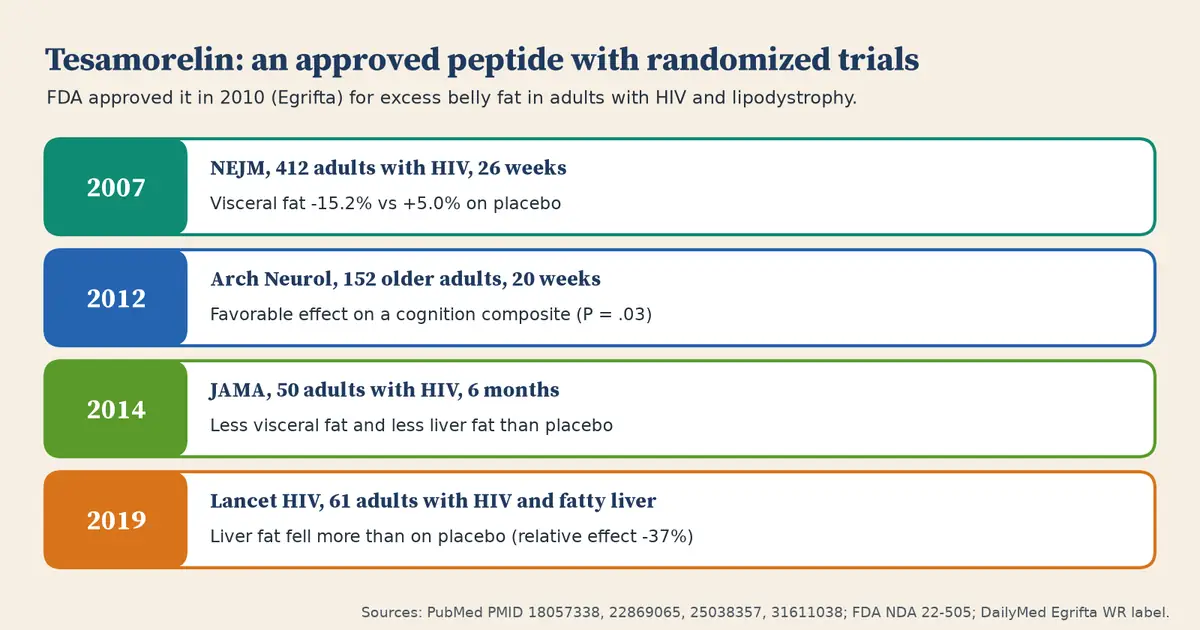
Belly fat in HIV, the approval trials. The first phase 3 trial, published in the New England Journal of Medicine in 2007, randomized 412 adults with HIV and extra abdominal fat. After 26 weeks, visceral fat had dropped 15.2% on tesamorelin and risen 5.0% on placebo, triglycerides fell, and IGF-1 rose 81%. [V] A pooled analysis of both phase 3 trials in the Journal of Clinical Endocrinology & Metabolism (2010) covered 806 randomized adults. Visceral fat fell about 15% more than on placebo, fat under the skin of the belly stayed about the same, and people's ratings of their own belly appearance improved. The fall in visceral fat held at 52 weeks, without clinically meaningful changes in blood sugar. [V] In the extension phases, fat came back in people switched to placebo. [V]
Liver fat. A 2014 JAMA trial of 50 adults with HIV found that six months of tesamorelin reduced both visceral fat and liver fat compared with placebo. [V] A 2019 Lancet HIV trial then focused on 61 adults with HIV and nonalcoholic fatty liver disease. Over 12 months, liver fat fraction fell 4.1 percentage points more than on placebo, a 37% relative reduction, and 35% of the tesamorelin group got below the 5% fatty-liver threshold, against 4% on placebo. Fasting glucose and HbA1c did not differ between groups. [V] The trial was funded by the National Institutes of Health. [V]
Pulling the trials together. A 2026 meta-analysis of five randomized trials in Obesity Research & Clinical Practice found less visceral fat, trunk fat, liver fat and waist size, plus about 1.4 kg more lean mass, with no significant glucose change. BMI and fat under the skin did not change significantly. [V]
Beyond HIV: cognition. In a 2012 Archives of Neurology trial, 152 adults aged 55 to 87, including 66 with mild cognitive impairment, received tesamorelin or placebo for 20 weeks. The tesamorelin group had a favorable effect on a cognition composite (P = .03), mostly from executive-function tests. [V] It is one trial and has not led to an approved use, but it is a randomized human result, higher on the evidence ladder than most peptides in the news.
What is being studied now. ClinicalTrials.gov lists 24 tesamorelin studies. Two were recruiting as of October 26, 2026: one on recovery after peripheral nerve injury (NCT03150511) and one pairing tesamorelin with exercise to improve physical function in people with HIV (NCT06554717). [V]
The regulatory record
| The question | Answer | What the record shows |
|---|---|---|
| Is it an FDA-approved drug? | Yes, for one use | Approved November 10, 2010 (NDA 22-505) to reduce extra belly fat in adults with HIV-related lipodystrophy. Current Egrifta WR label revised March 2025. [V] |
| Where is it on FDA's lists? | Not on the category lists | Tesamorelin is not named on FDA's 503ASection of federal drug law covering compounding by state-licensed pharmacies and doctors, usually for a prescription written for one patient. category list (May 14, 2026) or its category 2 page (April 22, 2026), as searched. [V] |
| Has the advisory committee reviewed it? | No | It was not on the July 2026 agenda or the later agenda FDA has announced. [V] |
| Is it on WADA's prohibited list? | Yes, by name | The 2026 list names tesamorelin under S2.2.4 (growth-hormone-releasing factors), prohibited at all times. [V] |
What the label limits. The Egrifta WR label says it is not indicated for weight loss because its effect on weight is neutral, that long-term cardiovascular safety has not been established, and that there are no data on better adherence to HIV medicines. It also says it is not for children. [V]
Compounding. Under section 503A, one of the three routes for a bulk ingredient is being a component of an FDA-approved drug. Tesamorelin is the active ingredient of Egrifta, so it falls under that approved-drug route rather than the bulks-list review that unapproved peptides face. [V] FDA also states that compounded drugs are not FDA-approved. [V]
Research-labeled products. In an August 24, 2026 warning letter, FDA told an online seller that its tesamorelin product, along with several GLP-1 and other peptide products, was an unapproved new drug, and quoted the seller's website text about liver research as evidence of intended use. [V] The approval covers Egrifta made under its application; it does not extend to other products sold under the same ingredient name. [V] Our GLP-1 page explains the approved, compounded and research-labeled split in more detail.
Limits and unknowns
- The label's warnings include possible growth of existing tumors, raised IGF-1 that should be monitored, fluid retention (swelling, joint pain, carpal tunnel symptoms), glucose intolerance, allergic reactions and reactions where the shot goes in. It is contraindicated in pregnancy and in people with active cancer or a disrupted hypothalamic-pituitary axis. [V]
- The most common side effects on the label, each above 5%, include joint pain, redness and itching at the skin site, limb pain, swelling and muscle pain. [V]
- In the original-formulation trials, about half of the people treated developed antibodies to tesamorelin, according to the label. [V]
- The approval trials studied adults with HIV. Results in other groups, such as people without HIV or with fatty liver alone, rest on smaller or ongoing studies. [V]
- Benefits on visceral fat faded after stopping in the extension phases. [V]
- The 2007 trial reported more withdrawals because of adverse events on tesamorelin than on placebo. [V]
What people get wrong
Claim
"Tesamorelin is FDA-approved, so any tesamorelin product is approved."
What research shows
- Regulatory record
FDA approved Egrifta for one use in adults with HIV and lipodystrophy. In 2026 it called a research-labeled tesamorelin product an unapproved new drug. [V]
What is unknown
Nothing about the approval itself; what matters is which product and which use. [V]
This card describes the kind of research that exists.
What people get wrong
"Tesamorelin is a weight-loss drug." Its label says it is not indicated for weight loss and has a weight-neutral effect. What the trials measured was visceral fat, the fat around the organs. [V]
"It's only been tested in rats." Tesamorelin has more randomized human trials than most peptides in the news, including two phase 3 trials with 806 people. [V]
Why it matters
Tesamorelin is a working example of the GHRH idea that many peptide conversations circle around. A peptide that nudges the body's own growth-hormone system went through phase 3 trials, earned an FDA approval, and has kept producing randomized results on liver fat and an early cognition signal. It also shows the line FDA draws: the approved product for its approved use on one side, and research-labeled sales of the same ingredient name on the other.
Questions to bring to a clinician or pharmacist
- Is the product the FDA-approved Egrifta, or something else sold under the tesamorelin name?
- What do the label's warnings on IGF-1, glucose and cancer history mean for someone with my history?
- What did the liver-fat trials measure, and in which patients?
- If I compete in tested sport, what does WADA's S2.2.4 listing mean for me?
What to watch next
Dates and decisions we're tracking
- PendingResults from the recruiting nerve-injury study NCT03150511 [V]
- PendingResults from the exercise and physical-function study in HIV, NCT06554717 [V]
- PendingThe White House review of FDA's "Interim Access Policy for Compounding Using Certain Peptides" [V]
- January 1, 2027WADA's 2027 Prohibited List takes effect; check the S2 entries again [S]
For all 14 peptides in the current FDA review, see the status table. The CJC-1295 and ipamorelin page covers two unapproved growth-hormone signals, and the approved peptide medicines page sets tesamorelin beside other approved peptides.
Sources (retrieved October 26, 2026 unless noted)
- DailyMed, EGRIFTA WR (tesamorelin) label, set id 839334d3-8c1d-4c26-9036-2ab524a6ea75, revised 03/2025 [V] — https://dailymed.nlm.nih.gov/dailymed/drugInfo.cfm?setid=839334d3-8c1d-4c26-9036-2ab524a6ea75
- DailyMed, EGRIFTA SV (tesamorelin) label listing [V] — https://dailymed.nlm.nih.gov/dailymed/search.cfm?labeltype=all&query=egrifta
- FDA, approval package for NDA 22-505, Egrifta (tesamorelin), approval date November 10, 2010 [V] — https://www.accessdata.fda.gov/drugsatfda_docs/nda/2010/022505Orig1s000TOC.cfm
- Falutz J, et al., "Metabolic effects of a growth hormone-releasing factor in patients with HIV," New England Journal of Medicine, 2007 (abstract on PubMed) [V] — https://pubmed.ncbi.nlm.nih.gov/18057338/
- Falutz J, et al., pooled analysis of two phase 3 trials of tesamorelin, Journal of Clinical Endocrinology & Metabolism, 2010 (abstract on PubMed) [V] — https://pubmed.ncbi.nlm.nih.gov/20554713/
- Dhillon S, "Tesamorelin: a review of its use in the management of HIV-associated lipodystrophy," Drugs, 2011 (abstract on PubMed) [V] — https://pubmed.ncbi.nlm.nih.gov/21668043/
- Stanley TL, et al., tesamorelin and liver fat in HIV, JAMA, 2014 (abstract on PubMed) [V] — https://pubmed.ncbi.nlm.nih.gov/25038357/
- Stanley TL, et al., tesamorelin in HIV and nonalcoholic fatty liver disease, Lancet HIV, 2019 (abstract on PubMed) [V] — https://pubmed.ncbi.nlm.nih.gov/31611038/
- Badran AS, et al., meta-analysis of randomized trials of tesamorelin in HIV-associated lipodystrophy, Obesity Research & Clinical Practice, 2026 (abstract on PubMed) [V] — https://pubmed.ncbi.nlm.nih.gov/41545261/
- Baker LD, et al., GHRH effects on cognition in adults with mild cognitive impairment and healthy older adults, Archives of Neurology, 2012 (abstract on PubMed) [V] — https://pubmed.ncbi.nlm.nih.gov/22869065/
- ClinicalTrials.gov, search for tesamorelin (24 studies), and records NCT03150511 and NCT06554717 [V] — https://clinicaltrials.gov/search?intr=tesamorelin
- FDA, warning letter to Peptide Partners LLC, MARCS-CMS 735063, August 24, 2026 [V] — https://www.fda.gov/inspections-compliance-enforcement-and-criminal-investigations/warning-letters/peptide-partners-llc-735063-08242026
- FDA, 503A bulk drug substances category list (PDF), updated May 14, 2026 [V] — https://www.fda.gov/media/94155/download
- FDA, "Certain Bulk Drug Substances for Use in Compounding that May Present Significant Safety Risks" (category 2 page), current as of 04/22/2026 [V] — https://www.fda.gov/drugs/human-drug-compounding/certain-bulk-drug-substances-use-compounding-may-present-significant-safety-risks
- FDA, "Compounding and the FDA: Questions and Answers," current as of 09/16/2025 [V] — https://www.fda.gov/drugs/human-drug-compounding/compounding-and-fda-questions-and-answers
- FDA, "Meeting of the Pharmacy Compounding Advisory Committee," current as of 04/15/2026 [V] — https://www.fda.gov/advisory-committees/pharmacy-compounding-advisory-committee/meeting-pharmacy-compounding-advisory-committee
- WADA, 2026 Prohibited List, text read in full [V] — https://www.wada-ama.org/sites/default/files/2025-09/2026list_en_final_clean_september_2025.pdf
- OMB/OIRA, pending EO 12866 regulatory review, RIN 0910-ZD94, received October 14, 2026 [V] — https://www.reginfo.gov/public/do/eoDetails?rrid=1568964
Spot a mistake? See how we source and our corrections policy.