Semaglutide, the peptide everyone has heard of: approved, compounded, or sold "for research"
Is semaglutide a peptide? Yes. The Wegovy label calls it a GLP-1 receptor agonist, and the molecule is a modified chain of amino acids built on a backbone made by yeast fermentation. So when people say they're "on a peptide," a GLP-1 drug is often what they mean.
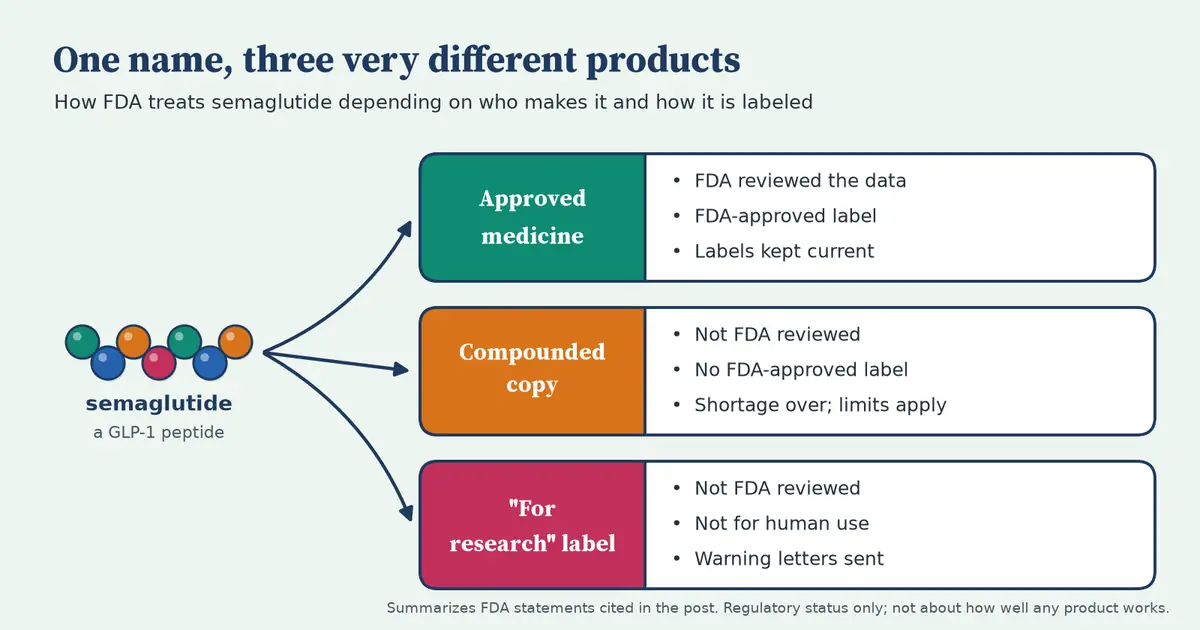
That raises a more useful question. Which version? The same ingredient name can sit on an FDA-approved pen, a pharmacy-compounded product, or a vial labeled "for research purposes." Federal agencies treat those three very differently.
Facts are as of October 26, 2026. Sources, with retrieval dates, are at the bottom.
The gist
- Approved semaglutide and tirzepatide medicines went through FDA review; compounded versions did not. [V]
- The shortages that opened the door to mass compounding were declared over in December 2024 (tirzepatide) and February 2025 (semaglutide). [V]
- FDA has warned firms selling GLP-1 drugs labeled "for research purposes" or "not for human consumption" to consumers. [V]
Why so many versions exist
Start with how common these drugs have become. In a KFF poll fielded from late October to early November 2025, 12% of US adults said they were currently taking a GLP-1 drug and 18% said they had taken one at some point. Among people who had used one, 76% said a doctor of theirs provided it, 17% named an online provider or website, and 9% a medical spa or aesthetic center. [V]
Demand like that is part of the backstory. Federal law usually bars pharmacies from making copies of approved drugs, but there's room when a drug is on FDA's shortage list. Semaglutide was in shortage from 2022 until FDA said it was resolved on February 21, 2025; FDA called the tirzepatide shortage resolved on December 19, 2024. [V] After that, FDA gave compounders wind-down periods. For semaglutide copies, they ended on April 22, 2025 for state-licensed pharmacies and May 22, 2025 for outsourcing facilities. [V]
Three versions, side by side
| Approved medicine | Compounded version | "Research" labeled | |
|---|---|---|---|
| FDA reviewed it before sale | Yes [V] | No [V] | No [V] |
| FDA-approved label | Yes [V] | No [V] | No [V] |
| What FDA has said lately | Labels updated on DailyMed [V] | Limits on copies; a proposal to drop these drugs from the outsourcing list [V] | Warning letters; "falsely labeled" in FDA's words [V] |
Approved. Wegovy (semaglutide) and Zepbound (tirzepatide) each have an FDA-approved label, which lists the uses FDA approved and the warnings. [V]
Compounded. FDA's GLP-1 page says compounded drugs are not FDA approved, so the agency doesn't review their safety, effectiveness or quality before sale. [V] It also says a compounded drug can make sense when a patient's need can't be met by an approved drug. [V] Since the shortages ended, FDA has said it may treat a compounded product as "essentially a copy" if it uses the same ingredient at a strength within about 10% of the approved product. That even covers semaglutide combined with vitamin B12. [V] FDA has said it doesn't intend to act when a compounder fills four or fewer such prescriptions in a calendar month. [V]
"Research" labeled. This is the version that most often turns up in peptide chat. FDA says it has warned companies that sold semaglutide, tirzepatide, retatrutide, survodutide or mazdutide labeled "for research purposes" or "not for human consumption," and that these were sold straight to consumers with use directions. [V]
- 990adverse-event reports FDA had received for compounded semaglutide as of May 31, 2026 [V]
- 730+reports for compounded tirzepatide by the same date [V]
- 2resolved shortages: tirzepatide (Dec. 19, 2024) and semaglutide (Feb. 21, 2025) [V]
FDA adds two cautions about those counts. Pharmacies that aren't outsourcing facilities aren't required to send it adverse-event reports, so the real numbers are probably higher. And a report doesn't prove the drug caused the problem. [V]
The outsourcing-list proposal
Outsourcing facilities (called 503BSection of federal drug law for outsourcing facilities: larger compounders that register with FDA and must follow drug-manufacturing quality rules. facilities, after the section of the law) can make drugs from bulk ingredients on a list FDA keeps for substances with a "clinical need." On April 30, 2026, FDA said it proposed leaving semaglutide, tirzepatide and liraglutide off that list, finding no clinical need. [V] The Federal Register notice ran May 1, 2026 (91 FR 23431), with comments due June 30. [V] A June 26 notice extended the comment period to July 30, 2026. [V] In our search of the Federal Register docket, we found no final determination published after that. [V]
What people get wrong
Claim
"A compounded or 'research' version is the same drug as the brand, just cheaper."
What research shows
- None (a question about regulatory status)
FDA says compounded drugs are not FDA approved and are not reviewed for quality before sale. It also says salt forms like semaglutide sodium or acetate count as separate active ingredients, not the one in approved drugs. [V]
What is unknown
What any single product contains. The FDA pages cited here describe categories and warning letters, not a specific item.
This card describes the kind of research that exists.
Another mix-up: "retatrutide is just the next semaglutide, so pharmacies can make it." FDA says retatrutide and cagrilintide can't be used in compounding under federal law. It adds that neither is part of any approved drug, and FDA has not found either one safe and effective for treating anything. [V]
Why it matters
The ingredient name tells you very little. Whether FDA reviewed the product, whether it has an approved label, and who answers for its quality depend on which of the three versions you're looking at. FDA's own checklist of telehealth warning signs includes a company saying its compounded drug is the same as an approved one, prices that look too good to be true, and no screening by a licensed doctor before a prescription. [V]
Questions to bring to a clinician or pharmacist
- Is this the FDA-approved product, or a compounded one? If compounded, which pharmacy made it, and is it a 503ASection of federal drug law covering compounding by state-licensed pharmacies and doctors, usually for a prescription written for one patient. pharmacy or a 503B outsourcing facility?
- What makes a compounded version appropriate in my case rather than the approved drug?
- Is the active ingredient the same one used in the approved drug, or a salt form?
- Who do I contact with questions after it arrives?
What to watch next
FDA's final decision on the 503B list proposal, which we'll report once it appears in the Federal Register. Eli Lilly reports quarterly results on October 29, 2026 [V]; we follow retatrutide for regulatory milestones, such as an FDA filing. For the bigger picture, see our approved vs. wellness peptides comparison and our telehealth explainer.
Sources (all retrieved October 26, 2026)
- DailyMed, WEGOVY (semaglutide) label, set id ee06186f-2aa3-4990-a760-757579d8f77b, version 19 [V] — https://dailymed.nlm.nih.gov/dailymed/services/v2/spls/ee06186f-2aa3-4990-a760-757579d8f77b.xml
- KFF, "Poll: 1 in 8 Adults Say They Are Currently Taking a GLP-1 Drug...," November 14, 2025 (fielded Oct. 27–Nov. 2, 2025; 1,350 adults) [V] — https://www.kff.org/public-opinion/poll-1-in-8-adults-say-they-are-currently-taking-a-glp-1-drug-for-weight-loss-diabetes-or-another-condition-even-as-half-say-the-drugs-are-difficult-to-afford/
- FDA, "FDA clarifies policies for compounders as national GLP-1 supply begins to stabilize," content current as of 04/01/2026 [V] — https://www.fda.gov/drugs/drug-alerts-and-statements/fda-clarifies-policies-compounders-national-glp-1-supply-begins-stabilize
- FDA, "FDA's Concerns with Unapproved GLP-1 Drugs Used for Weight Loss," content current as of 10/01/2026 [V] — https://www.fda.gov/drugs/drug-alerts-and-statements/fdas-concerns-unapproved-glp-1-drugs-used-weight-loss
- FDA, "FDA Proposes to Exclude Semaglutide, Tirzepatide, and Liraglutide on 503B Bulks List," April 30, 2026 [V] — https://www.fda.gov/news-events/press-announcements/fda-proposes-exclude-semaglutide-tirzepatide-and-liraglutide-503b-bulks-list
- Federal Register, 91 FR 23431, May 1, 2026, Docket FDA-2018-N-3240 [V] — https://www.federalregister.gov/documents/2026/05/01/2026-08552/list-of-bulk-drug-substances-for-which-there-is-a-clinical-need-under-section-503b-of-the-federal
- Federal Register, extension of comment period, June 26, 2026 [V] — https://www.federalregister.gov/documents/2026/06/26/2026-12937/list-of-bulk-drug-substances-for-which-there-is-a-clinical-need-under-section-503b-of-the-federal
- DailyMed, ZEPBOUND (tirzepatide) label, set id 487cd7e7-434c-4925-99fa-aa80b1cc776b, version 40 [V] — https://dailymed.nlm.nih.gov/dailymed/services/v2/spls/487cd7e7-434c-4925-99fa-aa80b1cc776b.xml
- Eli Lilly investor relations home page, for the October 29, 2026 earnings date [V] — https://investor.lilly.com/
Spot a mistake? See how we source and our corrections policy.