"Research use only," "not for human consumption" and other peptide label lines, decoded
Pick up almost any peptide product and the small print does a lot of talking. One vial says "For research use only." Another says "Not for human consumption." A pharmacy bag says "This is a compounded drug." A website promises an "FDA-registered facility." Some of those lines come straight from federal law and carry real meaning. Others are phrases sellers chose for themselves. Here's which is which, using the regulations and FDA's own letters.
Facts are as of October 28, 2026. Sources, with retrieval dates, are at the bottom.
The gist
- "For Research Use Only" is an official FDA phrase, but its home in the regulations is lab diagnostic products, not medicines for people. [V]
- FDA decides what a product is by its intended use, read from claims, advertising and the circumstances of sale, so a disclaimer line doesn't settle the question. [V]
- In 2026 warning letters, FDA treated peptides labeled "research use only" and "not for human consumption" as drugs for human use because of how they were marketed. [V]
- Some label lines do carry legal weight: the investigational-drug caution used in clinical trials, and the "This is a compounded drug" statement on outsourcing-facility products. [V]
- 4label lines on this page that come from federal law or regulation [V]
- 22026 FDA warning letters we read that rejected a "research use only" label [V]
- 0federal drug rules we found that define "not for human consumption" [U]
Label lines that come from the law
Start with the lines that mean exactly what they say, because they mark the official routes peptides reach people through.
"Caution: New Drug—Limited by Federal (or United States) law to investigational use." This is the required label on an investigational drug for human use, under 21 CFR 312.6. [V] It's what you'd see on a peptide being tested in a registered clinical trial. The same rule bars that label from calling the drug safe or effective for what it's being studied for. [V] It's a sign the product is inside the trial system, the route every approved peptide medicine has taken.
"This is a compounded drug." Federal law requires that statement, or a comparable one FDA accepts, on drugs made by 503BSection of federal drug law for outsourcing facilities: larger compounders that register with FDA and must follow drug-manufacturing quality rules. Glossary entry outsourcing facilities. The label also has to list the facility's name, address and phone number, a lot number, the compounding date, an expiration date and the line "Not for resale." [V] Drugs sent out without a prescription for a named patient must also say "Office Use Only." [V] FDA notes that compounded drugs aren't FDA-approved, meaning the agency doesn't check their safety, effectiveness or quality before they're marketed. [V] Compounding is still a legitimate, regulated route, and it's where FDA's current peptide decisions are playing out. Our category 1 and 2 explainer covers which peptides FDA's lists allow.
"FDA-approved." This one should be checkable. Approved drugs are listed in FDA's Drugs@FDA database, and a short list of peptide medicines, from insulin to the GLP-1 drugs, is there. Our approved versus wellness peptides comparison names them.
"For research use only": real phrase, different product
The exact words "For Research Use Only" do appear in FDA's regulations, in 21 CFR 809.10, the labeling rule for in vitroDone in a dish or test tube, using cells or tissue outside a living body. Glossary entry diagnostic products. Those are lab tests and reagents used on samples, not drugs taken by people. A diagnostic product still in the lab research phase must carry the statement "For Research Use Only. Not for use in diagnostic procedures." [V] FDA has a separate guidance on when diagnostic products are properly labeled that way. [V]
So the phrase has a narrow, legitimate job. It tells a lab that a test kit hasn't been validated for diagnosing patients. Printed on a peptide vial, it doesn't create a separate legal category for the peptide inside.
What FDA actually looks at: intended use
The key rule is intended use. Under 21 CFR 201.128, what a product is "intended" for is judged by the objective intent of the people responsible for it. That can be shown by labeling claims, advertising, oral or written statements, or the circumstances of distribution. [V] In practice, that means FDA reads the whole sales picture, not one line of fine print.
FDA has applied that test to peptides this year. In a March 31, 2026 warning letter to an online peptide seller, it noted the products were labeled "Research Use Only" and "not intended for human consumption, medical use, or veterinary use." It still concluded, from the seller's website, that they were intended as drugs for human use. [V] An August 24, 2026 letter to another seller reached the same conclusion despite "for research use only" and "not for human or veterinary use" statements. FDA pointed to the site's drug claims and to companion products it said made human use possible. [V] Our marketing red-flags guide walks through what those letters cited.
"Not for human consumption" and "for laboratory use"
We didn't find "not for human consumption" defined anywhere in FDA's drug regulations. [U] It's a seller's disclaimer, not a status FDA grants. FDA's letters treat it the same way they treat the research-use line: one piece of evidence among many, outweighed when the rest of the marketing points to people. [V]
"Made in an FDA-registered facility"
Registration is real, but it means less than it sounds. Under 21 CFR 207.77, registering a facility or listing a drug "does not denote approval" of the facility or the drug, and doesn't mean the product may be legally marketed. [V] The same rule goes further. A claim suggesting a drug is approved or legally sold because of registration, a listing or a National Drug Code is misleading, and it counts as misbranding. [V]
Quick decoder
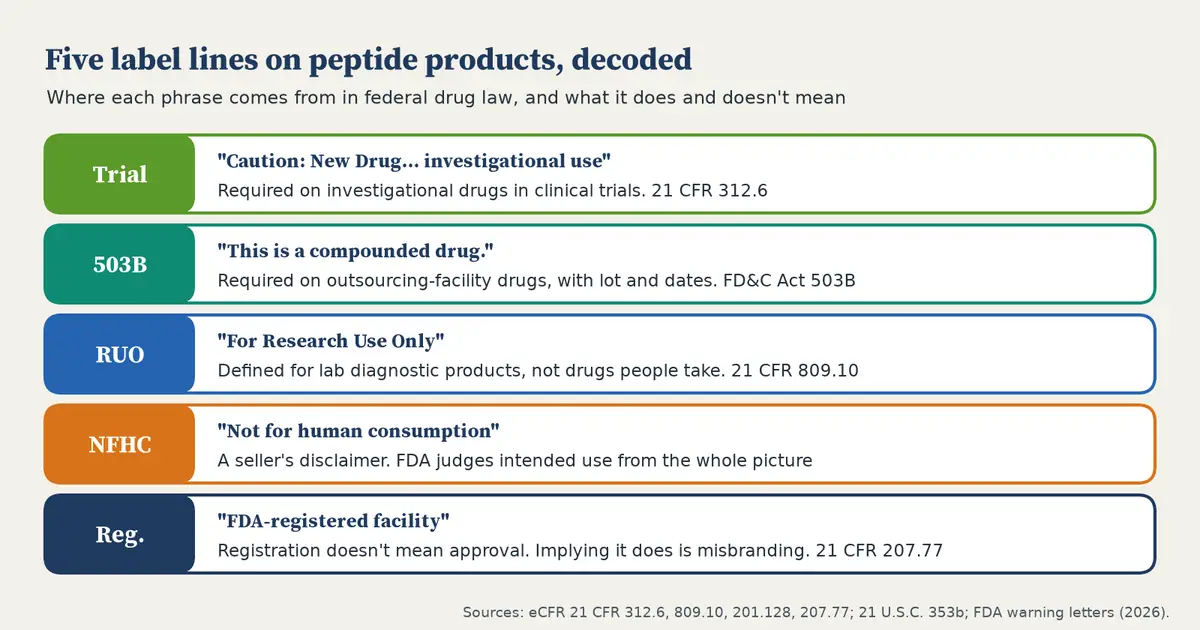
- "Caution: New Drug—Limited by Federal (or United States) law to investigational use": Required on investigational drugs in clinical trials (21 CFR 312.6). [V]
- "This is a compounded drug.": Required on 503B outsourcing-facility drugs, with facility, lot and dates (21 U.S.C. 353b). [V]
- "For Research Use Only": Defined for lab diagnostic products (21 CFR 809.10), not a status for drugs taken by people. [V]
- "Not for human consumption": A seller's disclaimer; FDA judges intended use from the whole picture. [V]
- "FDA-registered facility": Registration doesn't mean approval, and implying it does is misbranding (21 CFR 207.77). [V]
What a label can't tell you
The limits are worth stating once and plainly. A label tells you what the maker chose to say, not what's in the container. None of these lines, official or not, tells you about purity, identity or how well a peptide works. That's what clinical trials, FDA review and pharmacy quality standards are for. This page explains federal drug labeling. It isn't legal advice, and state rules can add more. For whether something is legal to make, prescribe or sell, our legal-status guide separates the questions. Rules can also shift. FDA's interim peptide access policy cleared White House review on October 27, and its text isn't public yet. [V] We'll update this page when it's out.
Peptide Policy Watch
"Research use only," "not for human consumption" and other peptide label lines, decoded
Printable checklist
Questions for your clinician
General questions drawn from this page, to take to a clinician or pharmacist who knows your health history.
- Is this an FDA-approved medicine, a compounded drug, or something with no approval for human use?
- What do the studies in people show, how large and how long were they, and where can I read them?
- How might my own health history, conditions and current medicines change how this applies to me?
- Is there an official label or other primary document I can read, and who would know if something goes wrong?
Print view Select it, then use your browser’s Print command to print only this box.
Sources (retrieved October 28, 2026 unless noted)
- eCFR, 21 CFR 312.6, "Labeling of an investigational new drug" (up to date as of October 26, 2026) [V] — https://www.ecfr.gov/current/title-21/section-312.6
- 21 U.S.C. 353b (FD&C Act section 503B), (a)(10) labeling of drugs, via Cornell Legal Information Institute [V] — https://www.law.cornell.edu/uscode/text/21/353b
- FDA, "Compounding and the FDA: Questions and Answers" (retrieved October 27, 2026) [V] — https://www.fda.gov/drugs/human-drug-compounding/compounding-and-fda-questions-and-answers
- eCFR, 21 CFR 809.10, "Labeling for in vitro diagnostic products," paragraph (c)(2)(i) [V] — https://www.ecfr.gov/current/title-21/section-809.10
- FDA, guidance "Distribution of In Vitro Diagnostic Products Labeled for Research Use Only or Investigational Use Only," docket FDA-2011-D-0305, page current as of 02/20/2018 [V] — https://www.fda.gov/regulatory-information/search-fda-guidance-documents/distribution-in-vitro-diagnostic-products-labeled-research-use-only-or-investigational-use-only
- eCFR, 21 CFR 201.128, "Meaning of 'intended uses'" [V] — https://www.ecfr.gov/current/title-21/section-201.128
- FDA, warning letter 721806, March 31, 2026 (retrieved October 26, 2026) [V] — https://www.fda.gov/inspections-compliance-enforcement-and-criminal-investigations/warning-letters/gram-peptides-721806-03312026
- FDA, warning letter 735063, August 24, 2026 (retrieved October 26, 2026) [V] — https://www.fda.gov/inspections-compliance-enforcement-and-criminal-investigations/warning-letters/peptide-partners-llc-735063-08242026
- eCFR, 21 CFR 207.77, "What legal status is conferred by registration and listing?" [V] — https://www.ecfr.gov/current/title-21/section-207.77
- FDA, Drugs@FDA database [V] — https://www.accessdata.fda.gov/scripts/cder/daf/
- OMB/OIRA, EO 12866 reviews completed in the last 30 days, RIN 0910-ZD94 [V] — https://www.reginfo.gov/public/do/XMLViewFileAction?f=EO_RULE_COMPLETED_30_DAYS.xml
Spot a mistake? See how we source and our corrections policy.