FDA's interim peptide policy clears White House review: what's official and what isn't
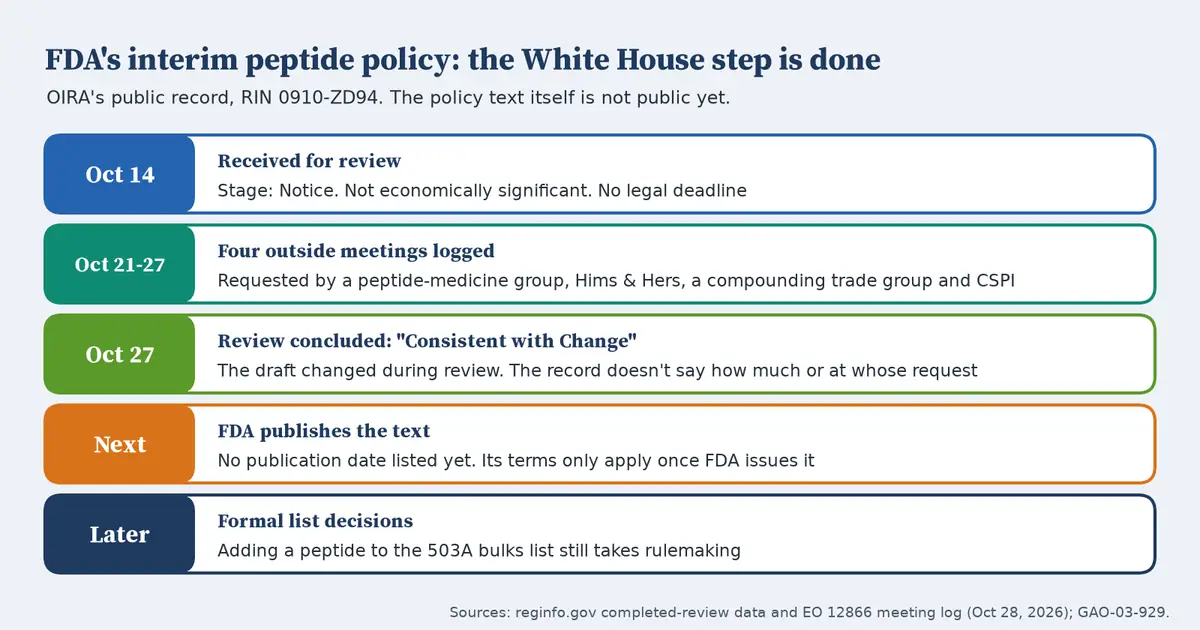
For two weeks, anyone following peptide news had one government page to refresh: a White House review record for an FDA document called "Interim Access Policy for Compounding Using Certain Peptides" (OIRA record). That record changed on October 27. The review is over. The policy itself still isn't public. Here's what the official record now shows, what has only been reported, and what has to happen before pharmacies see any difference.
Facts are as of October 28, 2026. Sources, with retrieval dates, are at the bottom.
The gist
- The White House Office of Information and Regulatory Affairs (OIRA) concluded its review of FDA's interim peptide access policy on October 27, 2026, 13 days after receiving it. [V]
- The result is coded "Consistent with Change," the most common outcome by far: 655 of 740 reviews concluded so far in 2026 carry it. [V]
- No publication date is listed yet, and we found no Federal Register document, FDA notice or press release with the policy text. [V]
- News reports in October said the policy would let pharmacies compound some popular peptides, including BPC-157, for a period of time. That still comes from unnamed sources, not an FDA document. [S]
- 13days from receipt (Oct. 14) to concluded review (Oct. 27) [V]
- 4outside meetings with OIRA logged on this policy [V]
- 0Federal Register documents with the policy text, as of Oct. 28 [V]
What the official record says
OIRA publishes a data file of every review it has finished in the past 30 days. Retrieved on October 28, it lists RIN 0910-ZD94, "Interim Access Policy for Compounding Using Certain Peptides," from FDA, at the "Notice" stage. It was received October 14 and completed October 27, with the decision "Consistent with Change." The publication-date field is empty. It's marked not economically significant, not major, with no legal deadline. [V]
That's a real step forward for a policy that was only a news report three weeks ago. OIRA is the office that clears significant agency documents before they're published. With its review finished, the next move belongs to FDA and HHS, which decide when to sign and release the final text.
OIRA's own FAQ says a "Notice" is the kind of document that announces new agency programs or policies, separate from a proposed or final rule. [V] It also says drafts under review are treated as deliberative and aren't released while the review is under way. [V] So the empty record isn't a sign of a problem. It's how the process works.
What "Consistent with Change" means
When OIRA finishes a review, it either finds the draft consistent with the executive order that governs regulatory review, Executive Order 12866, or sends it back to the agency. The Government Accountability Office explained the codes in a 2003 report. A draft gets "Consistent with Change" if it was modified at any point during review, whoever suggested it and however small the edit. [V]
“Even editorial changes made at the rulemaking agency's initiative can cause a rule to be coded "consistent with change.”
So the label tells you the review ended in clearance, not a return. It doesn't tell you whether the changes were large or small, or what they touched. How routine is it? In OIRA's 2026 year-to-date file, 35 of the 50 FDA reviews concluded this year carry the same code, and none were returned. [V] Across FDA's 42 completed notices this year, the middle review took about three weeks, so 13 days is on the quick side, though not unusual. [V]
Who met with OIRA
Under OIRA's stated practice, outside groups can ask for a meeting about a rule under review, and each one goes into a public log. [V] The log for this policy lists four meetings, by requesting organization [V]:
- October 21: the American Academy of Peptide Medicine
- October 23: Hims & Hers Health
- October 27, 2:00 PM: the Alliance for Pharmacy Compounding
- October 27, 2:30 PM: the Center for Science in the Public Interest
That's a mix of clinicians who work with peptides, a telehealth company, the compounding pharmacy trade group and a consumer-advocacy group, which shows how many interests are watching this one. The log lists who asked for each meeting. It doesn't show what anyone argued.
What's been reported about the contents
The best public description still comes from reporting. An Associated Press story published by CNBC on October 15 said, citing two people familiar with the plan, that the policy is meant to let pharmacies make some of the best-known peptides, BPC-157 among them, for a temporary period. [S] The same story described it as enforcement discretion, where FDA says it won't take action against certain compounding while the formal process continues. [S] FDA hasn't confirmed either point in a document we could find. [U]
That fits the official background. In July, FDA's Pharmacy Compounding Advisory Committee reviewed seven peptides, and AJMC reported that it recommended six of them for the 503ASection of federal drug law covering compounding by state-licensed pharmacies and doctors, usually for a prescription written for one patient. Glossary entry bulks list, against FDA staff's proposal. [S] Earlier in the year, BPC-157, TB-500, KPV, MOTS-c and other peptides were moved into a "nominated but withdrawn" section of FDA's category 2 page. [V] Our timeline has every step in order, and our BPC-157 status explainer shows where that one peptide sits on each FDA list.
What this doesn't settle yet
A finished review isn't a published policy. Until FDA releases the text, nobody outside government can say which peptides it covers, which kinds of pharmacies it applies to, what conditions come with it, or when it starts. [U] The "Consistent with Change" code also means the final version may differ from whatever was described in October. And an interim policy isn't the same as a final listing. Adding a substance to the 503A bulks list still requires rulemaking with public comment, which the October reporting said could take years. [S] Nothing here is an FDA approval of any peptide, which is a separate process built on clinical trials. Our legal-status guide walks through those separate questions.
What we're watching
Interim access policy: what comes next
- No date setFDA or HHS publishes the policy text, in the Federal Register or on FDA's compounding pages [V]
- No date setAny FDA response to the July 2026 advisory committee votes [V]
- Before end of Feb. 2027FDA's next compounding advisory committee meeting, with GHK-Cu, dihexa and three others on the agenda [V]
We'll update this page in place once the text is out. For the bigger picture of how these peptides are regulated today, start with the 14-peptide status table.
Peptide Policy Watch
FDA's interim peptide policy clears White House review: what's official and what isn't
Printable checklist
Questions for your clinician
General questions drawn from this page, to take to a clinician or pharmacist who knows your health history.
- Is this an FDA-approved medicine, a compounded drug, or something with no approval for human use?
- What do the studies in people show, how large and how long were they, and where can I read them?
- How might my own health history, conditions and current medicines change how this applies to me?
- Is there an official label or other primary document I can read, and who would know if something goes wrong?
Print view Select it, then use your browser’s Print command to print only this box.
Sources (retrieved October 28, 2026 unless noted)
- OMB/OIRA, EO 12866 reviews completed in the last 30 days (XML data file), entry for RIN 0910-ZD94: received 2026-10-14, completed 2026-10-27, "Consistent with Change," no publication date [V] — https://www.reginfo.gov/public/do/XMLViewFileAction?f=EO_RULE_COMPLETED_30_DAYS.xml
- OMB/OIRA, EO 12866 reviews completed in 2026 to date (XML data file), used for the 655-of-740 and FDA counts and review lengths [V] — https://www.reginfo.gov/public/do/XMLViewFileAction?f=EO_RULE_COMPLETED_YTD.xml
- OMB/OIRA, review record for RIN 0910-ZD94 (detail page showed blank fields on October 28) [V] — https://www.reginfo.gov/public/do/eoDetails?rrid=1568964
- OMB/OIRA, EO 12866 meeting log for RIN 0910-ZD94 (four meetings, October 21–27, 2026) [V] — https://www.reginfo.gov/public/do/eom12866SearchResults?rin=0910-ZD94
- OMB/OIRA, meeting records 1586023, 1588573, 1588523 and 1588623 (requestors) [V] — https://www.reginfo.gov/public/do/viewEO12866Meeting?meetingId=1588523&viewRule=true
- Reginfo.gov, Frequently Asked Questions (Notice stage; drafts under review are deliberative; meeting policy) [V] — https://www.reginfo.gov/public/jsp/Utilities/faq.myjsp
- U.S. General Accounting Office, "Rulemaking: OMB's Role in Reviews of Agencies' Draft Rules and the Transparency of Those Reviews," GAO-03-929, September 22, 2003 [V] — https://www.gao.gov/assets/gao-03-929.pdf
- Federal Register API, searches for "interim access" peptides and FDA compounding documents since October 1, 2026, plus the public inspection list for October 28 (no matching document) [V] — https://www.federalregister.gov/api/v1/documents.json
- Associated Press via CNBC, "Trump administration advances plan for peptide drugs favored by RFK Jr.," October 15, 2026 (retrieved October 15, 2026) [S] — https://www.cnbc.com/2026/10/15/peptides-trump-rfk-jr-maha.html
- AJMC, "FDA Panel Backs 6 Peptides for Compounding," July 31, 2026 (retrieved October 26, 2026) [S] — https://www.ajmc.com/view/fda-panel-backs-6-peptides-for-compounding
- FDA, category 2 page ("Certain Bulk Drug Substances for Use in Compounding that May Present Significant Safety Risks"), current as of 04/22/2026 [V] — https://www.fda.gov/drugs/human-drug-compounding/certain-bulk-drug-substances-use-compounding-may-present-significant-safety-risks
- FDA, Pharmacy Compounding Advisory Committee upcoming meeting page, current as of 04/15/2026 (retrieved October 25, 2026) [V] — https://www.fda.gov/advisory-committees/pharmacy-compounding-advisory-committee/meeting-pharmacy-compounding-advisory-committee
Spot a mistake? See how we source and our corrections policy.