Collagen peptides: what the skin, joint and bone trials show, and the supplement rules behind the label
Collagen peptides might be the most familiar peptide product there is. They're the powder in the coffee-shop smoothie add-on list and the tub on the pharmacy shelf, and plenty of people who'd never think of themselves as "peptide people" use them every day. They also have something many peptides on this site don't: dozens of randomized human trials. Here's what that research shows, where it's thinner than the marketing suggests, and the federal rules that decide what the label is allowed to say.
Facts are as of October 28, 2026. Sources, with retrieval dates, are at the bottom.
At a glance
- Collagen peptides, often sold as hydrolyzed collagen, are collagen broken into small fragments. Some of those fragments show up in the blood after you eat them. [V]
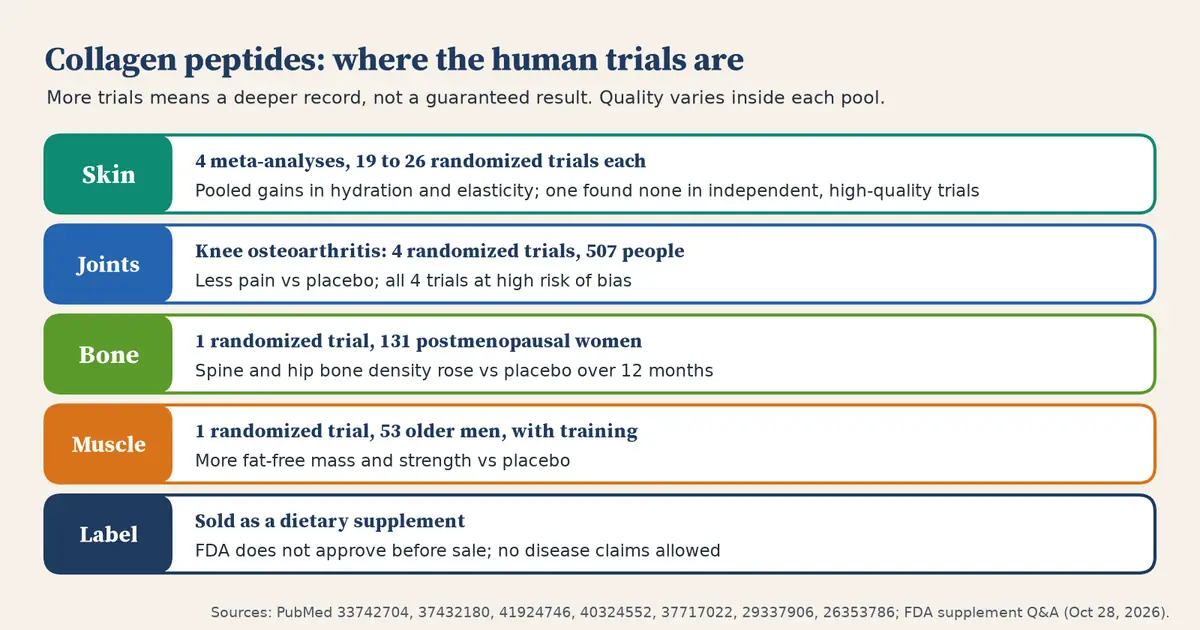
- We read four meta-analyses of randomized skin trials, each pooling 19 to 26 trials. All four found pooled gains, and one found those gains vanished in independently funded and high-quality trials. [V]
- Smaller sets of trials report less knee pain in osteoarthritis and, in single trials, better bone density and muscle measures. [V]
- In the U.S., collagen peptides are sold as dietary supplements, which FDA does not approve before they go on sale. The label can describe effects on the body's structure or function but can't claim to treat a disease. [V]
- 4skin meta-analyses we read, from 2021 to 2026 [V]
- 1,721participants in the largest of them, across 26 trials [V]
- 30 dayshow long a company has to notify FDA after it starts using a structure or function claim [V]
What's in the tub
Collagen is the main structural protein in skin, tendon and bone. Collagen peptides are made by breaking it down into short chains. That matters because the body doesn't simply absorb whole collagen. A 2014 study in the Journal of Agricultural and Food Chemistry measured specific two- and three-amino-acid fragments, the best-known being Pro-Hyp, appearing in human blood after people ate gelatin hydrolysate. [V] Evidence level: a human measurement study. Whether those fragments then signal skin or cartilage cells in people is still being worked out, with most of that evidence from lab and animal work, the usual first step. [U]
Skin: the deepest evidence
Skin is where the trial record is biggest, and the pooled results lean favorable.
- A 2021 meta-analysis in the International Journal of Dermatology pooled 19 randomized, double-blind trials with 1,125 participants, 95% of them women, aged 20 to 70. It found favorable results versus placebo for skin hydration, elasticity and wrinkles. [V]
- A 2023 meta-analysis in Nutrients pooled 26 randomized trials with 1,721 participants and found significantly improved skin hydration, while elasticity results didn't differ by collagen source. [V] Its authors flagged several biases in the trials and called for larger studies. [V]
- A 2026 meta-analysis in Frontiers in Medicine pooled 19 randomized trials of oral and topical peptides with 1,341 participants. It found better hydration and brightness, a modest effect on wrinkles driven mostly by oral products, inconsistent elasticity effects, and few side effects. [V]
Evidence level for all three: meta-analyses of randomized trials, the top rung of our evidence ladder, with quality limited by the trials inside them.
“There is currently no clinical evidence to support the use of collagen supplements to prevent or treat skin aging.” [V]
That's the fourth meta-analysis, and it's worth knowing about. Pooling 23 trials, it also found gains. But when the authors split trials by funding, the ones without pharmaceutical-company funding showed no effect, and neither did the high-quality trials. [V]
Joints, bone and muscle
- Knee osteoarthritis. A 2023 meta-analysis in the Journal of Orthopaedic Surgery and Research pooled 4 randomized trials with 507 patients and found significantly more pain relief with collagen peptides than placebo, rated moderate quality of evidence. [V] All four trials were judged at high risk of bias. [V]
- The wider supplement field. A 2018 British Journal of Sports Medicine review of 69 trials covering 20 supplements for osteoarthritis put collagen hydrolysate among seven with large short-term pain effects. It found none with clinically important long-term effects. [V]
- Bone. In a 12-month randomized trial of 131 postmenopausal women, published in Nutrients in 2018, bone mineral density at the spine and hip rose in the collagen group compared with placebo. [V] Evidence level: one randomized trial.
- Muscle. In a 2015 randomized trial of 53 older men with age-related muscle loss, all on the same 12-week strength program, the collagen group gained more fat-free mass and strength than the placebo group. [V] Evidence level: one randomized trial, alongside exercise.
Claim
"Collagen peptides improve your skin."
What research shows
- Research summary
Several meta-analyses of randomized trials report better hydration and elasticity on average. [V]
What is unknown
Why independent and high-quality trials, analyzed separately, found no effect, and how long any change lasts. [V]
This card describes the kind of research that exists.
What the label is allowed to say
This is where collagen differs most from the compounded peptides we usually cover. It's sold as a dietary supplement, under a 1994 law called the Dietary Supplement Health and Education Act. [V]
| The question | Answer | What the record shows |
|---|---|---|
| Does FDA approve them before sale? | No | Under the 1994 law, FDA has no authority to approve supplements before they're marketed. [V] |
| Who's responsible for safety and labeling? | The company | The firm must make sure its products aren't adulterated or misbranded. [V] |
| Can the label say "supports skin elasticity"? | Yes, as a structure or function claim | The company must have substantiation and notify FDA within 30 days of marketing. [V] |
| Can it say "treats arthritis"? | No | FDA says only a drug can legally claim to diagnose, treat, cure or prevent a disease. [V] |
| What disclaimer goes with a structure or function claim? | FDA's standard statement | The label must say FDA hasn't evaluated the statement and the product isn't meant to treat or prevent any disease. [V] |
That last line is the small-print box you've probably seen on the back of the tub, and it's set out in federal regulation at 21 CFR 101.93. [V] The supplement category also has a boundary that matters for peptides generally. FDA's definition generally leaves out ingredients that were first an approved drug, a licensed biologic, or the subject of an active investigational new drug application, unless they were sold as a supplement or food first. [V] Our cosmetic-or-drug explainer covers the parallel rule for peptide creams.
Limits and unknowns
- Industry funding runs through this field, and one meta-analysis found the benefit mostly disappeared in trials without it. [V]
- Trials differ widely in collagen source, product and length, which makes pooling hard. [V]
- Skin results rely on instrument readings and expert grading, and the size of change you'd notice in a mirror isn't well defined. [U]
- Bone and muscle findings each rest on a single trial that hasn't been widely repeated in what we found. [V]
- Because FDA doesn't review supplements before sale, what's in a given product depends on the maker's quality controls. [V]
What people get wrong
"FDA approved this collagen." FDA doesn't approve dietary supplements or their labeling before sale. [V]
"Collagen is just protein, so it can't do anything." Specific fragments do reach the blood, and multiple randomized trials found measurable changes. The open question is how big and how reliable those changes are. [V]
Peptide Policy Watch
Collagen peptides: what the skin, joint and bone trials show, and the supplement rules behind the label
Printable checklist
Questions for your clinician
General questions drawn from this page, to take to a clinician or pharmacist who knows your health history.
- Which of the trials behind this product were independently funded?
- Is the label making a structure or function claim, or a disease claim?
- Does the maker test for identity and purity, and say how?
Print view Select it, then use your browser’s Print command to print only this box.
What to watch next
Dates and decisions we're tracking
- No date setLarger, independently funded skin trials, which two of the four meta-analyses call for [V]
- No date setRepeat trials of the bone and muscle findings [U]
For the wider picture, see how approved drugs differ from wellness products and our guide to peptide marketing red flags.
Sources (retrieved October 28, 2026 unless noted)
- Taga Y, et al., "Highly accurate quantification of hydroxyproline-containing peptides in blood using a protease digest of stable isotope-labeled collagen," Journal of Agricultural and Food Chemistry, December 2014 (abstract) [V] — https://pubmed.ncbi.nlm.nih.gov/25417748/
- de Miranda RB, et al., "Effects of hydrolyzed collagen supplementation on skin aging: a systematic reviewA review that collects studies on one question by a stated search method, often pooling their numbers. Glossary entry and meta-analysis," International Journal of Dermatology, 2021 (abstract) [V] — https://pubmed.ncbi.nlm.nih.gov/33742704/
- Pu SY, et al., "Effects of Oral Collagen for Skin Anti-Aging: A Systematic Review and Meta-Analysis," Nutrients, 2023 (abstract) [V] — https://pubmed.ncbi.nlm.nih.gov/37432180/
- Nukaly HY, et al., systematic review and meta-analysis of oral and topical peptides for skin aging, Frontiers in Medicine, 2026 (abstract) [V] — https://pubmed.ncbi.nlm.nih.gov/41924746/
- Myung SK, Park Y, meta-analysis of collagen supplements for skin aging by funding source and study quality, The American Journal of Medicine, 2025 (abstract) [V] — https://pubmed.ncbi.nlm.nih.gov/40324552/
- Meta-analysis of collagen peptides for knee osteoarthritis pain, Journal of Orthopaedic Surgery and Research, 2023 (abstract) [V] — https://pubmed.ncbi.nlm.nih.gov/37717022/
- Liu X, et al., "Dietary supplements for treating osteoarthritis: a systematic review and meta-analysis," British Journal of Sports Medicine, February 2018 (abstract) [V] — https://pubmed.ncbi.nlm.nih.gov/29018060/
- König D, et al., "Specific Collagen Peptides Improve Bone Mineral Density and Bone Markers in Postmenopausal Women-A Randomized Controlled Study," Nutrients, January 16, 2018 (abstract) [V] — https://pubmed.ncbi.nlm.nih.gov/29337906/
- Zdzieblik D, et al., collagen peptide supplementation with resistance training in older sarcopenic men, British Journal of Nutrition, October 2015 (abstract; erratum 2025) [V] — https://pubmed.ncbi.nlm.nih.gov/26353786/
- FDA, "Questions and Answers on Dietary Supplements," content current as of 08/27/2026 [V] — https://www.fda.gov/food/information-consumers-using-dietary-supplements/questions-and-answers-dietary-supplements
- FDA, "Structure/Function Claims," content current as of 03/28/2024 [V] — https://www.fda.gov/food/nutrition-food-labeling-and-critical-foods/structurefunction-claims
- FDA, "Dietary Supplements" overview, content current as of 10/01/2024 [V] — https://www.fda.gov/food/dietary-supplements
- eCFR, 21 CFR 101.93, "Certain types of statements for dietary supplements" [V] — https://www.ecfr.gov/current/title-21/chapter-I/subchapter-B/part-101/subpart-F/section-101.93
Spot a mistake? See how we source and our corrections policy.