Peptide serums: cosmetic or drug? What the label claims decide, and what the research shows
"Peptides" is one of the most common words on a serum bottle right now, right next to retinol and vitamin C. Those creams sit in a very different legal world from the peptides in our FDA coverage. Most are sold as cosmetics, with no FDA approval step at all. What keeps them there is mostly the wording on the box. And the research on skincare peptides is more substantial than many people expect.
Facts are as of October 27, 2026. Sources, with retrieval dates, are at the bottom.
At a glance
- Under federal law, intended use decides whether a product is a cosmetic, a drug or both, and FDA reads intended use mainly from the claims a company makes. [V]
- Cosmetics and their ingredients, apart from color additives, don't need FDA approval before they're sold. Drugs generally do. [V]
- Since the 2022 cosmetics law (MoCRA), companies must register facilities, list products and report serious adverse events to FDA within 15 business days. [V]
- A 2026 meta-analysis of 19 randomized trials (1,341 participants) found peptides improved skin hydration and brightness; the pooled wrinkle effect was smaller. [V]
The research: more than marketing
Skincare peptides aren't one ingredient. A widely cited 2009 review sorted the topical ones into four families: signal, carrier, enzyme-inhibitor and neurotransmitter-inhibitor peptides. [V] Copper peptide (GHK-Cu) is usually filed with the carrier peptides, since it ferries copper, and we cover it on its own GHK-Cu human studies page.
One well-studied signal peptide is palmitoyl pentapeptide, a short chain (KTTKS) attached to a fatty acid so it can sit in a skin cream. It was designed to encourage collagen production. In a 2005 randomized, double-blind, split-face trial in 93 women aged 35 to 55, half of each face got a moisturizer with the peptide and the other half got the same moisturizer without it. After 12 weeks, the peptide side showed significant reductions in wrinkles and fine lines versus placebo on both image analysis and expert grading, and it was well tolerated. [V] That's a single human RCT of moderate size, run by researchers at Procter & Gamble, the company behind the ingredient.
A widely discussed neurotransmitter-inhibitor example is a six-amino-acid peptide its developers named Argireline. A 2002 paper reported that it interferes with the protein machinery nerve endings use to release signals, the same machinery botulinum toxin targets, with a much smaller effect than the toxin. In a test on healthy women volunteers, the authors reported wrinkle depth fell by up to 30% after 30 days. [V] That's lab work plus an early human test, not a large trial.
The biggest picture comes from a 2026 systematic reviewA review that collects studies on one question by a stated search method, often pooling their numbers. Glossary entry and meta-analysis in Frontiers in Medicine. Pooling 19 randomized controlled trials with 1,341 participants, the authors found that peptides significantly improved hydration and brightness, with oral formulations doing much of the work. The pooled wrinkle effect was modest, and mostly driven by oral polypeptides. Results for elasticity and density were inconsistent. Side effects were minimal across the trials, and the authors described peptides as safe, non-invasive anti-aging agents while calling for larger, more standardized trials. [V]
- 19randomized trials pooled in the 2026 meta-analysis [V]
- 1,341participants across those trials [V]
- 93women in the 2005 split-face peptide trial [V]
Cosmetic or drug: the claim decides
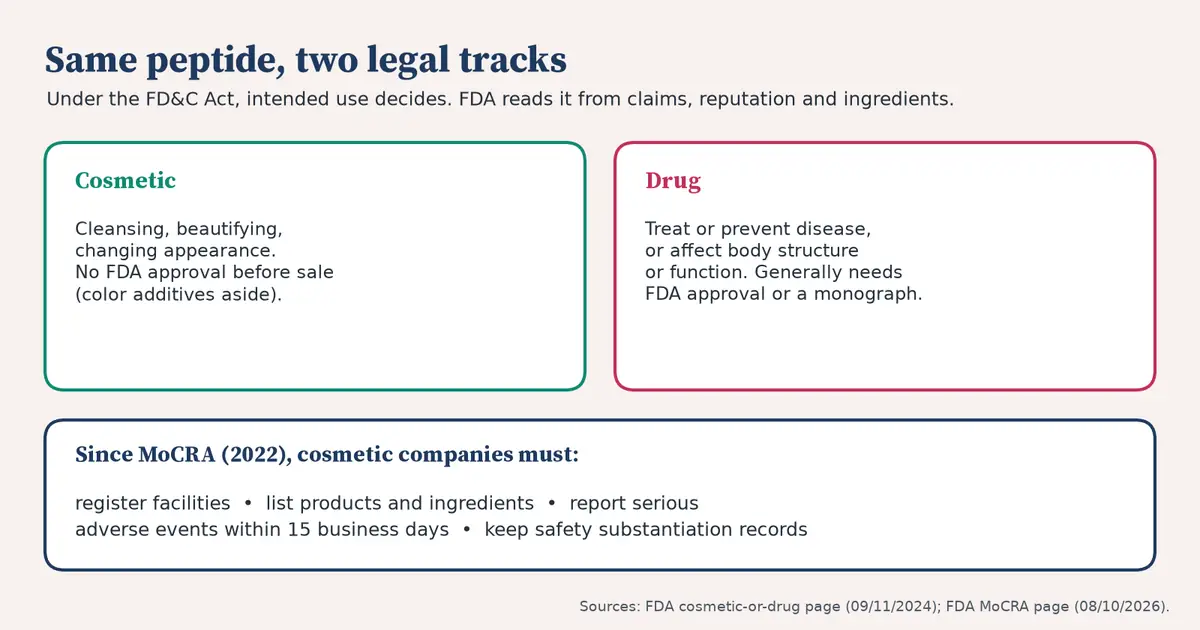
The Federal Food, Drug, and Cosmetic Act defines a cosmetic by purpose: products applied to the body for cleansing, beautifying, making someone more attractive or changing how they look. [V] A drug is something intended to diagnose, cure, mitigate, treat or prevent disease, or meant to change how the body is built or how it works. [V] Same molecule, two possible categories. The difference is what the product is for.
FDA's guidance says intended use can be shown three ways: claims on labels, ads, websites and other promotion; what consumers expect the product to do, based on its reputation; and ingredients with a well-known therapeutic use, like fluoride in toothpaste. [V] FDA's own examples of claims that turn a cosmetic into a drug include promises to restore hair growth, reduce cellulite or regenerate cells. [V]
So a peptide cream that promises to "reduce the look of fine lines" is speaking cosmetic language. A product that claims to rebuild collagen or repair skin can read as drug language, because it describes changing the body's structure. [U] Some products are legitimately both: FDA's examples include dandruff shampoo and moisturizers with sunscreen claims, which have to meet both sets of rules. [V]
The term "cosmeceutical" has no meaning under the law. [V]
That word shows up a lot in peptide skincare marketing. FDA says the FD&C Act doesn't recognize it as a category: a product is a drug, a cosmetic or both. [V]
What the 2022 law added
FDA calls MoCRA, the 2022 law that modernized cosmetics regulation, the biggest expansion of its cosmetics authority since the 1938 FD&C Act. [V] Under it, a company responsible for a cosmetic must [V]:
- register manufacturing facilities with FDA and renew every two years,
- list each product it markets, with ingredients, and update that yearly,
- report serious adverse events to FDA within 15 business days,
- keep records showing the product's safety is adequately substantiated.
FDA also gained mandatory recall authority for cosmetics that could cause serious harm when a company won't recall voluntarily. [V] Certain small businesses are exempt from some of these duties. [V] None of this is a premarket approval: cosmetics still go on sale without FDA signing off first. [V]
Why the line matters for peptides
The cosmetic-or-drug test is the same logic FDA uses across the peptide world. FDA decides what a product is by how it's marketed, which is why it has treated "research use only" peptides as drugs when the sales pages pointed to human use. Our marketing red flags page covers those letters. For GHK-Cu specifically, FDA's compounding list draws its own line, covering non-injectable routes only, which our GHK-Cu skincare and compounding page explains.
What people get wrong
"FDA approved this serum." Cosmetics don't get FDA approval before sale, apart from color additives. [V]
"Cosmeceutical is a stricter category." FDA says the term has no legal meaning. [V]
"If it's a cosmetic, nobody checks safety." Since MoCRA, companies must hold safety substantiation records and report serious adverse events. [V]
Limits and unknowns
Many single-ingredient trials are small and short, and some are run by ingredient makers, including the 2005 trial above. [V] The 2026 meta-analysis found inconsistent results for elasticity and density and called for larger trials with standard outcomes. [V] A cream's real-world results also depend on its full formula, which trials of single ingredients don't capture. [U] And claims on a label aren't checked by FDA before sale. [V]
What to watch next
Dates and decisions we're tracking
- Before end of February 2027FDA's next compounding advisory committee meeting, with GHK-Cu on the agenda [V]
- OngoingFDA's MoCRA rollout, including its May 4, 2026 update on implementation [V]
New to the basics? Start with what peptides are, or see Are peptides legal in the US? for how the drug-side rules work.
Peptide Policy Watch
Peptide serums: cosmetic or drug? What the label claims decide, and what the research shows
Printable checklist
Questions for your clinician
General questions drawn from this page, to take to a clinician or pharmacist who knows your health history.
- Is this an FDA-approved medicine, a compounded drug, or something with no approval for human use?
- What do the studies in people show, how large and how long were they, and where can I read them?
- How might my own health history, conditions and current medicines change how this applies to me?
- Is there an official label or other primary document I can read, and who would know if something goes wrong?
Print view Select it, then use your browser’s Print command to print only this box.
Sources (retrieved October 27, 2026 unless noted)
- FDA, "Is It a Cosmetic, a Drug, or Both? (Or Is It Soap?)," content current as of 09/11/2024 [V] — https://www.fda.gov/cosmetics/cosmetics-laws-regulations/it-cosmetic-drug-or-both-or-it-soap
- FDA, "Modernization of Cosmetics Regulation Act of 2022 (MoCRA)," content current as of 08/10/2026 [V] — https://www.fda.gov/cosmetics/cosmetics-laws-regulations/modernization-cosmetics-regulation-act-2022-mocra
- Robinson LR et al., Int J Cosmet Sci, 2005, palmitoyl pentapeptide split-face trial, PMID 18492182 [V] — https://pubmed.ncbi.nlm.nih.gov/18492182/
- Blanes-Mira C et al., Int J Cosmet Sci, 2002, Argireline hexapeptide, PMID 18498523 [V] — https://pubmed.ncbi.nlm.nih.gov/18498523/
- Gorouhi F, Maibach HI, Int J Cosmet Sci, 2009, review of topical peptides for aged skin, PMID 19570099 [V] — https://pubmed.ncbi.nlm.nih.gov/19570099/
- Nukaly HY et al., Front Med (Lausanne), March 17, 2026, systematic review and meta-analysis of peptides for skin aging, PMID 41924746 [V] — https://pubmed.ncbi.nlm.nih.gov/41924746/
- FDA, "Meeting of the Pharmacy Compounding Advisory Committee," current as of 04/15/2026 [V] — https://www.fda.gov/advisory-committees/pharmacy-compounding-advisory-committee/meeting-pharmacy-compounding-advisory-committee
Spot a mistake? See how we source and our corrections policy.