
Novo expects a CagriSema FDA decision this quarter. What the amylin-plus-semaglutide pairing is, and what the trials found
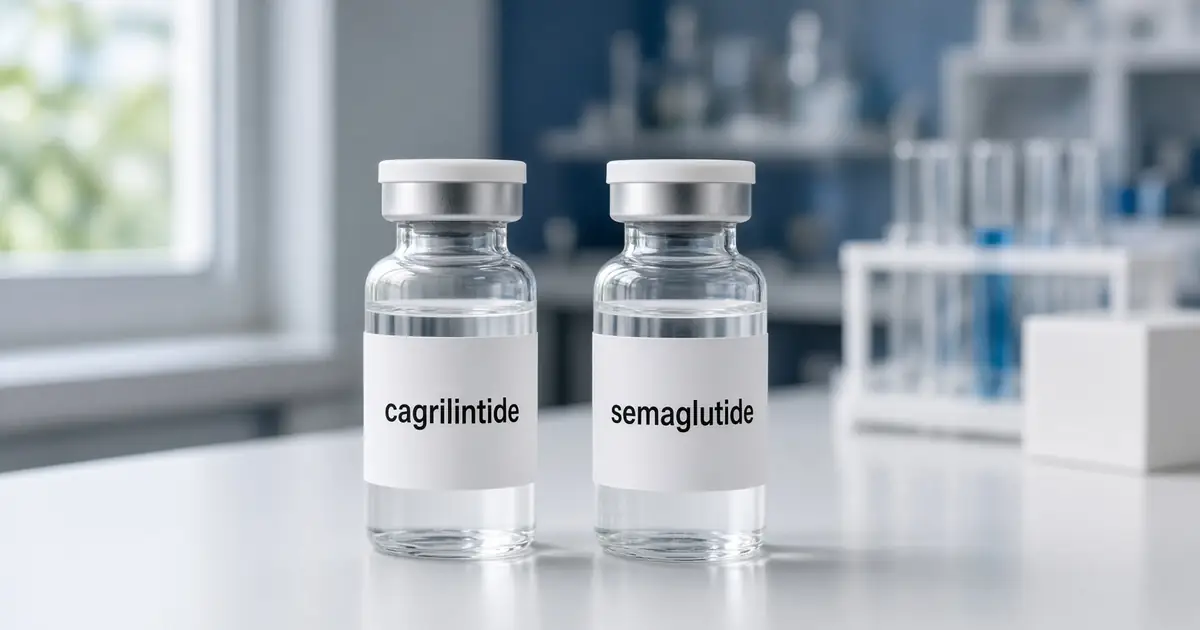
If you've followed GLP-1 news for a while, you've probably noticed the next wave isn't just stronger GLP-1 drugs. It's combinations. Novo Nordisk's CagriSema pairs semaglutide with a second peptide, cagrilintide, that copies a different gut-and-pancreas hormone called amylin. Novo filed it with FDA in December 2025, and on November 4, 2026, the company said it's preparing for a U.S. launch in early 2027, "subject to regulatory approval." [V] Here's what's in it, what the trials showed, and where it stands.
Facts are as of November 4, 2026. Sources, with retrieval dates, are at the bottom.
If you only read one box
- CagriSema is a once-weekly fixed combination of cagrilintide, a long-acting amylin analogue, and semaglutide. If approved, Novo says, it would be the first injectable combination of a GLP-1 drug and an amylin analogue. [V]
- Novo submitted its application to FDA on December 18, 2025, for long-term weight management. In September 2026, Novo said it expected a decision in the fourth quarter of 2026. [V]
- In the 68-week REDEFINE 1 trial of 3,417 adults without diabetes, average weight loss was 20.4% with CagriSema versus 3.0% with placebo. [V]
- CagriSema isn't approved in the U.S. FDA says cagrilintide can't be used in compounding under federal law. [V]
Amylin, the other hormone
Most people have heard of GLP-1 by now. Amylin is less famous, though it's been studied for decades. It's a hormone your pancreas's beta cells release alongside insulin when you eat. According to FDA labeling, it slows how fast food leaves the stomach, damps down glucagon after meals and helps regulate appetite through the brain. [V]
This isn't the first time a drug has borrowed it. FDA approved pramlintide (Symlin), a synthetic amylin analogue, in March 2005 for people with diabetes who use insulin. [V] Its label describes pramlintide as a 37-amino-acid peptide that differs from human amylin at three positions. [V] Cagrilintide is a newer, longer-acting take on the same idea, built to last a week. [S]
That makes CagriSema a two-peptide product: an amylin mimic plus semaglutide, which is itself a modified version of the human GLP-1 hormone. Our peptide medicines timeline shows how long this lineage runs.
- 20.4%average weight loss at 68 weeks with CagriSema in REDEFINE 1, vs 3.0% on placebo [V]
- 3,417adults randomized in REDEFINE 1 [V]
- 13.7%average weight loss in REDEFINE 2, in adults with type 2 diabetes, vs 3.4% on placebo [V]
What the big trials showed
REDEFINE 1 enrolled 3,417 adults with obesity, or with overweight and a weight-related condition, and no diabetes. People were randomized to CagriSema, semaglutide alone, cagrilintide alone or placebo, all alongside lifestyle support, for 68 weeks. [V] Counting everyone randomized, average weight change was -20.4% on CagriSema and -3.0% on placebo, according to the New England Journal of Medicine paper. [V] Novo reports a higher figure, 22.7%, for the scenario where everyone stayed on treatment. [V] Our orforglipron page explains why trials report both numbers.
REDEFINE 2 focused on people with type 2 diabetes: 1,206 adults who also carried excess weight. Average weight change at 68 weeks was -13.7% on CagriSema and -3.4% on placebo. [V] Nearly three in four people on CagriSema (73.5%) reached an HbA1c of 6.5% or lower, against 15.9% on placebo. [V]
Two newer trials came out in September 2026, as company topline results. In REDEFINE 9, a lower-strength version of CagriSema produced 21.0% weight loss at 68 weeks versus 2.0% on placebo. [V] In REIMAGINE 5, a head-to-head trial in adults with type 2 diabetes, that lower-strength version produced 12.4% weight loss at 60 weeks versus 9.1% for a lower-strength version of tirzepatide, with similar HbA1c drops. [V] Both figures assume people stayed on treatment, and neither trial has a peer-reviewed paper yet that we found. [U]
“CagriSema remains investigational, but these findings strengthen our confidence in its potential”
Where it stands with FDA
Novo's December 18, 2025 release said the application rests on REDEFINE 1 and REDEFINE 2 and that FDA was expected to review it in 2026. [V] Novo's September 21, 2026 release put the expected decision in the fourth quarter of 2026. [V] Its November 4 nine-month report doesn't give a decision date. It says Novo is "preparing for the US launch of CagriSema in early 2027, subject to regulatory approval." [V] FDA doesn't publish pending application dates, so we can't confirm the exact target. [U]
On the compounding side, the answer is already written down. According to FDA's page on unapproved GLP-1 drugs, retatrutide and cagrilintide can't be used in compounding under federal law, aren't part of any approved drug and haven't been shown safe and effective for any use. [V] Approval of CagriSema wouldn't change that by itself, since compounding rules turn on the 503ASection of federal drug law covering compounding by state-licensed pharmacies and doctors, usually for a prescription written for one patient. Glossary entry bulks list and other criteria. [S] Our GLP-1 explainer sorts approved, compounded and research-labeled versions, and our label decoder covers what "research use only" means when cagrilintide shows up online. For the wider question of what makes any peptide legal in the US, see our five-way guide.
Limits and unknowns
Stomach side effects were common. In REDEFINE 1, 79.6% of people on CagriSema reported gastrointestinal events, compared with 39.9% on placebo, mostly mild to moderate and temporary, the authors wrote. [V] Novo says 5.9% stopped CagriSema because of adverse events in REDEFINE 1, versus 3.5% on placebo. [V] Both REDEFINE papers were funded by Novo. [V]
We haven't seen FDA's review documents, which only appear after a decision. [U] Late-stage results don't guarantee an approval, either, a point our piece on why most drugs in human trials never get approved covers. We'll update this page when FDA acts. Meanwhile, the semaglutide half of CagriSema already has a liver approval of its own, and our ESSENCE trial explainer covers how it got there.
Peptide Policy Watch
Novo expects a CagriSema FDA decision this quarter. What the amylin-plus-semaglutide pairing is, and what the trials found
Printable checklist
Questions for your clinician
Print or copy these questions for your next visit with a clinician or pharmacist.
- Is this an FDA-approved medicine, a compounded drug, or something with no approval for human use?
- What do the studies in people show, how large and how long were they, and where can I read them?
- How might my own health history, conditions and current medicines change how this applies to me?
- Is there an official label or other primary document I can read, and who would know if something goes wrong?
Print view Select it, then use your browser’s Print command to print only this box.
Common questions
Is CagriSema FDA approved?
Not as of November 4, 2026. Novo Nordisk submitted its application in December 2025 and said in September 2026 that it expected a decision in the fourth quarter of 2026. [V] Source: Novo Nordisk, Dec. 18, 2025; Novo Nordisk, Sept. 21, 2026
What is cagrilintide?
A long-acting analogue of amylin, a hormone the pancreas releases with insulin. FDA says cagrilintide can't be used in compounding under federal law and isn't a component of any approved drug. [V] Source: FDA, concerns with unapproved GLP-1 drugs
How much weight did people lose in REDEFINE 1?
Average weight change at 68 weeks was -20.4% with CagriSema and -3.0% with placebo, counting everyone randomized. Gastrointestinal side effects affected 79.6% versus 39.9%. [V] Source: NEJM via PubMed 40544433
Sources (retrieved November 4, 2026 unless noted)
- Novo Nordisk, financial report for the first nine months of 2026, company announcement, November 4, 2026 [V] — https://www.globenewswire.com/news-release/2026/11/04/3395015/0/en/novo-raises-full-year-outlook-on-continued-glp-1-momentum-with-third-quarter-adjusted-operating-profit-increasing-27-at-cer-to-dkk-31-720-million.html
- Novo Nordisk U.S. press release on the CagriSema New Drug Application submission, December 18, 2025 [V] — https://www.novonordisk-us.com/media/press-releases/novo-nordisk-cagrisema-fda-nda-submission.html
- Novo Nordisk, "Novo's CagriSema delivers superior weight loss versus tirzepatide in REIMAGINE 5 trial," September 21, 2026 [V] — https://www.globenewswire.com/news-release/2026/09/21/3365319/0/en/novo-s-cagrisema-delivers-superior-weight-loss-versus-tirzepatide-in-reimagine-5-trial.html
- Garvey WT et al., "Coadministered Cagrilintide and Semaglutide in Adults with Overweight or Obesity" (REDEFINE 1), New England Journal of Medicine, August 14, 2025, PubMed 40544433 [V] — https://pubmed.ncbi.nlm.nih.gov/40544433/
- Davies MJ et al., "Cagrilintide-Semaglutide in Adults with Overweight or Obesity and Type 2 Diabetes" (REDEFINE 2), New England Journal of Medicine, August 14, 2025, PubMed 40544432 [V] — https://pubmed.ncbi.nlm.nih.gov/40544432/
- FDA, Symlin (pramlintide acetate) label, NDA 021332, March 2005 [V] — https://www.accessdata.fda.gov/drugsatfda_docs/label/2005/021332lbl.pdf
- openFDA Drugs@FDA, NDA 021332 (Symlin), original approval March 16, 2005 [V] — https://api.fda.gov/drug/drugsfda.json?search=application_number:NDA021332
- FDA, "FDA's Concerns with Unapproved GLP-1 Drugs Used for Weight Loss," content current as of October 1, 2026 [V] — https://www.fda.gov/drugs/drug-alerts-and-statements/fdas-concerns-unapproved-glp-1-drugs-used-weight-loss
Cite or link to this page
Peptide Policy Watch staff. “Novo expects a CagriSema FDA decision this quarter. What the amylin-plus-semaglutide pairing is, and what the trials found.” Peptide Policy Watch. Published November 4, 2026. Updated November 5, 2026. https://peptidepolicywatch.com/2026/11/04/cagrisema-fda-decision-amylin-semaglutide-trials/
Link: https://peptidepolicywatch.com/2026/11/04/cagrisema-fda-decision-amylin-semaglutide-trials/
Spot a mistake? See how we source and our corrections policy.
Image: AI-generated. Image credits