
Why most drugs that enter human trials never get approved, and what that means for peptides
If you follow peptide news for long, you hear the same comeback: "If it worked, it would be approved by now." It sounds airtight until you look at how few drugs make it through FDA approval at all, including ones that looked good early on. Most never finish. Here's what the numbers say, why candidates drop out, and why "not approved" is a statement about a process, not a verdict on a molecule.
Facts are as of October 31, 2026. Sources, with retrieval dates, are at the bottom.
The gist
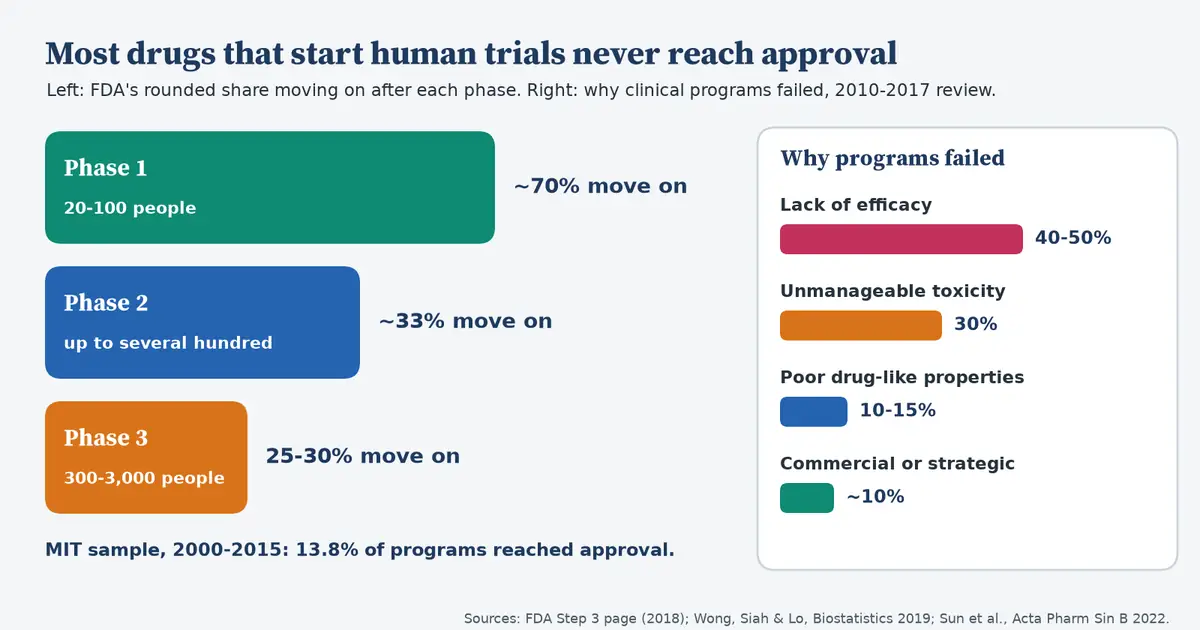
- FDA's own guide to drug development says roughly 70% of drugs move on from Phase 1, about 33% from Phase 2, and 25-30% from Phase 3. [V]
- A large MIT analysis of more than 21,000 compounds, using trial records from 2000 to 2015, found that 13.8% of drug development programs ended in approval. [V]
- A 2022 review traced 40-50% of clinical failures to drugs that didn't work well enough and 30% to side effects that couldn't be managed. About 10% stopped for commercial or strategic reasons. [V]
- A 2020 JAMA study estimated the median cost of bringing one new drug to market at about $985 million, counting the trials that failed along the way. [V]
- 13.8%of drug development programs reached approval in MIT's 2000-2015 sample [V]
- ~10%of clinical failures tied to commercial or strategic reasons, per a 2022 review [V]
- $985Mmedian estimated R&D cost per new drug, 2009-2018, including failures [V]
The three phases, and who drops out where
FDA lays the path out in steps. Before any human trial, a sponsor has to file an Investigational New Drug application with animal and toxicity data, manufacturing details and the study plans. [V] Then come three phases. Phase 1 enrolls 20 to 100 people over several months and looks at safety and dosage. [V] Phase 2 enrolls up to several hundred people with the condition and runs from several months to two years. [V] Phase 3 enrolls 300 to 3,000 people for one to four years, and FDA calls these the studies that show whether a product offers a treatment benefit. [V]
At each step, FDA's page gives a rough share that moves on: about 70% after Phase 1, about 33% after Phase 2, and 25-30% after Phase 3. [V] FDA presents these as approximate figures, on a page last updated January 4, 2018. [V] Multiplying them gives a rough sense of the funnel: fewer than one in ten drugs that start Phase 1 get through all three steps on those numbers. That last figure is our arithmetic, not FDA's. [S]
Other datasets land in a similar place by different routes. An MIT team (Wong, Siah and Lo) traced 406,038 trial records for more than 21,000 compounds and estimated that 13.8% of programs reached approval, higher than earlier published estimates of about 10%. [V] Their success rate for cancer drugs was 3.4%. [V] Numbers differ by method and disease area, but every source we read agrees that most candidates don't finish. [V]
Why candidates fall out
The 2022 review in Acta Pharmaceutica Sinica B, from researchers at the University of Michigan and Bristol Myers Squibb, sorted clinical failures from 2010 to 2017 into four groups. [V]
- Lack of clinical efficacy, 40-50%. The drug didn't beat the comparison in people. [V]
- Unmanageable toxicity, 30%. Side effects outweighed the benefit at the doses tested. [V]
- Poor drug-like properties, 10-15%. Problems such as how the body absorbs or clears the compound. The authors note this cause has shrunk since the 1990s, when it accounted for 30-40% of failures. [V]
- Lack of commercial need or poor strategic planning, about 10%. The program stopped for business reasons. [V]
That last group matters for anyone reading peptide news. Around one in ten clinical failures, by this review's count, had nothing to do with the molecule failing a test. [V] A program can end because a company merged, changed priorities or decided the market was too small.
The money behind each approval
Late-stage trials are expensive, and someone has to pay for them. Wouters and colleagues, writing in JAMA in 2020, used public filings for 63 drugs FDA approved between 2009 and 2018 and estimated a median investment of $985.3 million per new drug, once failed trials were counted in. [V] Their median ranged from about $766 million for nervous system drugs to about $2.77 billion for cancer and immune drugs. [V] The authors caution that the drugs with public data skewed toward smaller firms and orphan drugs. [V]
Spending on that scale usually comes from a company that expects to sell the approved product. For a peptide that no company is developing toward approval, nobody is paying for the Phase 3 trials that approval generally needs. [S] That's one reason so many peptides discussed by patients and practitioners sit in early research rather than on a pharmacy shelf. Our explainer on why doctors can't simply prescribe them follows that gap through to insurance.
“We find that 13.8% of all drug development programs eventually lead to approval”
What this does and doesn't tell you about a given peptide
These rates describe large groups of drugs. They can't be applied to any single peptide, and we don't try to. A peptide with no approval might have failed a trial, might never have had a large trial, or might be early in one. Those are different situations, and the record for each one is public. Our guide to reading a ClinicalTrials.gov listing shows how to tell which is which, and our evidence ladder explains the stages from cell studies to large trials.
Peptides can make it all the way. Tesamorelin, a growth-hormone-releasing peptide, went through two phase 3 trials with 806 people and won FDA approval in 2010. Its full path is in our tesamorelin explainer. [V] Most failures in the 2022 review came down to efficacy or toxicity, which is the screening the approval system is designed to do. [V] The same system also screens out candidates for reasons of cost and strategy, and a peptide stuck in early research may simply never have been tested at that scale.
There are other routes besides approval. HHS's interim compounding policy for six peptides is one, and the policy tracker logs each dated change as it happens.
Peptide Policy Watch
Why most drugs that enter human trials never get approved, and what that means for peptides
Printable checklist
Questions for your clinician
General questions drawn from this page, to take to a clinician or pharmacist who knows your health history.
- Has it been through any registered human trial, and what phase did that trial reach?
- If a trial ended early, does the registry say why?
- Is any company or academic group running a program toward approval today?
- Does FDA's compounding category list or HHS's interim policy mention it?
Print view Select it, then use your browser’s Print command to print only this box.
Limits and unknowns
- FDA's phase percentages are rounded and don't name a dataset or time span on the page we read. [V]
- The MIT and 2022 review figures cover all drug types, not peptides alone. We didn't find a peptide-specific approval rate from a primary source. [U]
- Cost estimates vary widely between studies, from hundreds of millions to more than $2 billion, depending on the drugs sampled and the assumptions used. [V]
The short version: a missing approval tells you that no sponsor carried a drug through a long, costly process. It doesn't tell you why, and that question is worth asking each time.
Common questions
What share of drugs that enter human trials get approved?
Estimates vary by method. An MIT analysis of trial records from 2000 to 2015 found that 13.8% of drug development programs ended in approval, and FDA's own rounded phase figures point to a similar or lower share. Source: Wong, Siah and Lo, Biostatistics 2019; FDA, Step 3: Clinical Research
Why do drug candidates fail in clinical trials?
A 2022 review of failures from 2010 to 2017 found that most came down to the drug not working well enough in people (40-50%) or to side effects that couldn't be managed (30%). Problems with how the body handles the compound explained 10-15%, and about 10% ended for business or planning reasons. Source: Sun et al., Acta Pharmaceutica Sinica B 2022
How much does it cost to bring a new drug to market?
A 2020 JAMA study of drugs approved from 2009 to 2018 estimated a median of about $985 million per new drug, counting failed trials. Published estimates range from about $314 million to $2.8 billion. Source: Wouters, McKee and Luyten, JAMA 2020
Does "not FDA-approved" mean a peptide failed testing?
Not necessarily. A drug can lack approval because it failed a trial, because no large trial was ever run, or because a program stopped for business reasons. A 2022 review put that last group at about 10% of clinical failures. Source: Sun et al., Acta Pharmaceutica Sinica B 2022
Sources (retrieved October 31, 2026 unless noted)
- FDA, "Step 3: Clinical Research," content current as of January 4, 2018, retrieved October 29, 2026 [V] — https://www.fda.gov/patients/drug-development-process/step-3-clinical-research
- Wong CH, Siah KW, Lo AW. "Estimation of clinical trial success rates and related parameters." Biostatistics 2019;20(2):273-286, PMID 29394327, full text via PMC6409418 [V] — https://pmc.ncbi.nlm.nih.gov/articles/PMC6409418/
- Sun D, Gao W, Hu H, Zhou S. "Why 90% of clinical drug development fails and how to improve it?" Acta Pharmaceutica Sinica B 2022;12(7):3049-3062, PMID 35865092, full text via PMC9293739 [V] — https://pmc.ncbi.nlm.nih.gov/articles/PMC9293739/
- Wouters OJ, McKee M, Luyten J. "Estimated Research and Development Investment Needed to Bring a New Medicine to Market, 2009-2018." JAMA 2020;323(9):844-853, PMID 32125404 [V] — https://pubmed.ncbi.nlm.nih.gov/32125404/
- FDA, Drugs@FDA approval package for Egrifta (tesamorelin), NDA 22-505, approved November 10, 2010 [V] — https://www.accessdata.fda.gov/drugsatfda_docs/nda/2010/022505Orig1s000TOC.html
Spot a mistake? See how we source and our corrections policy.