
How to read a clinical-trial listing on ClinicalTrials.gov: status, phase, dates and results
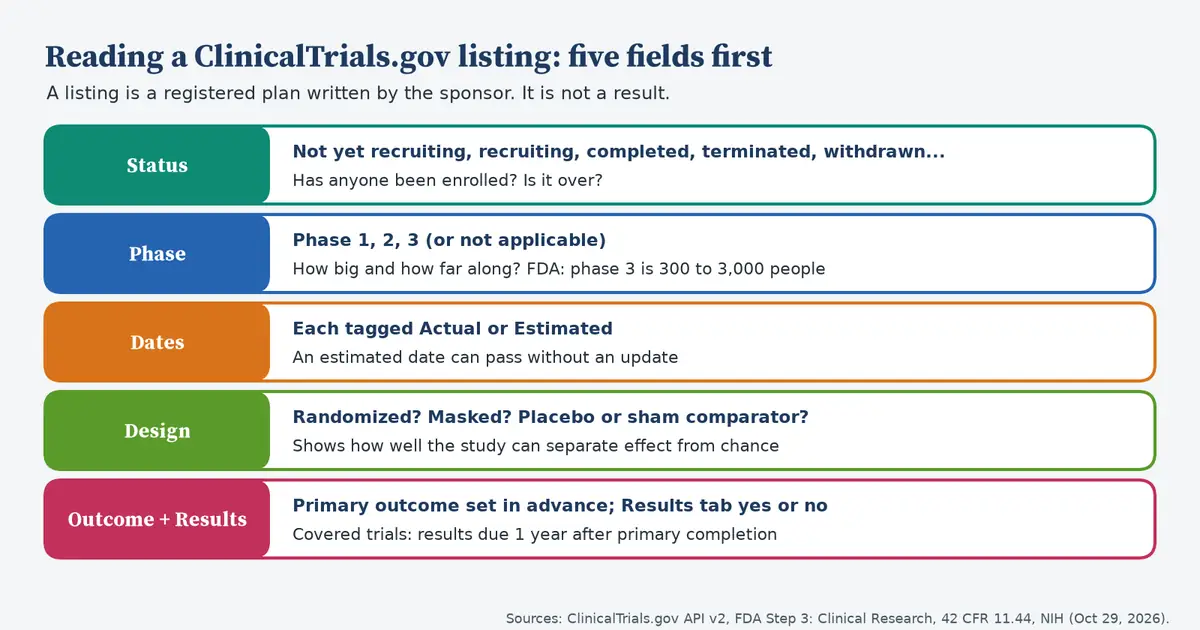
Search "BPC-157 clinical trial" and you'll land on a government page with a long ID number, a status badge and a wall of fields. It looks official, and it is a federal website. But a listing tells you that a study was planned and registered, not what it found. Here's how to read one in about five minutes, using three real peptide records as examples.
Facts are as of October 29, 2026. Sources, with retrieval dates, are at the bottom.
The gist
- ClinicalTrials.gov is a registry run by the National Library of Medicine, and the sponsor or investigator writes and updates each record. [V]
- Five fields do most of the work: status, phase, dates (actual or estimated), design and the primary outcome. [V]
- A record with no Results tab has no posted results. For many FDA-regulated trials, federal rules set a one-year deadline after the primary completion date. [V]
- 14status values the registry's data system can return [V]
- 300 to 3,000typical people in a phase 3 study, per FDA [V]
- 1 yearstandard results deadline after primary completion, for covered trials [V]
What a listing is, and who wrote it
ClinicalTrials.gov opened to the public in February 2000 after a 1997 law asked NIH to build a trial registry. [S] It's a genuinely useful tool. You can see a study's question, who can join, where it runs and, for many finished trials, the results in a standard format. [V]
The catch is authorship. NLM says the sponsor or principal investigator provides and updates the information, usually registering when the study begins. [S] NIH puts the point plainly.
“Listing a study does not mean it has been evaluated by the U.S. Federal Government.”
Five fields worth reading first
1. Overall status. This is the badge at the top. The data system defines 14 values, from "Not yet recruiting" and "Recruiting" through "Completed," "Terminated," "Withdrawn" and "Unknown status." [V] A University of Arkansas study of BPC-157 after rotator cuff surgery, NCT07803250, reads "Not yet recruiting," with an estimated start of January 1, 2027. [V] That means nobody has been enrolled yet, so there's nothing to report on.
2. Phase. FDA describes phase 1 as about 20 to 100 people with a focus on safety, phase 2 as up to several hundred people looking at effects and side effects, and phase 3 as 300 to 3,000 people. [V] FDA's page also estimates that about 70% of drugs move on from phase 1 and about 33% from phase 2. [V] The rotator cuff study is labeled phase 1 with an estimated 30 participants, while a registered BPC-157 hamstring study, NCT07437547, is labeled phase 2 with an estimated 120. [V]
3. Dates, and the word "Estimated." Every key date carries a tag of "Actual" or "Estimated." [V] That tag matters more than the date. SEER-2, a phase 3 eye trial of a thymosin beta-4 eye drop (NCT05555589), lists an estimated primary completion of April 30, 2026, but the record was last updated December 23, 2025. [V] As of today the estimate has passed and the record hasn't said what happened, which is common and not by itself a warning sign. [U]
4. Design. Look for three words: randomized, masked (or blinded) and comparator. The hamstring study is randomized, compares BPC-157 with a placebo, and is "quadruple" masked, meaning participants, care providers, investigators and outcome assessors don't know who got what. [V] The rotator cuff study uses a sham comparator. [V] It's encouraging to see peptide studies registered in that format.
5. Primary outcome. This is the question the trial was built to answer, set in advance. In the hamstring study it's the time to return to full sport and the change in injury volume on MRI by day 14. [V] If a later paper headlines a different outcome, compare it with this field.
The Results tab, and the one-year rule
A record either has posted results or it doesn't, and the data system flags it. None of the three records above has results posted. [V] For "applicable clinical trials," which are broadly FDA-regulated drug and device trials, 42 CFR 11.44 says results are due no later than one year after the primary completion date. [V] Delays are allowed with a certification when a sponsor is seeking FDA approval, and extensions for good cause can be requested. [V]
The records also carry an "FDA-regulated drug" flag that the sponsor fills in. The rotator cuff record answers yes and the hamstring record answers no, which shows why the field is worth reading rather than assuming. [V] We haven't checked how either answer was decided. [U]
What people get wrong
"It's on a government site, so it's been vetted." NIH says a listing doesn't mean the federal government evaluated the study. [V]
"Recruiting means it works." Recruiting means the study is enrolling people to find out. [V]
"Phase 2 means it's two steps from approval." FDA's own page estimates that only about a third of drugs move on from phase 2. [V]
Limits and unknowns
- Not every study is in the registry, because the law doesn't require all of them to register, for example some observational and non-drug studies. [S]
- Records are self-reported. The sponsor of the hamstring study also registered a TB-500 heart study whose own summary calls itself fictional, so we treat that sponsor's records with extra caution until results appear (details). [V]
- A listing describes a plan. Results, if they come, may appear years later in a journal, on the Results tab, or both. [V]
Peptide Policy Watch
How to read a clinical-trial listing on ClinicalTrials.gov: status, phase, dates and results
Printable checklist
Questions for your clinician
General questions drawn from this page, to take to a clinician or pharmacist who knows your health history.
- Is the status current, and when was the record last updated?
- Are the key dates marked actual or estimated?
- Is there a comparator, and who is masked?
- What is the primary outcome, and has a Results tab appeared?
Print view Select it, then use your browser’s Print command to print only this box.
For how those registered BPC-157 studies sit next to the published pilots, see BPC-157 human studies. For where a trial fits among other kinds of evidence, see the evidence ladder. Today's HHS compounding policy brief covers the regulatory side for BPC-157 and five other peptides.
Sources (retrieved October 29, 2026 unless noted)
- NIH, "Finding a Clinical Trial" [V] — https://www.nih.gov/health-information/nih-clinical-research-trials-you/finding-clinical-trial
- NLM Customer Support Center, knowledge article KA-03869 on ClinicalTrials.gov (search excerpt; page is script-rendered) [S] — https://support.nlm.nih.gov/kbArticle/?pn=KA-03869
- ClinicalTrials.gov API v2, enums (overall status, phase and date-type values) [V] — https://clinicaltrials.gov/api/v2/studies/enums
- ClinicalTrials.gov API v2, study data structure metadata (lead sponsor, results flag) [V] — https://clinicaltrials.gov/api/v2/studies/metadata
- ClinicalTrials.gov, NCT07803250, BPC-157 and recovery after rotator cuff repair (University of Arkansas), last updated September 3, 2026 [V] — https://clinicaltrials.gov/study/NCT07803250
- ClinicalTrials.gov, NCT07437547, BPC-157 and acute hamstring strain, last updated February 27, 2026 [V] — https://clinicaltrials.gov/study/NCT07437547
- ClinicalTrials.gov, NCT05555589, SEER-2 (RGN-259, neurotrophic keratopathy), last updated December 23, 2025 [V] — https://clinicaltrials.gov/study/NCT05555589
- FDA, "Step 3: Clinical Research" (phases, typical sizes, share moving to the next phase) [V] — https://www.fda.gov/patients/drug-development-process/step-3-clinical-research
- eCFR, 42 CFR 11.44, when clinical trial results information must be submitted [V] — https://www.ecfr.gov/current/title-42/chapter-I/subchapter-A/part-11/subpart-C/section-11.44
- ClinicalTrials.gov, NCT07487363, record whose summary describes itself as fictional (retrieved October 28, 2026) [V] — https://clinicaltrials.gov/study/NCT07487363
Spot a mistake? See how we source and our corrections policy.