Thymosin beta-4 in people: the eye, skin and heart trials behind the TB-500 name
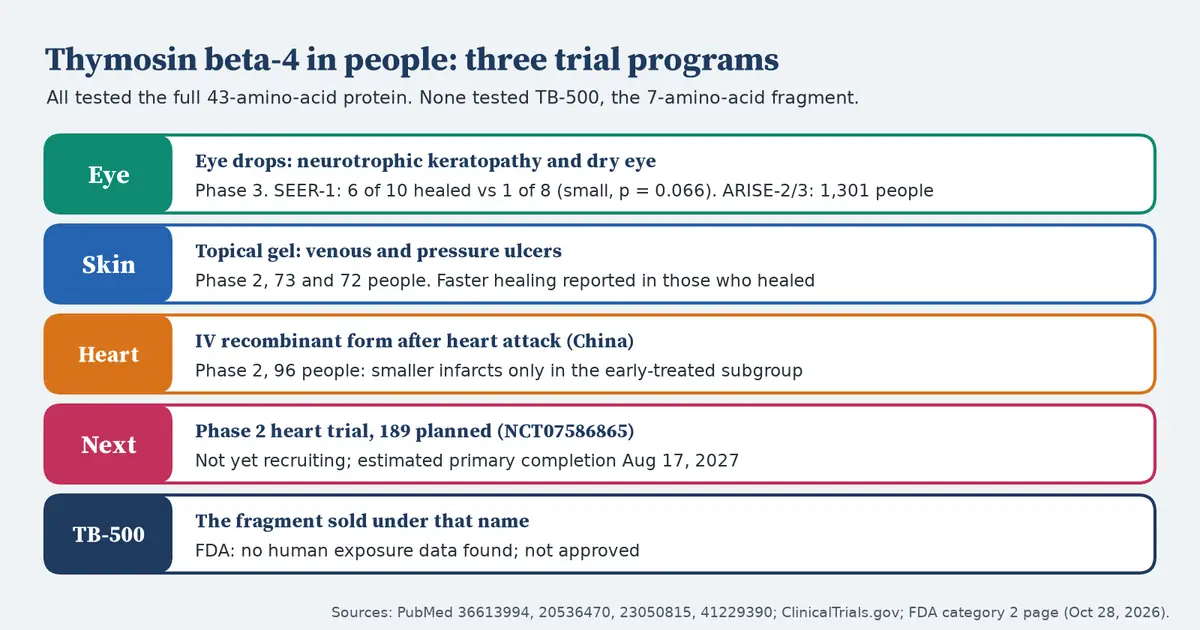
Search "TB-500 research" and most of what comes back is about rats. Look one step up the family tree, though, and the picture changes. Thymosin beta-4, the full-length protein that TB-500 is cut from, has been tested in hundreds of people: eye drops in late-stage trials, wound gels in Europe and the U.S., and an intravenous heart-attack drug that's still moving through trials in China. Here's what each program found, where it stands, and why none of it transfers automatically to the short fragment.
Facts are as of October 28, 2026. Sources, with retrieval dates, are at the bottom.
The gist
- Thymosin beta-4 is a natural protein of 43 amino acids. TB-500 is a seven-amino-acid piece of it, which FDA lists as LKKTETQ. [V]
- The protein has reached phase 3 eye trials, in neurotrophic keratopathy and dry eye, plus phase 2 trials in skin ulcers and heart attack. [V]
- The strongest results so far: faster healing of stubborn corneal wounds in a small phase 3 trial, and smaller heart-attack damage in one subgroup of a randomized trial. [V]
- FDA says it has found no human exposure data for products containing the TB-500 fragment, and it has not approved either molecule. [V]
- 43amino acids in full-length thymosin beta-4 [V]
- 7amino acids in TB-500, the fragment FDA lists as LKKTETQ [V]
- 1,300+people enrolled in the two completed phase 3 dry eye trials, ARISE-2 and ARISE-3 [V]
Where the interest comes from
Thymosin beta-4 is one of the body's own repair signals. A 2012 review in Expert Opinion on Biological Therapy describes how platelets and other cells release it after an injury, and summarizes lab evidence that it helps cells move, supports new blood vessels and cuts down on scarring. [V] The finding that put it on cardiologists' radar came in 2004, when a team at UT Southwestern reported in Nature that it helped heart cells survive and improved heart function in mice after a blocked coronary artery. [V] That's early-stage research, the usual first step, and it set off two decades of human work.
The eye: the furthest along
The eye program is the most developed, and its most encouraging result is in a hard-to-treat condition. Neurotrophic keratopathy is damage to the cornea's nerves that leaves wounds on the eye's surface slow to close.
It started small. In a 2010 report of nine compassionate-use patients with long-standing corneal wounds, the six with larger, map-shaped defects showed what the authors called dramatic healing, while the three with pinpoint defects showed no clear change. [V] Evidence level: a case series, no comparison group.
Then came SEER-1, a randomized, double-masked phase 3 trial of thymosin beta-4 eye drops. Complete healing at four weeks occurred in 6 of 10 treated patients and 1 of 8 on placebo. [V] That difference narrowly missed the usual statistical cutoff (p = 0.0656), while a healing measure two weeks after treatment stopped did reach significance, and no significant adverse effects were reported. [V] The trial stopped early with 18 people enrolled. [V] Evidence level: a small randomized trial with a promising signal. A follow-up, SEER-2, is listed as recruiting, with 70 people planned. [V]
“promotes rapid healing of epithelial defects in neurotrophic keratopathy, improves ocular comfort, and is safe” [V]
That's the authors' own summary of the trial, and the paper discloses that several of them work for the developer. [V]
Dry eye is where the program went biggest. After mixed phase 2 results in 2015 (one 72-person trial missed both primary endpoints, and a nine-person trial in severe dry eye reported significant gains), two phase 3 trials enrolled 601 and 700 people. [V] Both are complete and have results posted on ClinicalTrials.gov. [V] On the posted primary measures, the drug and placebo groups' average changes sit close together. [V]
The skin: wound gels in phase 2
The skin work tested a topical gel on chronic wounds. A phase 2 trial randomized 73 people with venous leg ulcers at eight sites in Italy and Poland. Its authors found safety comparable to placebo and wrote that one strength may help wounds close faster, with about a quarter of patients fully healed within three months. [V] A companion phase 2 trial in pressure ulcers enrolled 72 people. [V] A 2012 review, whose authors include the venous ulcer trial's lead investigator, reported that across the two trials, patients who healed did so almost a month sooner. [V] Evidence level: phase 2 trials, with the speed finding limited to people who healed.
Two trials in epidermolysis bullosa, a rare blistering skin disease, ended early, with 30 and 4 participants. [V]
The heart: still moving in China
The newest human data comes from a recombinant form of the protein made by a Beijing company. A phase 1 study in healthy volunteers, 54 in one part and 30 in another, reported mild to moderate side effects and no serious adverse events. [V] Then, in a randomized, double-blind trial of 96 people treated after a major heart attack, published in Cardiovascular Research in December 2025, the drug didn't shrink damaged heart tissue across the whole group. [V] In people who got their first treatment within eight hours of having the artery reopened, though, infarcts were significantly smaller at 90 days. [V] Evidence level: a subgroup result from one randomized trial, the kind that sets up the next trial. That next trial, a 189-person phase 2 study, is registered and lists August 17, 2027 as its estimated primary completion. [V]
Claim
"TB-500 has been through human trials."
What research shows
- Research record
Full-length thymosin beta-4 has phase 1, 2 and 3 trials in eye drops, wound gels and an intravenous form. [V]
What is unknown
How the seven-amino-acid fragment behaves in people. FDA says it has found no human exposure data for it. [V]
This card describes the kind of research that exists.
Where it stands with FDA and in sport
| The question | Answer | What the record shows |
|---|---|---|
| Is either FDA-approved? | No | We found no approval for either in FDA's Drugs@FDA database. [V] |
| Where is TB-500 on FDA's compounding lists? | Category 2 page | FDA lists the fragment among substances that may present significant safety risks. [V] |
| Has the advisory committee weighed in? | Yes, July 2026 | AJMC reports an 8-6 vote in favor of adding TB-500 to the 503ASection of federal drug law covering compounding by state-licensed pharmacies and doctors, usually for a prescription written for one patient. Glossary entry list, with one member abstaining. Votes are advice only. [S] |
| Is a new FDA policy pending? | Under White House review | FDA's interim access policy for compounding certain peptides was received for review October 14, 2026. [V] |
| Is it allowed in tested sport? | No | WADAWorld Anti-Doping Agency: it publishes the yearly Prohibited List for tested sport. Glossary entry's 2026 list names thymosin beta-4 and derivatives such as TB-500 under S2.3, prohibited at all times. [V] |
FDA's category 2 entry raises possible immune reactions and peptide-related impurities and says the agency lacks important safety information on the fragment. [V] That's a statement about missing data, not a finding of harm. The eye drops, gels and heart drug above went through a different door: trials run by drug sponsors, which is how a medicine reaches FDA review. Our Wolverine stack page covers how TB-500 gets paired with BPC-157.
Limits and unknowns
- None of these trials tested TB-500. A fragment can behave differently from the parent protein in the body, and no published human study we found measured that. [V]
- The best eye result came from 18 people, and its main comparison missed the usual statistical cutoff. [V]
- The dry eye phase 3 records list no statistical result favoring the drug on their primary measures. [V]
- The heart result that reached significance was in a subgroup, and the full-group comparison was not significant. [V]
- Much of the human research was designed or written by people tied to the companies developing it, and the papers say so. [V]
- One ClinicalTrials.gov record for a TB-500 trial in heart disease (NCT07487363) calls itself "fictional" in its own summary, so we don't count it as a study. [V]
What people get wrong
"Phase 3 trials mean it's about to be approved." Phase 3 is the last trial stage, not a verdict. Two phase 3 dry eye trials have posted results without a clear win on their main measures, and we found no approval. [V]
"No human data at all." That's accurate for the TB-500 fragment, according to FDA. It isn't accurate for thymosin beta-4, which has trials in eye, skin and heart. [V]
Why the parent-versus-fragment line matters
Thymosin beta-4 is one of the more interesting repair molecules in the literature, with real trials in real patients and a heart program that's still active. But a trial result belongs to the molecule, the form and the route that was tested. Read "thymosin beta-4 eye drops healed corneas" as exactly that, and you'll be reading the research the way its authors meant it.
What to watch next
Dates and decisions we're tracking
- August 17, 2027Estimated primary completion of the phase 2 heart attack trial, NCT07586865 [V]
- No date setResults of SEER-2, the second phase 3 eye trial, NCT05555589 [V]
- PendingThe White House review of FDA's interim access policy for compounding certain peptides [V]
- PendingWhether FDA acts on the July 2026 advisory committee votes [V]
The 14-peptide status table sets TB-500 beside the other names in FDA's review, and our BPC-157 human studies page does the same trial-by-trial count for its usual partner.
Peptide Policy Watch
Thymosin beta-4 in people: the eye, skin and heart trials behind the TB-500 name
Printable checklist
Questions for your clinician
General questions drawn from this page, to take to a clinician or pharmacist who knows your health history.
- Is this an FDA-approved medicine, a compounded drug, or something with no approval for human use?
- What do the studies in people show, how large and how long were they, and where can I read them?
- How might my own health history, conditions and current medicines change how this applies to me?
- Is there an official label or other primary document I can read, and who would know if something goes wrong?
Print view Select it, then use your browser’s Print command to print only this box.
Sources (retrieved October 28, 2026 unless noted)
- FDA, "Certain Bulk Drug Substances for Use in Compounding that May Present Significant Safety Risks" (category 2 page), current as of 04/22/2026 [V] — https://www.fda.gov/drugs/human-drug-compounding/certain-bulk-drug-substances-use-compounding-may-present-significant-safety-risks
- Guarnera G, DeRosa A, Camerini R, "The effect of thymosin treatment of venous ulcers," Annals of the New York Academy of Sciences, April 2010 (abstract) [V] — https://pubmed.ncbi.nlm.nih.gov/20536470/
- Goldstein AL, et al., "Thymosin β4: a multi-functional regenerative peptide," Expert Opinion on Biological Therapy, January 2012 (abstract) [V] — https://pubmed.ncbi.nlm.nih.gov/22074294/
- Bock-Marquette I, et al., "Thymosin beta4 activates integrin-linked kinase and promotes cardiac cell migration, survival and cardiac repair," Nature, November 25, 2004 (abstract) [V] — https://pubmed.ncbi.nlm.nih.gov/15565145/
- Dunn SP, et al., "Treatment of chronic nonhealing neurotrophic corneal epithelial defects with thymosin beta4," Annals of the New York Academy of Sciences, April 2010 (abstract) [V] — https://pubmed.ncbi.nlm.nih.gov/20536469/
- Sosne G, et al., "0.1% RGN-259 (Thymosin ß4) Ophthalmic Solution Promotes Healing and Improves Comfort in Neurotrophic Keratopathy Patients...," International Journal of Molecular Sciences, December 29, 2022 (abstract and disclosures) [V] — https://pubmed.ncbi.nlm.nih.gov/36613994/
- ClinicalTrials.gov, NCT02600429 (SEER-1), terminated, 18 enrolled, results posted [V] — https://clinicaltrials.gov/study/NCT02600429
- ClinicalTrials.gov, NCT05555589 (SEER-2), recruiting, last updated December 23, 2025 [V] — https://clinicaltrials.gov/study/NCT05555589
- Sosne G, et al., phase II dry eye trial using the controlled adverse environment model, Clinical Ophthalmology, 2015 (abstract) [V] — https://pubmed.ncbi.nlm.nih.gov/26056426/
- Sosne G, Dunn SP, Kim C, "Thymosin beta 4 significantly improves signs and symptoms of severe dry eye in a phase 2 randomized trial," Cornea, May 2015 (abstract) [V] — https://pubmed.ncbi.nlm.nih.gov/25826322/
- ClinicalTrials.gov, NCT02974907 (ARISE-2), completed, 601 enrolled, results posted [V] — https://clinicaltrials.gov/study/NCT02974907
- ClinicalTrials.gov, NCT03937882 (ARISE-3), completed, 700 enrolled, results posted [V] — https://clinicaltrials.gov/study/NCT03937882
- ClinicalTrials.gov, NCT00382174, phase 2 pressure ulcer trial, completed, 72 enrolled [V] — https://clinicaltrials.gov/study/NCT00382174
- Treadwell T, et al., "The regenerative peptide thymosin β4 accelerates the rate of dermal healing in preclinicalResearch done before any testing in people, such as lab-dish and animal studies. Glossary entry animal models and in patients," Annals of the New York Academy of Sciences, October 2012 (abstract) [V] — https://pubmed.ncbi.nlm.nih.gov/23050815/
- ClinicalTrials.gov, NCT00311766 and NCT03578029, epidermolysis bullosa trials, both terminated [V] — https://clinicaltrials.gov/study/NCT00311766 and https://clinicaltrials.gov/study/NCT03578029
- Wang et al., first-in-human phase I study of recombinant human thymosin beta4 in healthy Chinese volunteers, Journal of Cellular and Molecular Medicine, September 2021 (abstract) [V] — https://pubmed.ncbi.nlm.nih.gov/34346165/
- Zhang Y, et al., "Recombinant human thymosin beta 4 improves ischemic cardiac dysfunction in mice and patients with acute ST-segment elevation myocardial infarction after reperfusion," Cardiovascular Research, December 31, 2025 (abstract) [V] — https://pubmed.ncbi.nlm.nih.gov/41229390/
- ClinicalTrials.gov, NCT07586865, phase IIc heart attack trial, not yet recruiting, last updated May 14, 2026 [V] — https://clinicaltrials.gov/study/NCT07586865
- ClinicalTrials.gov, NCT07487363, record whose summary describes itself as fictional [V] — https://clinicaltrials.gov/study/NCT07487363
- openFDA Drugs@FDA API, searches for "thymosin" and "timbetasin," no matches [V] — https://open.fda.gov/apis/drug/drugsfda/
- AJMC, "FDA Panel Backs 6 Peptides for Compounding," July 31, 2026 (retrieved October 26, 2026) [S] — https://www.ajmc.com/view/fda-panel-backs-6-peptides-for-compounding
- OMB/OIRA, pending EO 12866 regulatory review, RIN 0910-ZD94, received October 14, 2026 (status detail page returned blank fields on October 28; meeting log reachable) [V] — https://www.reginfo.gov/public/do/eoDetails?rrid=1568964
- WADA, 2026 Prohibited List, S2.3 (retrieved October 25, 2026) [V] — https://www.wada-ama.org/sites/default/files/2025-09/2026list_en_final_clean_september_2025.pdf
Spot a mistake? See how we source and our corrections policy.