
HHS opens a compounding path for six peptides: what the interim policy says
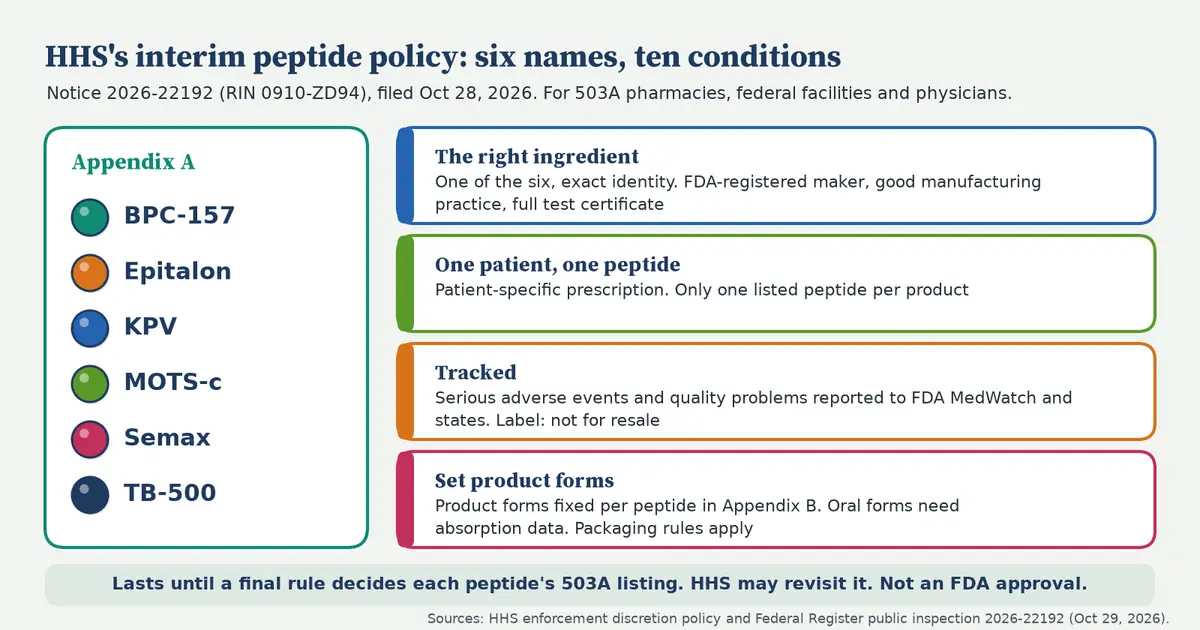
For months the question was simple: when would the government say what pharmacies can do with BPC-157 and the other peptides its advisers backed in July? The answer arrived on October 28. HHS filed a notice with the Federal Register that names six peptides, sets ten conditions, and says it won't take enforcement action against licensed pharmacies and physicians that meet them. Here's what the text says, in plain terms, with the parts still open marked as open.
Facts are as of October 29, 2026. Sources, with retrieval dates, are at the bottom.
The gist
- HHS's "Enforcement Discretion Policy Regarding 503ASection of federal drug law covering compounding by state-licensed pharmacies and doctors, usually for a prescription written for one patient. Glossary entry Compounding Using Certain Peptide Bulk Drug Substances" names six peptides: BPC-157, TB-500, epitalon, KPV, MOTS-c and semax. [V]
- It reaches pharmacies licensed by a state, federal facilities and licensed doctors who compound, and it lasts until a final rule decides each peptide's place on the 503A bulks list. [V]
- The conditions include a patient-specific prescription, one active ingredient per product, tested ingredients from FDA-registered makers, and reporting of serious adverse events. [V]
- The notice went on public inspection October 28 and is scheduled to publish in the Federal Register on October 30, with a two-week comment window. [V]
- 6peptides named in the policy's Appendix A [V]
- 10conditions a compounder has to meet [V]
- 2 weekscomment window after Federal Register publication [V]
What changed
This is the document we described on October 28 as cleared by the White House but not yet public. It carries the same regulatory identifier, RIN 0910-ZD94, under a new title. OIRA's record had called it "Interim Access Policy for Compounding Using Certain Peptides." [V] The published version is issued by the HHS Office of the Secretary and signed by Secretary Robert F. Kennedy Jr. [V]
Under federal law, a 503A pharmacy can only build a drug from a bulk ingredient that meets a USP or NF monograph, is part of an FDA-approved drug, or sits on FDA's 503A bulks list. [V] None of the six cleared those bars, so their compounding status turned on FDA's interim category lists. Since April 22, 2026, FDA's category 2 page has listed them in its table of withdrawn nominations. [V] The new policy adds a separate federal statement on top of that: for these six, under these conditions, HHS doesn't intend to act.
Why HHS says it's doing this
HHS gives two reasons. The first is demand. Citing the July advisory committee meeting and data on how peptides are used, the notice says there is "significant interest" in compounding them given the lack of approved products. [V] The second is quality. HHS says the policy will discourage the widespread use of research-use-only peptides from foreign manufacturers that it calls a safety risk, and offer patients "a more controlled alternative." [V]
“the policy advances patient choice and freedom while appropriately protecting patient safety.”
The appendix gives a reason for each peptide, and they lean on the evidence more than you might expect from an enforcement notice. For every one of the six, HHS records that FDA's drug center (CDER) recommended against listing, and that the Pharmacy Compounding Advisory Committee voted in favor. [V] HHS then says the record has changed since CDER wrote its reviews. In its account, lot-specific certificates from FDA-registered facilities now supply the identity, impurity and contamination test results CDER said were missing, and use of each peptide is now documented. [V]
Some of the safety reasoning is specific. For semax, HHS notes that CDER's own review of nasal use in people spans a few hundred participants, with no adverse outcome reported. [V] For MOTS-c, it points to a randomized, placebo-controlled trial of a related analogue that reported no serious adverse events. [V] For TB-500, it says CDER's concerns were "inferential rather than observed." [V] Those are HHS's descriptions of the record. We haven't yet traced each one to the underlying study. [U]
The ten conditions, grouped
Read together, the conditions build a paper trail from the ingredient to the patient. The peptide must be one of the six, with the exact identity HHS lists, down to the amino acid sequence. [V] It must come from an FDA-registered maker that follows good manufacturing practice, with a certificate of analysis that covers identity, purity, potency and contaminants such as endotoxins. [V] Each product can contain only one listed peptide, which HHS says makes adverse events easier to trace. [V]
Compounders must report serious adverse events and quality problems to FDA's MedWatch program and to the states involved. [V] The label must say "This is a compounded drug product. Not for resale." [V] A valid patient-specific prescription is required, as it already is under section 503A. [V] Oral products need documentation that the formula is absorbed adequately in people, and the only delivery device allowed in the package is an FDA-cleared syringe. [V]
HHS also limits each peptide to particular product forms. Semax is covered only as a nasal product, and KPV only in topical and oral forms, while the other four include injectable forms as Appendix B spells out. [V]
Limits and unknowns
- This isn't an FDA approval of any peptide. HHS's own text says compounded drugs aren't FDA-approved and don't get an FDA check of safety, effectiveness or quality ahead of sale. [V]
- It's interim. HHS keeps the right to change or drop all or some of it if a safety signal or product quality problem shows up. [V]
- The Federal Register notice calls the document a "draft" in one place and invites comments, so the final wording could still change. [V] How HHS will handle the comments isn't stated. [U]
- It covers 503A compounding only. The text names pharmacies, federal facilities and physicians, not outsourcing facilities, and BakerHostetler's summary reads it the same way. [V]
- Critics object. Reuters quoted Public Citizen's Robert Steinbrook saying Kennedy acted "recklessly and unilaterally," and Reuters reported that some advisory committee members had ties to peptide businesses, which HHS said earlier had cleared ethics checks. [S]
- The other peptides we track, including CJC-1295, ipamorelin, AOD-9604, selank, dihexa and thymosin alpha-1, aren't in Appendix A. [V]
- The notice is a federal enforcement statement. It doesn't address state pharmacy rules, which sit alongside it. [V]
What to watch next
HHS peptide policy: dates ahead
- Oct. 30, 2026Scheduled Federal Register publication of notice 2026-22192 [V]
- About Nov. 13, 2026Comment window closes, two weeks after publication, on docket HHS-OASH-2026-0496 [V]
- No date setFDA rulemaking on whether to add any of the six to the 503A bulks list [V]
- Before end of Feb. 2027FDA's next compounding advisory committee meeting, with GHK-Cu and dihexa on the agenda [V]
For where each peptide stood before this notice, see the 14-peptide status table and our White House review explainer. The research behind the two best-known names is in our BPC-157 human studies page and the Wolverine stack page. We'll update this page once the notice publishes and the docket opens.
Peptide Policy Watch
HHS opens a compounding path for six peptides: what the interim policy says
Printable checklist
Questions for your clinician
General questions drawn from this page, to take to a clinician or pharmacist who knows your health history.
- Is this an FDA-approved medicine, a compounded drug, or something with no approval for human use?
- What do the studies in people show, how large and how long were they, and where can I read them?
- How might my own health history, conditions and current medicines change how this applies to me?
- Is there an official label or other primary document I can read, and who would know if something goes wrong?
Print view Select it, then use your browser’s Print command to print only this box.
Sources (retrieved October 29, 2026 unless noted)
- HHS, "Enforcement Discretion Policy Regarding 503A Compounding Using Certain Peptide Bulk Drug Substances," with Appendix A (six peptides) and Appendix B (identities, product forms, justifications, testing standard) [V] — https://www.hhs.gov/sites/default/files/hhs-503a-peptide-enforcement-discretion-policy-appendix-b.pdf
- Federal Register, public inspection document 2026-22192, notice of availability, Docket No. HHS-OASH-2026-0496, RIN 0910-ZD94, filed October 28, 2026, scheduled to publish October 30, 2026 [V] — https://public-inspection.federalregister.gov/2026-22192.pdf
- Federal Register, public inspection listing for 2026-22192 [V] — https://www.federalregister.gov/public-inspection/2026-22192/enforcement-discretion-policy-regarding-503a-compounding-using-certain-peptide-bulk-drug-substances
- OMB/OIRA, EO 12866 review record for RIN 0910-ZD94, "Interim Access Policy for Compounding Using Certain Peptides," concluded October 27, 2026 [V] — https://www.reginfo.gov/public/do/eoDetails?rrid=1569111
- FDA, category 2 page ("Certain Bulk Drug Substances for Use in Compounding that May Present Significant Safety Risks"), current as of 04/22/2026 [V] — https://www.fda.gov/drugs/human-drug-compounding/certain-bulk-drug-substances-use-compounding-may-present-significant-safety-risks
- FDA, "Bulk Drug Substances Used in Compounding Under Section 503A of the FD&C Act," current as of 05/14/2026 [V] — https://www.fda.gov/drugs/human-drug-compounding/bulk-drug-substances-used-compounding-under-section-503a-fdc-act
- BakerHostetler, "HHS Issues Enforcement Discretion Policy Regarding 503A Compounding Using Certain Peptide Bulk Drug Substances," October 28, 2026 [S] — https://www.bakerlaw.com/insights/hhs-issues-enforcement-discretion-policy-regarding-503a-compounding-using-certain-peptide-bulk-drug-substances/
- Reuters via Investing.com, "US Health Secretary Kennedy opens access to some unapproved peptides," October 28, 2026 [S] — https://www.investing.com/news/general-news/us-health-department-to-allow-temporary-sale-of-some-unapproved-peptides-4980278
- NCPA, "FDA grants enforcement discretion to compounding six peptides," October 29, 2026 [S] — https://ncpa.org/newsroom/qam/2026/10/29/fda-grants-enforcement-discretion-compounding-six-peptides
Spot a mistake? See how we source and our corrections policy.