
Do peptide serums have real research behind them, or just good marketing?
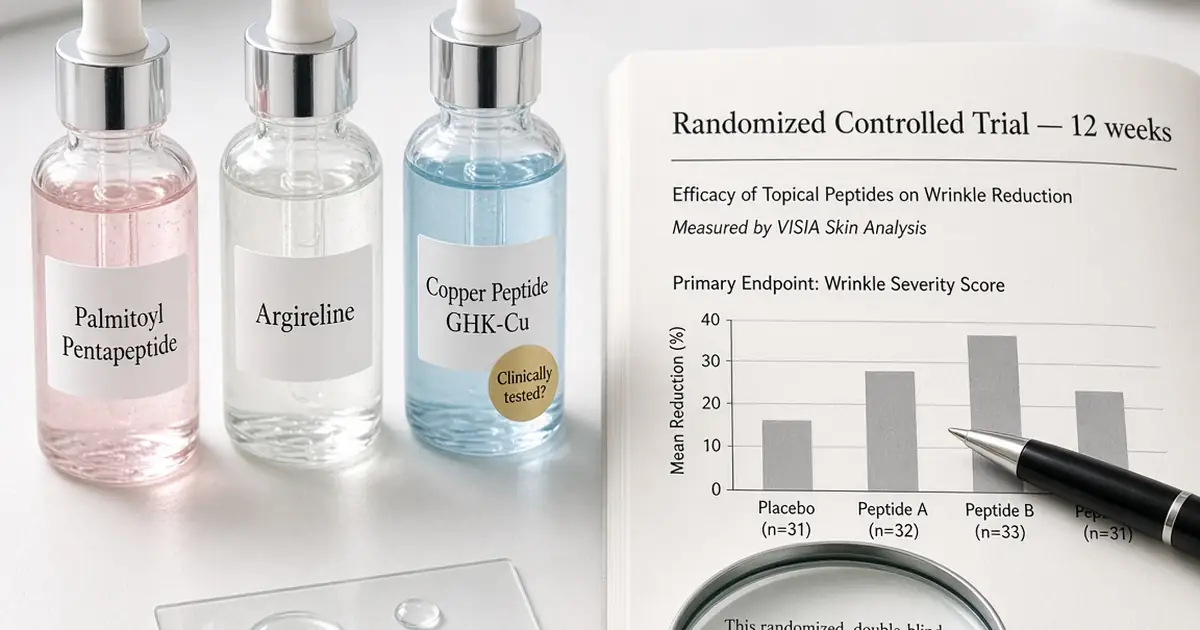
Turn a peptide serum around and the back panel can read like a lab notebook: a named peptide, a long chemical name, maybe the words "clinically tested." So is there published science behind any of it, or is that simply how skincare gets sold? The honest answer is more interesting than either.
Facts are as of November 3, 2026. Sources, with retrieval dates, are at the bottom.
If you only read one box
- Yes, real studies exist. Several cosmetic peptides have been tested on people against a placebo or plain base, and the researchers reported smoother-looking skin. [V]
- Those trials are small and short: a few dozen to about a hundred people, for 4 to 12 weeks. [V]
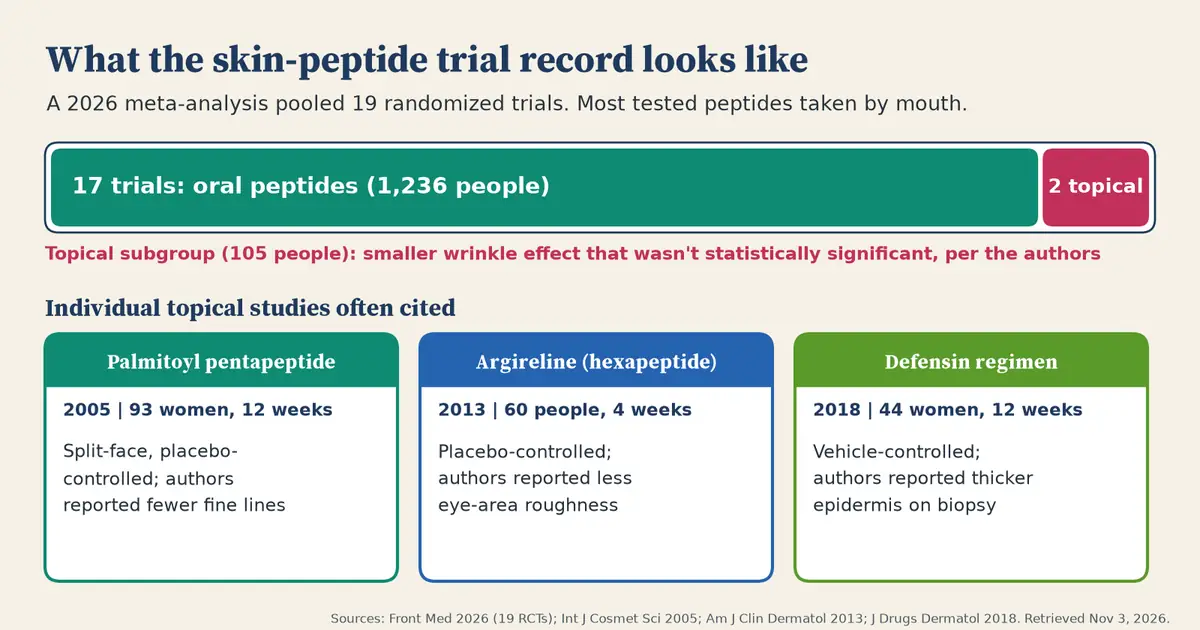
- A 2026 meta-analysis pooled 19 randomized trials of peptides for skin aging. Only 2 tested peptides put on the skin, and that small topical group didn't reach statistical significance for wrinkles. [V]
- A trial of one formula tells you about that formula, not every jar listing the same ingredient. FTC staff guidance says claims have to match what the research found. [V]
Three studies, three kinds of peptide
Skin peptides have been tested on people since at least the early 2000s. A 2009 review in the International Journal of Cosmetic Science sorted the peptides and proteins used on aging skin into four families: signal peptides, carrier peptides, peptides that block certain enzymes and peptides that damp down nerve signals. [V] The 2026 meta-analysis below uses the same four families. [V] Three placebo-controlled human studies show what that research looks like up close.
A signal peptide. Palmitoyl pentapeptide is a five-amino-acid chain with a fatty palmitoyl group attached, built to nudge skin toward making collagen. [V] In a 2005 study, 93 women aged 35 to 55 used a moisturizer with the peptide on one side of the face and the same moisturizer without it on the other, for 12 weeks. Both computer image analysis and expert graders found fewer wrinkles and fine lines on the peptide side, and the skin tolerated it well. [V] The authors worked at Procter & Gamble's Miami Valley Laboratories. [V]
A neurotransmitter-inhibitor peptide. Argireline, a six-amino-acid peptide, came out of a Spanish design program in 2002. Its designers wanted a non-toxic molecule that mimics botulinum toxin's knack for blocking nerve-signal release, with a much weaker effect. Their lab work showed it got in the way of the protein machinery cells use to let those signals out. [V] A 2013 randomized trial in China gave 60 people either Argireline or a placebo around the eyes for four weeks, three to one. In the graders' overall assessment, 48.9% of the Argireline group improved and none of the placebo group did, and skin-surface roughness measured from silicone casts dropped only with the peptide. [V]
A defensin regimen. A 2018 multi-center trial tested a serum, cream and mask built around two immune peptides, alpha-defensin 5 and beta-defensin 3. Forty-four women aged 41 to 71 finished 12 weeks, two-thirds on the full formula and one-third on look-alike products without the actives. The full-formula group showed a thicker outer skin layer on biopsy, plus fewer visible pores and superficial wrinkles; elasticity and hydration trended better without reaching significance. [V]

What the biggest review found
In March 2026, a research team from Canada, Saudi Arabia and Pakistan published a systematic reviewA review that collects studies on one question by a stated search method, often pooling their numbers. Glossary entry and meta-analysis in Frontiers in Medicine. They pooled 19 randomized controlled trials with 1,341 participants. [V] Across all of them, peptides improved hydration and brightness and had a modest overall effect on wrinkles. [V]
Then they split the trials by route. The wrinkle benefit came mostly from peptides taken by mouth, while the two topical trials showed a smaller effect that wasn't statistically significant. [V] The authors flag that imbalance themselves: with only two topical trials, they wrote, the results mostly describe oral peptides. They call for larger trials that compare the two routes directly. [V] Safety looked good across the board, with minimal adverse events and no serious ones reported. [V] The authors declared no outside funding and no conflicts of interest. [V]
- 19randomized trials pooled in the 2026 meta-analysis [V]
- 2of those tested peptides applied to the skin [V]
- 105people in the topical trials, out of 1,341 in total [V]
Why would route matter? The review explains that a peptide on the skin first has to get through the tough outer layer, the stratum corneum, and how well it does depends on the molecule's size, how readily it dissolves in fats and the base it's carried in. Attaching a lipid or using nanoparticle carriers may help. [V]
Where the label can run ahead of the paper
What people get wrong
"Clinically tested" means proven. It means a test happened. For health claims, the FTC looks for competent and reliable scientific evidence, and it weighs sample size, how long a study ran and what it measured. [V]
A study on the ingredient covers this bottle. Each trial above tested one specific formula. FTC staff guidance warns that a claim stretching past what the research actually found is likely to be deceptive, however sound the research is. [V]
If it builds collagen, it's still just skincare. FDA says a product meant to increase the skin's collagen production is a drug or a medical device. [V] That's why cosmetic labels lean on looks: "smoother-looking," "fine lines appear reduced."
Cosmetics, color additives aside, don't need FDA approval before they're sold. [V] Drugs need FDA approval for both safety and effectiveness first. [V] So the wording on a serum tells you which rulebook the company chose, and our page on skincare peptides as cosmetic or drug walks through that line. For the wider claims picture, see how FDA and FTC rules sort anti-aging peptide claims.
Limits and unknowns
None of the trials described here ran longer than 12 weeks, and they measured change in different ways: grader scores, image analysis, silicone casts, biopsies. [V] The 2005 study came from researchers at a company that makes skincare, so independent repeats would add weight. [V] We haven't reviewed every peptide sold in skincare. Copper peptide GHK-Cu has its own record, covered on our GHK-Cu human studies page.
Peptide Policy Watch
Do peptide serums have real research behind them, or just good marketing?
Printable checklist
Questions for your clinician
A short list built from this article, for a conversation with a clinician or pharmacist who knows you.
- Was the study done on this exact product, or on one ingredient in a different formula?
- Did it compare against a placebo or the same base without the peptide, and how many people took part?
- How long did it run, and how was the change measured?
- Is the full paper published somewhere I can read it?
Print view Select it, then use your browser’s Print command to print only this box.
Peptides taken by mouth have their own trial record, mostly collagen; our collagen research page has those details. And the next time a jar says "clinically tested," you know the follow-up: tested how, on what, and for how long?
Common questions
Have peptide serums been tested in placebo-controlled trials?
Some cosmetic peptides have. Examples include a 2005 split-face trial of palmitoyl pentapeptide in 93 women over 12 weeks and a 2013 placebo-controlled Argireline trial in 60 people over 4 weeks. Both reported smoother-looking skin. [V] Source: Robinson et al. 2005 (PubMed); Wang et al. 2013 (PubMed)
What did the 2026 meta-analysis find about topical peptides?
It pooled 19 randomized trials, but only 2 tested peptides applied to the skin. The wrinkle benefit came mostly from oral peptides; the topical effect was smaller and not statistically significant. [V] Source: Nukaly et al., Frontiers in Medicine 2026
Does FDA approve peptide serums before they're sold?
No. Cosmetics, apart from color additives, don't need FDA approval before going on the market. A product meant to increase collagen production is treated as a drug or device. [V] Source: FDA cosmetic vs. drug guidance
Sources (retrieved November 3, 2026 unless noted)
- Nukaly HY, et al., "Oral and topical peptides for skin aging: systematic review and meta-analysis of randomized controlled trials," Frontiers in Medicine, 2026;13 (published March 17, 2026; full text via Europe PMC, PMC13037056) [V] — https://doi.org/10.3389/fmed.2026.1618306
- Gorouhi F, Maibach HI, "Role of topical peptides in preventing or treating aged skin," International Journal of Cosmetic Science, 2009 (PubMed abstract) [V] — https://pubmed.ncbi.nlm.nih.gov/19570099/
- Robinson LR, et al., "Topical palmitoyl pentapeptide provides improvement in photoaged human facial skin," International Journal of Cosmetic Science, 2005 (PubMed abstract) [V] — https://pubmed.ncbi.nlm.nih.gov/18492182/
- Blanes-Mira C, et al., "A synthetic hexapeptide (Argireline) with antiwrinkle activity," International Journal of Cosmetic Science, 2002 (PubMed abstract) [V] — https://pubmed.ncbi.nlm.nih.gov/18498523/
- Wang Y, et al., "The anti-wrinkle efficacy of argireline, a synthetic hexapeptide, in Chinese subjects: a randomized, placebo-controlled study," American Journal of Clinical Dermatology, 2013 (PubMed abstract) [V] — https://pubmed.ncbi.nlm.nih.gov/23417317/
- Taub A, et al., multi-center, double-blind, vehicle-controlled trial of an alpha and beta defensin-containing skin care regimen, Journal of Drugs in Dermatology, 2018 (PubMed abstract) [V] — https://pubmed.ncbi.nlm.nih.gov/29601620/
- FTC staff, "Health Products Compliance Guidance," December 2022 (retrieved November 2, 2026) [V] — https://www.ftc.gov/business-guidance/resources/health-products-compliance-guidance
- FDA, "Wrinkle Treatments and Other Anti-aging Products," content current as of 02/25/2022 (retrieved November 2, 2026) [V] — https://www.fda.gov/cosmetics/cosmetic-products/wrinkle-treatments-and-other-anti-aging-products
- FDA, "Is It a Cosmetic, a Drug, or Both? (Or Is It Soap?)," content current as of 09/11/2024 (retrieved November 2, 2026) [V] — https://www.fda.gov/cosmetics/cosmetics-laws-regulations/it-cosmetic-drug-or-both-or-it-soap
Cite or link to this page
Peptide Policy Watch staff. “Do peptide serums have real research behind them, or just good marketing?.” Peptide Policy Watch. Published November 3, 2026. https://peptidepolicywatch.com/2026/11/03/peptide-serums-published-research-or-marketing-claims/
Link: https://peptidepolicywatch.com/2026/11/03/peptide-serums-published-research-or-marketing-claims/
Spot a mistake? See how we source and our corrections policy.
Image: AI-generated. Image credits