
Is glutathione FDA approved? What the human studies and FDA's records actually show
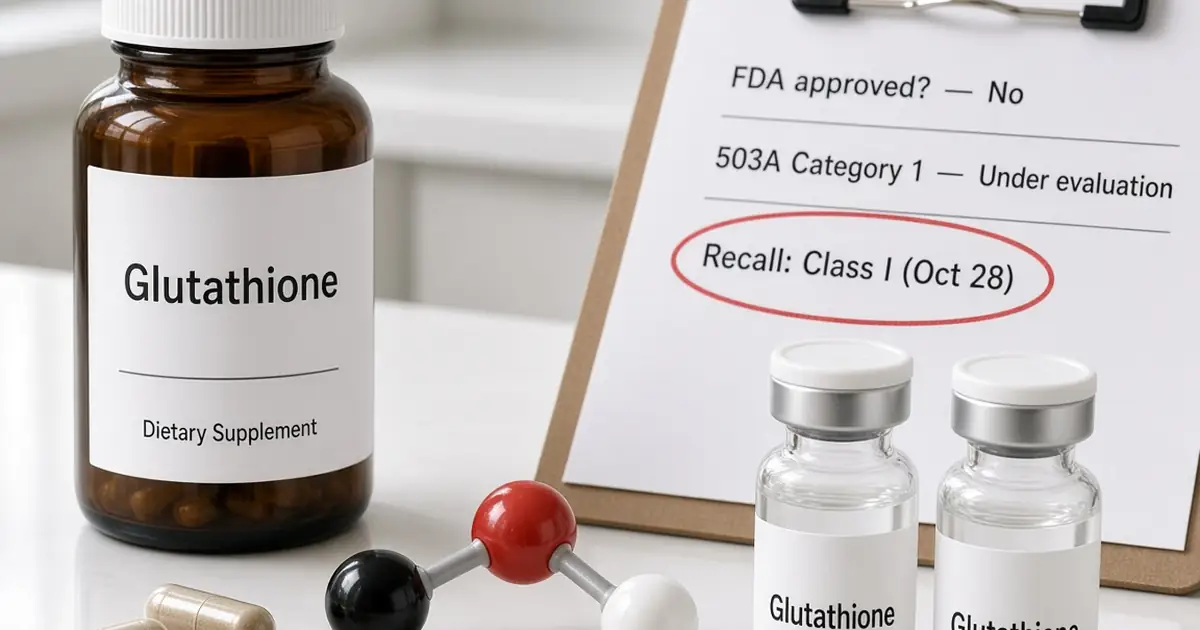
Glutathione gets called the body's "master antioxidant," and it's everywhere right now: capsules on drugstore shelves, IV drips at wellness clinics, and at least one big telehealth company saying it plans to offer it. So a fair first question is whether FDA has approved it for anything. It hasn't. The longer answer explains why glutathione can still be sold, and why it keeps turning up in FDA safety notices.
Facts are as of November 3, 2026. Sources, with retrieval dates, are at the bottom.
What to know first
- According to CDC, no glutathione product has FDA approval in the U.S. It's sold here as a dietary supplement taken by mouth. [V]
- Supplements don't need FDA approval before they're sold, and FDA generally doesn't approve their label claims. [V]
- Glutathione sits on FDA's 503ASection of federal drug law covering compounding by state-licensed pharmacies and doctors, usually for a prescription written for one patient. Glossary entry "Category 1An interim FDA group of nominated bulk ingredients that FDA generally does not object to pharmacies using while its review continues. Not an approval. Glossary entry" list, which means it's under evaluation for compounding. That's an enforcement stance, not an approval. [V]
- Small human trials of oral glutathione disagree: one six-month trial found higher blood levels, while a four-week trial found no change. [V]
- Since July 2026, contaminated compounded glutathione injections have been linked to illness, and FDA classified one 2026 recall as Class I on October 28. [V]
What glutathione is
Glutathione is a tripeptide: three amino acids (glutamic acid, cysteine and glycine) linked together. [V] Your body makes it, and researchers describe it as the most abundant antioxidant made inside human cells. [V] That's why it lands on a peptide site at all, even though it's far smaller than the peptides in most of our policy coverage.
Being made by the body doesn't tell you what a pill or an infusion does, though. That's a question for trials.
Why it's on store shelves without approval
FDA approval is a drug concept. For dietary supplements, FDA's own Q&A says the agency has no authority to approve them before they reach the market, and companies generally don't have to show FDA their safety evidence first. [V] FDA also doesn't sign off on the wording of most supplement claims before they're printed. [V]
CDC's description of how glutathione is promoted in the U.S. reads like a supplement aisle: skin brightening, immune support, detoxification and more energy. [V] None of those are FDA-approved uses, because there's no approved glutathione product to carry them. [V] If you want to read what a supplement label is and isn't telling you, our guide to proprietary blends is a good companion.
What the human trials found
Here's where people often get a cleaner story than the research supports. The controlled trials we found are small, short and pointed in different directions:
- A six-month trial at Penn State (2015). 54 healthy nonsmoking adults took oral glutathione or placebo. Glutathione levels in blood rose in both treatment groups and fell back after a one-month washout. Immune-cell activity rose in the higher-intake group at three months. [V]
- A four-week trial at Bastyr University (2011). 40 healthy adults took oral glutathione or placebo. The researchers found no significant change in oxidative stress markers or in glutathione levels in red blood cells. [V]
- A 24-week trial in children with cystic fibrosis (2020). 58 children finished. Oral glutathione didn't change growth or inflammation markers compared with placebo, though the authors reported it was safe and well tolerated. [V]
- A three-week trial in Denmark (2021). 20 men with obesity, half with type 2 diabetes. Insulin sensitivity rose in the glutathione group, but oxidative stress markers didn't move. [V]
- 54adults in the longest oral glutathione trial we found (6 months) [V]
- 40adults in a 4-week trial that found no change in glutathione status [V]
- 0FDA-approved glutathione products in the U.S., per CDC [V]
A newer 2026 crossover study compared how well three oral supplement forms raised blood glutathione in 14 people. Several authors work for or advise companies in the supplement business, and one formulation it tested is covered by a pending patent, which the paper discloses. [V] Absorption studies like that one measure blood levels, not whether anyone feels or functions better.
So the honest summary is that oral glutathione can raise blood levels in some studies, and no trial we found shows it treats a disease. That matches the absence of any approval.
The IV side, and why FDA keeps writing about it
Most of FDA's recent glutathione notices are about injections, not capsules. On August 27, 2026, FDA said it knew of at least 30 patients who had adverse events after IV glutathione made by different compounding pharmacies, all traced to one lot of dietary supplement grade glutathione from a single supplier. [V] FDA reminded compounders that supplement-grade ingredients may carry impurities, including endotoxins, and shouldn't go into injectable drugs. [V]
CDC opened its own investigation page. It says heavy endotoxin exposure can bring on fever and chills, aches, headache, nausea, dizziness or a drop in blood pressure, and notes earlier outbreaks in Australia in 2015 and at a U.S. clinic in 2019. [V]
Recalls followed. FDA's enforcement data lists four compounding pharmacies with glutathione recalls reported since August 2026, three of them already classified as Class I. [V] The most recent classification, dated October 28, 2026, covers the Greenwich Rx recall of 4,319 vials. [V] FDA reserves Class I for cases where using the product could reasonably cause serious health problems or death. [V] Our Greenwich Rx recall explainer has the details of that notice.
Where it sits on the compounding lists
Glutathione appears in Category 1 of FDA's list of substances nominated for 503A compounding, last updated May 14, 2026. NAD and NADH sit on the same list. [V] Category 1 means FDA is still evaluating the substance and, for now, doesn't plan to act against compounders who meet its conditions. [V] Our Category 1, 2 and 3 explainer walks through what each category means.
It isn't one of the six peptides in HHS's October 2026 interim compounding policy. That policy covers a different group, which our six-peptide breakdown lists. [V]
What people get wrong
"Category 1" means FDA cleared it. It means FDA hasn't finished evaluating it. The list describes when FDA doesn't intend to take enforcement action, and it says nothing about whether the substance works. [V]
Natural means safe in any form. The 2026 illnesses weren't about glutathione itself. FDA tied them to supplement-grade ingredients that weren't meant for injection, and the endotoxins that can come with them. [V]
A study showing higher blood levels proves a benefit. Higher levels in blood are a lab measurement. The Penn State trial measured body stores and immune markers, not health outcomes like illness or energy. [V]
Peptide Policy Watch
Is glutathione FDA approved? What the human studies and FDA's records actually show
Printable checklist
Questions for your clinician
Questions this page raises, worth bringing to a clinician or pharmacist familiar with your health history.
- Is this product FDA-approved, compounded, or a dietary supplement?
- If it's compounded for injection, was it made from an ingredient intended for injection rather than supplement grade?
- Has the pharmacy that made it had any recent recalls?
- What result are we expecting, and what evidence supports it?
Print view Select it, then use your browser’s Print command to print only this box.
What we couldn't confirm
We didn't find a large, long-term trial showing that glutathione, by mouth or by IV, improves a health outcome. If one exists that we missed, we'll add it. [U] CDC's investigation page was updated in September 2026, and we couldn't load a newer version today, so case counts may have moved since. [U] The skin-lightening trials in the literature are outside this page's scope.
The short version holds, though: glutathione is a real molecule with real biology, sold as a supplement, under evaluation for compounding, and approved for nothing.
Sources (retrieved November 3, 2026 unless noted)
- PubChem (National Library of Medicine), Glutathione, compound summary CID 124886 [V] — https://pubchem.ncbi.nlm.nih.gov/compound/124886
- CDC, "Adverse Events Linked to Injectable Glutathione Compounded with Dietary Supplement Grade Ingredient: Current Situation," updated September 11, 2026 (page dated September 15, 2026; retrieved October 29, 2026) [V] — https://www.cdc.gov/healthcare-associated-infections/current-situation/index.html
- FDA, "Questions and Answers on Dietary Supplements" [V] — https://www.fda.gov/food/information-consumers-using-dietary-supplements/questions-and-answers-dietary-supplements
- FDA, Bulk Drug Substances Nominated for Use in Compounding Under Section 503A (Categories 1-3), updated May 14, 2026 [V] — https://www.fda.gov/media/94155/download
- Richie JP Jr et al., "Randomized controlled trial of oral glutathione supplementation on body stores of glutathione," European Journal of Nutrition, 2015 (online May 5, 2014), PubMed 24791752 [V] — https://pubmed.ncbi.nlm.nih.gov/24791752/
- Allen J, Bradley RD, "Effects of oral glutathione supplementation on systemic oxidative stress biomarkers in human volunteers," J Altern Complement Med, September 2011, PubMed 21875351 [V] — https://pubmed.ncbi.nlm.nih.gov/21875351/
- Bozic M et al., "Oral Glutathione and Growth in Cystic Fibrosis," J Pediatr Gastroenterol Nutr, December 2020, PubMed 32960827 [V] — https://pubmed.ncbi.nlm.nih.gov/32960827/
- Søndergård SD et al., "The effects of 3 weeks of oral glutathione supplementation on whole body insulin sensitivity in obese males with and without type 2 diabetes," Appl Physiol Nutr Metab, 2021, PubMed 33740389 [V] — https://pubmed.ncbi.nlm.nih.gov/33740389/
- Solnier J et al., "A Targeted Metabolomic Assessment of Oral Glutathione Bioavailability and Safety in Humans," Antioxidants, March 11, 2026, PubMed 41897500 [V] — https://pubmed.ncbi.nlm.nih.gov/41897500/
- FDA, "FDA reminds compounders not to use dietary supplement grade glutathione for injectables," August 27, 2026 [V] — https://www.fda.gov/drugs/human-drug-compounding/fda-reminds-compounders-not-use-dietary-supplement-grade-glutathione-injectables
- openFDA drug enforcement reports, glutathione recalls with report dates June 1 to November 3, 2026 (includes D-0084-2027, Greenwich Rx, Class I, report date October 28, 2026) [V] — https://api.fda.gov/drug/enforcement.json?search=product_description:glutathione+AND+report_date:[20260601+TO+20261103]&limit=50
- FDA, "Recalls Background and Definitions" [V] — https://www.fda.gov/safety/industry-guidance-recalls/recalls-background-and-definitions
- HHS, Enforcement Discretion Policy Regarding 503A Compounding Using Certain Peptide Bulk Drug Substances, October 28, 2026 (retrieved October 29, 2026) [V] — https://www.hhs.gov/sites/default/files/hhs-503a-peptide-enforcement-discretion-policy-appendix-b.pdf
Cite or link to this page
Peptide Policy Watch staff. “Is glutathione FDA approved? What the human studies and FDA's records actually show.” Peptide Policy Watch. Published November 3, 2026. https://peptidepolicywatch.com/2026/11/03/is-glutathione-fda-approved-human-studies-compounding-status/
Spot a mistake? See how we source and our corrections policy.
Image: AI-generated. Image credits