
Proprietary blend on a supplement label: what it tells you and what it can leave out
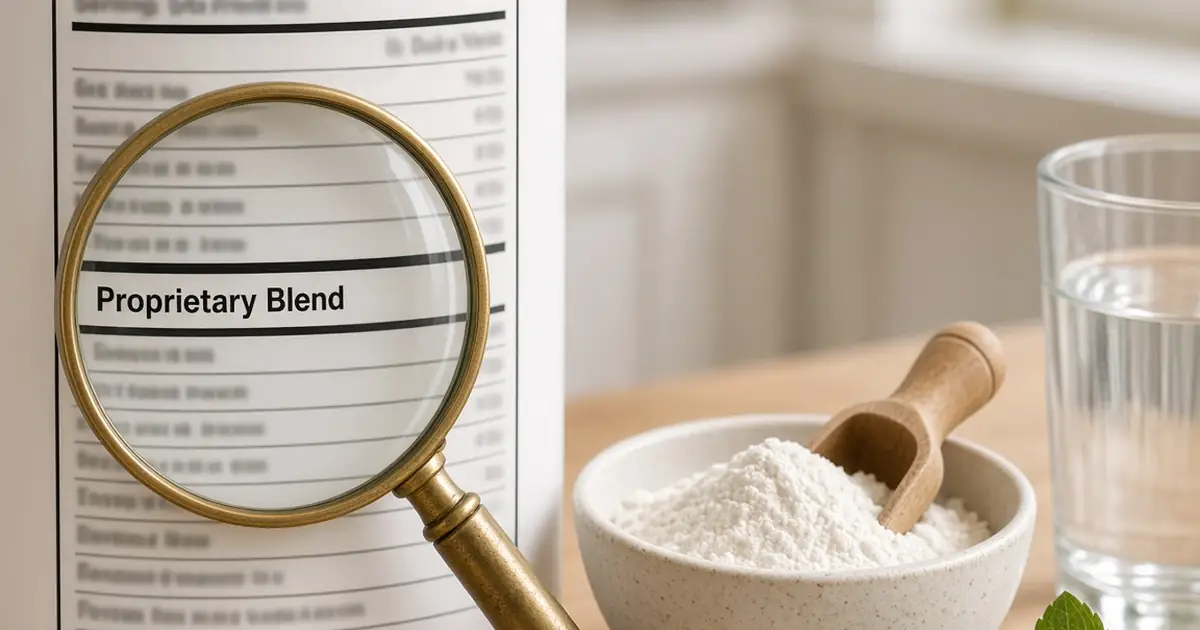
A "proprietary blend" line on a Supplement Facts panel is legal, common and often misunderstood. Federal rules require the blend's total weight and the order of its ingredients, but not how much of each one is inside, and that gap is worth understanding before you read the next label, including on collagen peptide and "recovery" products.
Facts are as of November 2, 2026. Sources, with retrieval dates, are at the bottom.
What a blend line can and can't tell you
- FDA's labeling rule, 21 CFR 101.36, lets a supplement group ingredients under the name "Proprietary Blend" or a descriptive or fanciful name. [V]
- The label must give the blend's total weight and list its ingredients from most to least by weight. It doesn't have to give each ingredient's amount. [V]
- Vitamins and minerals with a set Daily Value still have to be listed separately with their own weights, even inside a blend. [V]
- FDA doesn't approve supplements or their labels before they're sold; the company is responsible for getting both right. [V]
- USADA warns that labels can misidentify or leave out ingredients, a risk that matters most to tested athletes. [V]
What the Supplement Facts panel has to show
Every dietary supplement sold in the US needs a nutrition panel called Supplement Facts, unless a specific exemption applies. [V] FDA's labeling guide describes the basics: a serving size, then the dietary ingredients and their amounts per serving. [V]
The rule splits ingredients into two groups. The first is nutrients that have a reference value, such as vitamin C or calcium. For those, the panel gives an amount and usually a percent Daily Value. [V] The second group, called "other dietary ingredients," covers things like botanicals and amino acids that have no Daily Value. Each one is marked with a symbol pointing to the footnote "Daily Value not established." [V] Outside a blend, each of these also gets its own weight per serving. [V]
Collagen peptides usually fall in that second group when they appear in a supplement. Under the rule, that would typically mean a gram amount with an asterisk where a percent would otherwise sit. [V] Our collagen research page covers what the human trials on collagen peptides have found.
How a proprietary blend changes the panel
Here's the exception. Under 101.36(c), a company can bundle some "other dietary ingredients" into a blend, give it a name and print it in bold. [V] Three rules then apply:
| What the rule requires | What it allows |
|---|---|
| The blend's total weight, on the same line as its name [V] | No amount for each ingredient inside it [V] |
| Ingredients listed from most to least by weight, indented under the blend name [V] | A descriptive or fanciful name instead of "Proprietary Blend" [V] |
| Vitamins and minerals with Daily Values listed separately, each with its weight [V] | Keeping the exact recipe private |
So a reader can tell which ingredient makes up the largest share of a 2-gram blend, and which the smallest. What a reader can't tell is whether the first ingredient is 1.9 grams and the others share the last 0.1, or whether they're close to even. The ranking is real information, but it doesn't add up to a recipe.
Why allow it? The rule itself doesn't say. The usual explanation is that a formula can be a trade secret, so the rule protects the recipe while still requiring the order and the total. Many companies list every amount anyway, which gives the reader more to work with. [U]
- 101.36(c)the paragraph of FDA's rule that governs blends [V]
- 1weight required for a blend: the total [V]
- 0individual amounts required for the "other dietary ingredients" inside it [V]
Common misreadings
What people get wrong
"If FDA allows the label, FDA checked the product." It didn't. FDA says it has no authority to approve dietary supplements before they're marketed and generally doesn't approve their labeling before use. [V]
"A blend hides illegal ingredients." Not by design. A blend still has to list every ingredient in it by name. What it can leave out is the amount of each one. [V] Mislabeling, when it happens, is a separate problem.
"First on the list means most of the product." Most of the blend, yes. Not necessarily most of the whole capsule or scoop, which can also contain ingredients outside the blend. [V]
Where labels can go wrong
The bigger worry for some readers isn't a legal blend. It's a label that doesn't match what's inside. USADA's 2026 Clean Sport Handbook warns that a label can name a prohibited substance wrongly or skip it entirely, and notes that FDA doesn't analyze a supplement's contents before it's sold. [V] The NCAA's banned-substances page carries a similar warning: a supplement can carry banned ingredients the label never mentions. [V]
“No organization, including USADA, can guarantee the contents or safety of any dietary supplements.”
For athletes this matters because anti-doping rules hold them responsible for whatever is in their sample. [V] For everyone else, it's a reason to treat a label as a company's statement rather than a lab result. FDA does require supplement makers to follow manufacturing rules meant to protect identity, purity and composition, and it enforces them after products reach the market through inspections and import checks. [V] Our cGMP and certificate of analysis page explains what those quality words mean.
Peptides that never get a Supplement Facts panel
Many peptides that come up in gym and wellness talk, such as BPC-157, aren't sold as supplements at all. They're often labeled "for research use only," which is a different lane with no Supplement Facts panel. USADA says products labeled that way, or with no label, carry risk both for health and for anti-doping status. [V] Our research-use-only label decoder covers what that phrase does and doesn't mean, and our anti-aging claims page covers the claim rules that sit on top of any label.
Peptide Policy Watch
Proprietary blend on a supplement label: what it tells you and what it can leave out
Printable checklist
Questions for your clinician
General questions drawn from this page, to take to a clinician or pharmacist who knows your health history.
- Could any ingredient in this blend interact with a medicine I take?
- The blend doesn't list amounts. Is that a concern for me specifically, given my health conditions?
- Is anything on this label banned in my sport, if I'm a tested athlete?
- Is this product a supplement, a cosmetic or something else, and what does that mean for how it was checked?
Print view Select it, then use your browser’s Print command to print only this box.
Limits and unknowns
This page explains federal labeling rules. It doesn't evaluate any product, brand or ingredient, and it isn't a guide to choosing one. [V] FDA's labeling guide we used dates from April 2005; the eCFR text of 101.36 we read reflects amendments through 2018. [V] We didn't find FDA data on how many supplements use blends or how often blend labels are inaccurate, so we don't estimate either. [U] State laws can add requirements we haven't covered. [U]
Why it matters
Peptide products now show up across supplement shelves, from collagen powders to blends marketed for recovery. Knowing what a label is required to say, and what it isn't, makes the whole panel easier to read, and it puts the more important questions where they belong: with the evidence for the ingredient and a clinician who knows your health.
What to watch next
- Any FDA proposal to change 21 CFR 101.36, which would appear in the Federal Register. [U]
- FDA's wider dietary supplement work, posted on its Questions and Answers page (content current as of August 27, 2026). [V]
Sources (retrieved November 2, 2026 unless noted)
- 21 CFR 101.36, nutrition labeling of dietary supplements (eCFR; amendments through 83 FR 65502, December 21, 2018; retrieved November 1, 2026) [V] — https://www.ecfr.gov/current/title-21/chapter-I/subchapter-B/part-101/subpart-C/section-101.36
- FDA, "Dietary Supplement Labeling Guide: Chapter IV. Nutrition Labeling," April 2005 (retrieved November 1, 2026) [V] — https://www.fda.gov/food/dietary-supplements-guidance-documents-regulatory-information/dietary-supplement-labeling-guide-chapter-iv-nutrition-labeling
- FDA, "Questions and Answers on Dietary Supplements," content current as of 08/27/2026 (retrieved October 28, 2026) [V] — https://www.fda.gov/food/information-consumers-using-dietary-supplements/questions-and-answers-dietary-supplements
- USADA, 2026 Clean Sport Handbook, dietary supplements section [V] — https://www.usada.org/wp-content/uploads/2026-Clean-Sport-Handbook%5Fv2.pdf
- NCAA, Banned Substances, supplement and medication warning (retrieved October 27, 2026) [V] — https://www.ncaa.org/sports/2015/6/10/ncaa-banned-substances.aspx
Spot a mistake? See how we source and our corrections policy.
Image: AI-generated. Image credits