Is BPC-157 or TB-500 banned in the NCAA? College and pro league peptide rules beyond WADA
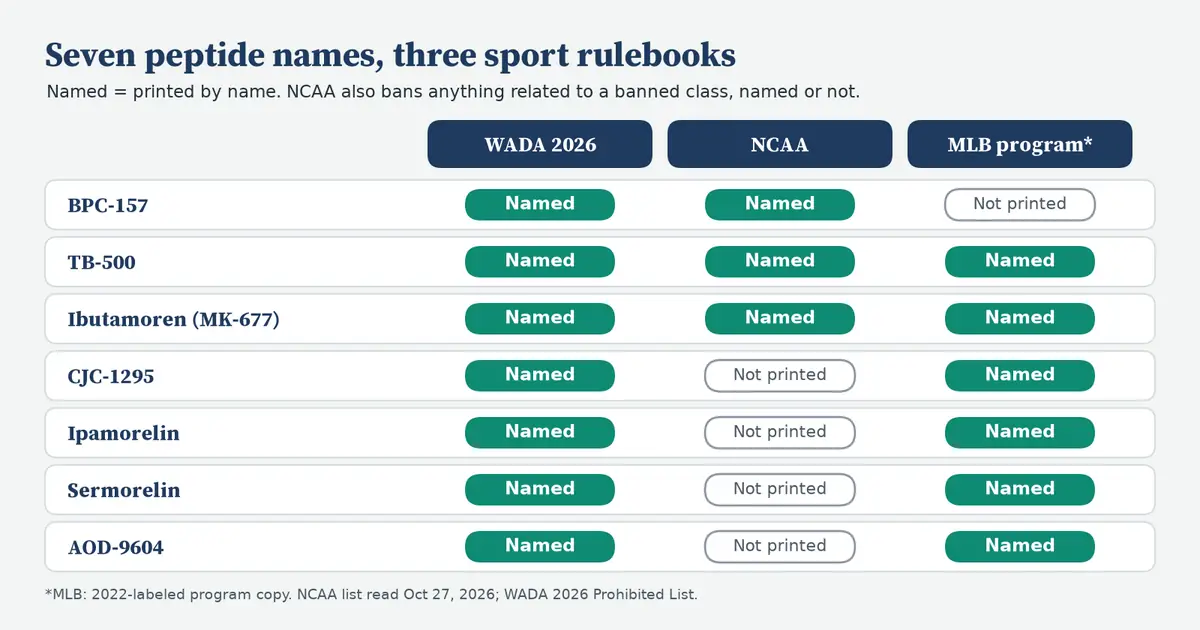
Plenty of college athletes hear about BPC-157 or TB-500 from a teammate, a trainer's podcast or a recovery forum long before they hear about drug-testing rules. And most of them aren't covered by WADAWorld Anti-Doping Agency: it publishes the yearly Prohibited List for tested sport. Glossary entry directly at all. The NCAA writes its own banned-drug list, and pro leagues like Major League Baseball bargain theirs with the players' union. Here's what those rulebooks actually say about peptides, in the governing bodies' own documents.
Facts are as of October 27, 2026. Sources, with retrieval dates, are at the bottom.
At a glance
- The NCAA bans a whole class of peptide hormones and growth factors, plus related substances and mimics. Its own examples include BPC-157, TB-500 and ibutamoren (MK-677). [V]
- The NCAA says its examples aren't a complete list: anything chemically or pharmacologically related to a banned class counts too. [V]
- MLB's drug program, in the public copy we read, names TB-500, CJC-1295, ipamorelin, sermorelin, tesamorelin and AOD-9604 in its list of banned performance-enhancing substances. [S]
- WADA's 2026 List names all of those, plus BPC-157 under its non-approved substances class (S0). [V]
Why this question keeps coming up
Peptides have a real following in training culture. Recent reviews describe BPC-157 as the peptide most talked about in fitness circles, and the animal research behind it is genuinely large. [V] Our Wolverine page walks through that research. But a college athlete answers to a different authority than a gym member does. Tested sport has its own lists, and they don't wait for FDA to decide anything.
The NCAA: a class ban, with examples
The NCAA's banned-substances page groups everything into eight banned drug classes. Number six covers peptide hormones and growth factors, along with related substances and mimics. [V] In its table of examples for that class, the NCAA lists BPC-157 and TB-500 by name, next to familiar entries such as EPO, growth hormone, hCG, IGF-1 and ibutamoren (MK-677). [V] It also carves out three named exceptions in that row: insulin, Synthroid and Forteo aren't banned. [V]
The bigger point is how the NCAA writes the rule. Its page says plainly that the list of examples is neither complete nor exhaustive, and that any substance related chemically or pharmacologically to a banned class is banned as well, named or not. [V] It adds, in capitals, that there's no complete list of banned substances. [V] So "it isn't on the list" isn't the same as "it's allowed." CJC-1295, ipamorelin and sermorelin aren't printed among the NCAA's examples, for instance, but they belong to the same growth-hormone-signaling family that WADA and MLB name in their peptide sections. Whether the NCAA would treat a given name as covered is its call, not ours. [U]
There is no complete list of banned substances. [V]
The NCAA also puts responsibility squarely on the athlete and school. Its page says athletes should report all their medications, prescription and over-the-counter, to their athletics health care provider and check with athletics staff before using any substance. [V] For label questions it points to one service, Drug Free Sport AXIS, as its authoritative reviewer of ingredients. [V]
Pro leagues: rules bargained with the players
Pro leagues work differently from Olympic sport. MLB's drug program, for example, was set up by agreement between the Commissioner's Office and the players' association, and disputes go through the league's grievance procedure. [S]
MLB's Joint Drug Prevention and Treatment Program is the clearest public example on peptides. In the copy we read (the version posted by the players' association, labeled 2022), the program's list of banned performance drugs includes a line for growth hormone, secretagogues and peptides. That line names AOD-9604, CJC-1295, ipamorelin, sermorelin, tesamorelin and ibutamoren, along with thymosin beta-4 under its TB-500 name. [S] We read that document through a search-index text copy because the PDF wouldn't download to our tools, so we've marked it [S]. BPC-157 isn't printed in that line. MLB's program also has its own therapeutic use exemption process. [S]
We haven't read the current NFL, NBA or NHL policies in full, so we aren't summarizing them here. [U] Players in those leagues get their policy from the league and union, and that's the document that counts.
How the three rulebooks line up
| The question | Answer | What the record shows |
|---|---|---|
| BPC-157 | Named by NCAA and WADA | NCAA peptide-hormone examples; WADA 2026 S0. Not printed in the MLB line we read. [V] [S] |
| TB-500 | Named by all three | NCAA examples; WADA S2.3 (thymosin-β4 and derivatives); MLB names it as thymosin beta-4. [V] [S] |
| Ibutamoren (MK-677) | Named by all three | NCAA examples; WADA S2.2.4; MLB peptide line. [V] [S] |
| CJC-1295 | Named by WADA and MLB | Not printed among the NCAA's examples; the NCAA's related-substances rule still applies to the class. [V] [S] |
| Ipamorelin | Named by WADA and MLB | Same pattern as CJC-1295 on the NCAA side. [V] [S] |
| Sermorelin | Named by WADA and MLB | Same pattern on the NCAA side. Sermorelin was once an FDA-approved medicine; see our sermorelin page. [V] [S] |
| AOD-9604 | Named by WADA and MLB | WADA S2.2.3, growth hormone fragments; not among the NCAA's printed examples. [V] [S] |
WADA's column comes from the 2026 Prohibited List, which we read in full. The sermorelin page covers that peptide's FDA history. Our athletes page has a quick filter for 15 names on that list, and our 14-peptide status table sets the WADA column beside FDA's.
What USADA says about BPC-157
USADA, the U.S. anti-doping agency for Olympic and Paralympic sport, has a dedicated BPC-157 page. It confirms the S0 listing and notes that the peptide isn't approved for human clinical use by FDA or any other health authority. [V] It describes the research as mostly animal work on soft tissue, bone, gut and nerve injury, and says human clinical trials haven't established efficacy. [V] It also says a therapeutic use exemption for BPC-157 is unlikely to be granted because permitted alternatives exist. [V] For the human research picture so far, see BPC-157 in people.
Canada's anti-doping body sent a similar reminder on April 27, 2026, noting that BPC-157 and similar unapproved peptides fall under S0 and that possession or trafficking, not just use, can be a violation under its program. [V]
What people get wrong
"It's not on the NCAA's list, so it's fine." The NCAA says its examples are incomplete and that related substances in a banned class are banned too. [V]
"Pro leagues just copy WADA." MLB's program is its own document, negotiated with the players, with its own named list and exemption process. [S]
"A supplement label would tell me if something's banned." The NCAA warns that supplements can contain banned substances not listed on the label, and says it approves no supplements at all. [V]
Limits and unknowns
The NCAA page carries no revision date, so we can only say what it showed on October 27, 2026. [V] Our MLB reading is a 2022-labeled copy, and the current edition may differ. [S] We haven't covered testing methods, detection or penalties, and we won't: this page is about what the rules say. [U] Schools and conferences can also run their own programs on top of the NCAA's. [U]
Peptide Policy Watch
Is BPC-157 or TB-500 banned in the NCAA? College and pro league peptide rules beyond WADA
Printable checklist
Questions for your clinician
General questions drawn from this page, to take to a clinician or pharmacist who knows your health history.
- Which rulebook covers me: NCAA, a pro league program, a national anti-doping agency or more than one?
- Is this name banned by example, or by the related-substances rule for its class?
- If a doctor prescribes something, how do I report it and is there an exemption process?
- Has our ingredient-review service checked this product's label?
Print view Select it, then use your browser’s Print command to print only this box.
What to watch next
Dates and decisions we're tracking
- January 1, 2027WADA's 2027 Prohibited List takes effect, adding "peptides" to the S0 wording [S]
- OngoingNCAA updates to its banned-drug classes during the academic year, which its page says can happen [V]
- PendingFDA's interim peptide compounding policy (RIN 0910-ZD94), under White House review since October 14, 2026 [V]
For how sport rules sit beside FDA's, see Are peptides legal in the US?. For BPC-157 across every list, see Is BPC-157 FDA-approved?.
Sources (retrieved October 27, 2026 unless noted)
- NCAA, "NCAA Banned Substances" (no revision date shown) [V] — https://www.ncaa.org/sports/2015/6/10/ncaa-banned-substances.aspx
- MLB and MLBPA, Joint Drug Prevention and Treatment Program, 2022-labeled copy, read via search-index text [S] — https://registrationz.mlbpa.org/pdf/2022JointDrugProgram_English.pdf
- MLB, Player Resource Center, drug program page [S] — https://www.mlb.com/player-resource-center/drug-program
- WADA, 2026 Prohibited List (PDF), read in full (retrieved October 26, 2026) [V] — https://www.wada-ama.org/sites/default/files/2025-09/2026list_en_final_clean_september_2025.pdf
- WADA, "WADA publishes 2027 Prohibited List," September 21, 2026 (retrieved October 25, 2026) [V] — https://www.wada-ama.org/en/news/wada-publishes-2027-prohibited-list
- USADA, "BPC-157: Experimental Peptide Creates Risk for Athletes" [V] — https://www.usada.org/spirit-of-sport/bpc-157-peptide-prohibited/
- Sport Integrity Canada, "Reminder: Non-Approved Peptides Included on the Prohibited List," April 27, 2026 [V] — https://sportintegrity.ca/news/reminder-non-approved-peptides-included-prohibited-list
- OMB/OIRA, pending EO 12866 review, RIN 0910-ZD94, received October 14, 2026 [V] — https://www.reginfo.gov/public/do/eoDetails?rrid=1568964
- HSS Journal, BPC-157 review, 2025 (PMID 40756949; retrieved October 25, 2026) [V] — https://pubmed.ncbi.nlm.nih.gov/40756949/
Spot a mistake? See how we source and our corrections policy.