
"Naturally occurring" peptides: what the phrase tells you, and what it leaves out
You've probably seen it on a product page, in a forum thread or in a podcast clip: "it's a peptide your body already makes." That's a fair thing to be curious about. Origin is one of the more interesting parts of the peptide story, and it reaches all the way back to insulin. But "natural" and "synthetic" turn out to describe how a molecule was made, not what the rules say about it or what the research has shown. Here's how the pieces fit.
Facts are as of November 1, 2026. Sources, with retrieval dates, are at the bottom.
The short version
- Many approved peptide medicines are lab-made copies or close cousins of hormones the body produces. [V]
- Pitocin's label says its oxytocin is made synthetically to avoid contamination with other hormones. Made in a lab can mean cleaner. [V]
- In US drug law, a product's intended use decides whether it's regulated as a drug, not where the molecule came from. [V]
- FDA has never formally defined "natural," even for food. [V]
- 94%of semaglutide's sequence matches human GLP-1, per its FDA label [V]
- 40amino acids: above this, FDA's rule calls a chain a protein [V]
- 3small pilot studies of BPC-157 in humans, per a 2025 review [V]
Most peptide medicines started as the body's own molecules
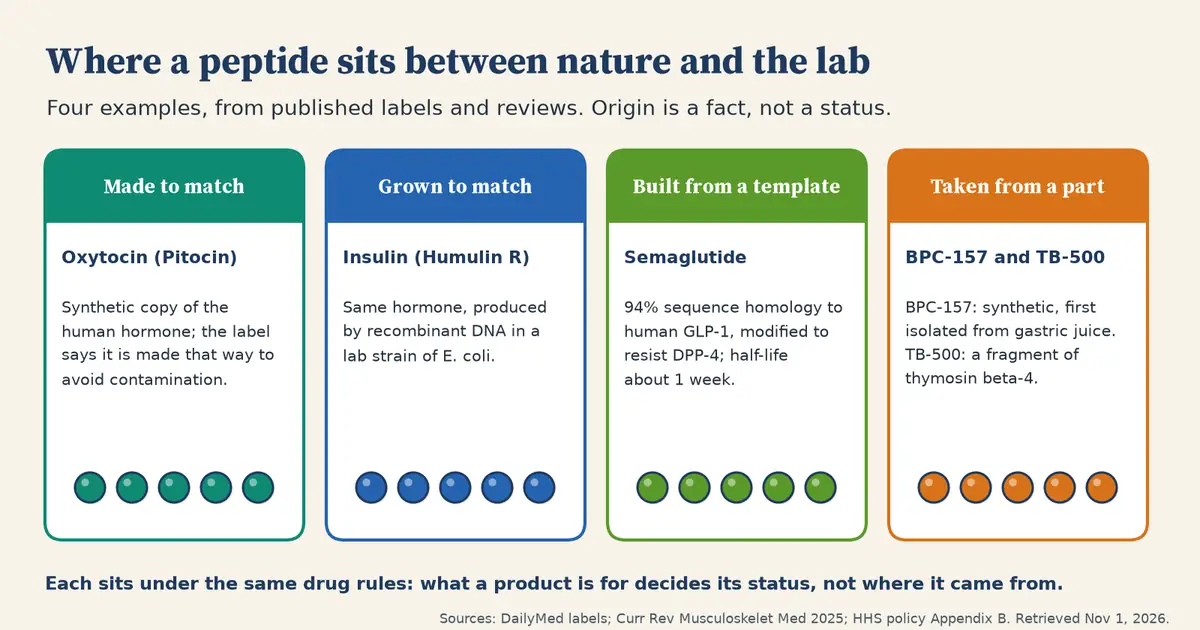
The history here is a good one. Insulin, the first big peptide medicine, is a hormone your pancreas makes. Today's Humulin R is human insulin, and its label says it's produced by recombinant DNA technology using a lab strain of E. coli. [V] Same molecule as the body's, grown by microbes. Our timeline of peptide medicines traces how that path led to today's GLP-1 drugs.
Oxytocin is another example. The Pitocin label describes its contents as synthetic oxytocin and gives a reason: the hormone is "prepared synthetically to avoid possible contamination with vasopressin (ADH) and other small polypeptides." [V] That's a nice reversal of the usual intuition. Here, a fully lab-made version is the one chosen for purity.
“The hormone is prepared synthetically to avoid possible contamination with vasopressin”
Some of the best-known peptides are deliberate redesigns
Semaglutide starts from a natural hormone and changes it on purpose. Its label says 94% of its amino-acid sequence matches human GLP-1. [V] It's modified at position 8 to resist breakdown by the enzyme DPP-4, and it binds albumin in the blood, so its elimination half-life is about a week. [V] The label names albumin binding as the main reason the molecule lasts so long, and that staying power is the point of the redesign. [V] Our GLP-1 explainer covers how the approved, compounded and research-labeled versions differ.
Where BPC-157 and TB-500 fit
These two come up most often in "naturally occurring" conversations, and both have a real link to the body, with a twist.
A 2025 review in Current Reviews in Musculoskeletal Medicine describes BPC-157 as a synthetic 15-amino-acid peptide first isolated from gastric juice. [V] So it traces back to a stomach protein, while the material studied is made in a lab. The authors report regenerative effects across many animal models (animal evidence) and count three small human pilot studies, with no adverse effects reported in them (small human studies). [V] They call for well-designed human trials. [V] Our BPC-157 status explainer has the regulatory side.
TB-500 is described in HHS's October 2026 policy as a fragment of thymosin beta-4. HHS's reasoning points to the full parent protein's safety record in controlled human studies, and says the fragment is quickly cut down in human blood serum. [V] That's a case where the natural-protein background actually did work in a policy argument: HHS used it as one reason to let licensed compounders use TB-500 under conditions. See our brief on the six-peptide policy and our thymosin beta-4 trials page.
Why "natural" isn't a legal category
Under the federal drug definition, an article intended to diagnose, cure, mitigate, treat or prevent disease is a drug. [V] Nothing in that definition turns on origin. A synthetic copy and an extracted version sit under the same rules, and the same compound can be regulated differently depending on how it's sold and what it's sold for. We cover that in what "legal" means for peptides.
Size matters more than origin in one spot. FDA's biologics rule defines a protein as an amino-acid chain of more than 40 amino acids. [V] A shorter chain doesn't count as a "protein" under that rule, whether it was made in a lab or found in the body. Our glossary has short entries on both.
Even on food labels, the word is loose. FDA says it has never set a formal definition for "natural" by rule. Its longstanding policy reads it as meaning nothing artificial or synthetic was added that wouldn't normally be expected in the food. [V] FDA also says it didn't consider whether "natural" should describe any health benefit. [V]
Peptide Policy Watch
"Naturally occurring" peptides: what the phrase tells you, and what it leaves out
Printable checklist
Questions for your clinician
General questions drawn from this page, to take to a clinician or pharmacist who knows your health history.
- Is this molecule identical to the body's own, a fragment of it, or a modified version?
- What has been studied in people, and at what evidence stage?
- Is the product sold as an approved drug, a compounded drug, a supplement or something else, and what does that mean for quality checks?
- Does the label name a manufacturer and a lot number you can look up?
Print view Select it, then use your browser’s Print command to print only this box.
Limits and unknowns
Origin can be a helpful clue to a molecule's history, but it doesn't answer quality or effect questions by itself. The BPC-157 review's authors note that human data are very limited. [V] The HHS reasons for TB-500 are a policy judgment for compounding, not an FDA approval. [V] Our examples cover four molecules; others will follow different paths.
What to watch
The comment window on HHS's six-peptide policy, which includes BPC-157 and TB-500, closes at 11:59 PM Eastern on November 13, 2026. [V] Separately, a registered phase 2 BPC-157 hamstring trial (NCT07437547) lists an estimated primary completion date of February 14, 2027. [V] Either could add to the record on where these molecules stand.
So the next time a page tells you a peptide is "already in your body," you'll know which question to ask next: which version, made how, and studied in whom?
Common questions
Are approved peptide medicines natural or synthetic?
Many are lab-made versions of the body's own hormones. Humulin R's label says its human insulin is produced by recombinant DNA technology, and Pitocin's label says its oxytocin is prepared synthetically to avoid contamination with other hormones. Source: DailyMed, Humulin R; DailyMed, Pitocin
Is BPC-157 naturally occurring?
A 2025 review describes BPC-157 as a synthetic 15-amino-acid peptide first isolated from gastric juice. Its regenerative effects come mostly from animal models; the review counts three small human pilot studies. Source: Curr Rev Musculoskelet Med 2025 (PMID 40789979)
Does FDA define "natural"?
FDA has not defined "natural" by rule. For food labels, its longstanding policy treats it as meaning nothing artificial or synthetic was added that would not normally be expected in the food. For drugs, the federal definition turns on intended use, not origin. Source: FDA, Use of the Term Natural; 21 U.S.C. 321 (Cornell LII)
Sources (retrieved November 1, 2026 unless noted)
- DailyMed, Humulin R (insulin human) prescribing information, Eli Lilly, label version published September 7, 2026 [V] — https://dailymed.nlm.nih.gov/dailymed/lookup.cfm?setid=b519bd83-038c-4ec5-a231-a51ec5cc291f
- DailyMed, Pitocin (oxytocin injection, USP) prescribing information, Par Health, label version published May 21, 2026 [V] — https://dailymed.nlm.nih.gov/dailymed/lookup.cfm?setid=6e5a66fc-e507-497c-b5ce-44a8c95898ad
- DailyMed, Ozempic (semaglutide) prescribing information, Novo Nordisk, label version published June 10, 2026 [V] — https://dailymed.nlm.nih.gov/dailymed/lookup.cfm?setid=adec4fd2-6858-4c99-91d4-531f5f2a2d79
- "Regeneration or Risk? A Narrative Review of BPC-157 for Musculoskeletal Healing," Current Reviews in Musculoskeletal Medicine, 2025, PMID 40789979, doi:10.1007/s12178-025-09990-7 (abstract via Europe PMC) [V] — https://pmc.ncbi.nlm.nih.gov/articles/PMC12446177/
- HHS, "Enforcement Discretion Policy Regarding 503ASection of federal drug law covering compounding by state-licensed pharmacies and doctors, usually for a prescription written for one patient. Glossary entry Compounding Using Certain Peptide Bulk Drug Substances," Appendix B (TB-500 justification) [V] — https://www.hhs.gov/sites/default/files/hhs-503a-peptide-enforcement-discretion-policy-appendix-b.pdf
- 21 U.S.C. 321(g)(1), drug definition (Cornell LII copy of the US Code) [V] — https://www.law.cornell.edu/uscode/text/21/321
- 21 CFR 600.3(h)(6), definition of "protein" (eCFR) [V] — https://www.ecfr.gov/current/title-21/chapter-I/subchapter-F/part-600/subpart-A/section-600.3
- FDA, "Use of the Term Natural on Food Labeling," content current as of 10/22/2018 [V] — https://www.fda.gov/food/nutrition-food-labeling-and-critical-foods/use-term-natural-food-labeling
- Regulations.gov, docket HHS-OASH-2026-0496 (comment close 11:59 PM Eastern, November 13, 2026) [V] — https://www.regulations.gov/docket/HHS-OASH-2026-0496
- ClinicalTrials.gov, NCT07437547 (estimated primary completion February 14, 2027) [V] — https://clinicaltrials.gov/study/NCT07437547
Spot a mistake? See how we source and our corrections policy.