Dihexa: the memory-peptide research, the two journal notices, and where FDA's review stands
Ever seen dihexa pitched online as a way to grow new brain connections and wondered what the papers behind that line actually say? The answer is more interesting than the slogan. Dihexa came out of a Washington State University lab as a small, stable cousin of angiotensin IV, a fragment of a blood-pressure hormone that researchers had linked to learning and memory. Rat, mouse, fish and cell studies followed, several with striking results. Then, in 2021 and 2025, the journal that published the founding papers added notices to them. FDA has put dihexa on an upcoming advisory committee agenda.
This page leads with what the research reports, then covers the regulatory record. Both get equal room.
Facts are as of October 26, 2026. Sources, with retrieval dates, are at the bottom.
At a glance
- Dihexa is a modified, shortened analog of angiotensin IV that its developers built to resist breakdown, work by mouth and cross the blood-brain barrier, according to their 2013 rat study. [V]
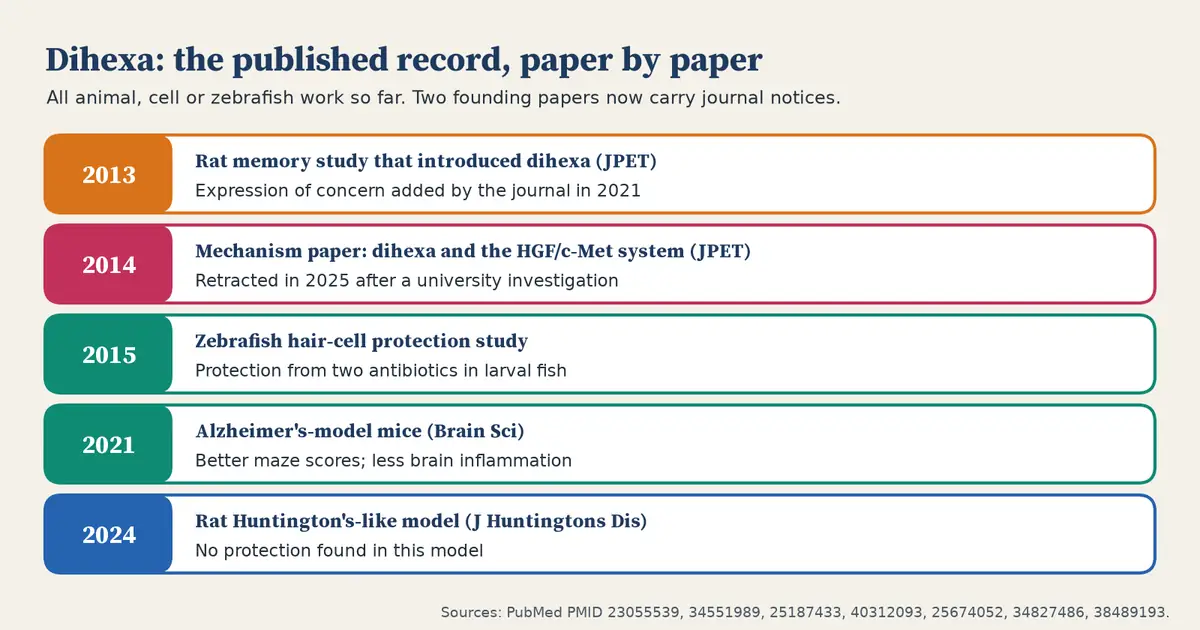
- In rats, that 2013 study reported improved performance in two memory-impairment models and new synapse formation. The journal added an expression of concern to it in 2021. [V]
- Later studies reported better maze scores in Alzheimer's-model mice (2021) and protection of zebrafish hair cells from antibiotic damage (2015). A 2024 rat study of a Huntington's-like model found no protection. [V]
- The 2014 paper that proposed dihexa's main mechanism, through the HGF/c-Met growth-factor system, was retracted in 2025. [V]
- FDA says it has found no human exposure data for dihexa acetate by any route, and has put it on the agenda of an advisory committee meeting expected before the end of February 2027. [V]
- 0studies of dihexa registered on ClinicalTrials.gov, as searched October 26, 2026 [V]
- 8 of 9animal studies in a 2018 systematic review where angiotensin IV and its analogs improved cognitive performance [V]
- 2027committee review expected before the end of February [V]
The science: what the research reports
Where it came from. Angiotensin IV is a six-amino-acid piece of the angiotensin hormone system. Decades of rodent work tied it and its analogs to better learning in impaired animals. A 2018 systematic review in Neuroscience & Biobehavioral Reviews found that in eight of nine studies using cognitive-deficit models, angiotensin IV or an analog such as dihexa improved performance. All of those studies were in animals. [V] Dihexa itself is a trimmed-down, capped version (N-hexanoic-tyrosine-isoleucine-aminohexanoic amide) designed to stay intact in the body. [V]
Rats, 2013. The study that introduced dihexa, in JPET, a long-running pharmacology journal, reported that it was orally active, entered the brain and was metabolically stable. Rats impaired with the drug scopolamine, and aged rats, performed better on memory tasks, and the authors reported new synapse formation in their cell and tissue work. [V] In 2021 JPET attached an expression of concern to this paper, a notice that questions have been raised. As of October 26, 2026, PubMed lists no retraction of it. [V]
Mice, Alzheimer's model, 2021. A group publishing in Brain Sciences gave dihexa to APP/PS1 mice, a standard Alzheimer's model. Treated mice did better in the Morris water maze, a spatial-memory test. The authors reported fewer activated glial cells, lower inflammatory signals (IL-1-beta and TNF-alpha), higher IL-10, and activity along the PI3K/AKT pathway. [V] This is early-stage research, the usual first step for any medicine.
Zebrafish, hearing cells, 2015. In larval zebrafish, lateral-line hair cells work much like the sensory cells of the inner ear. A Frontiers in Cellular Neuroscience study found that dihexa protected them from damage by the antibiotics neomycin and gentamicin, and that the protection depended on HGF signaling. [V]
Rats, nerve repair, 2021. A study in Annals of Medicine and Surgery tested stem cells, a growth factor and dihexa in rats after sciatic nerve repair. Walking scores at 8 to 16 weeks improved when stem cells plus dihexa were given into the calf muscle. [V]
Lab dishes. Stem-cell researchers have used dihexa as a stand-in for the growth factor HGF in recipes that turn stem cells into liver-like cells. [V] That use does not depend on any brain claim, and it is a sign that the compound does something measurable in cells.
A negative result, 2024. A study in the Journal of Huntington's Disease gave dihexa to rats exposed to 3-nitropropionic acid, a toxin that mimics Huntington's disease. It did not protect against the toxin's effects. [V] Negative results are part of a normal research record and help narrow where a compound might matter.
The closest human test of the idea. No human trial of dihexa itself appears on ClinicalTrials.gov. [V] A different molecule, fosgonimeton, was designed to boost HGF signaling and has been tested in people. Its phase 2/3 Alzheimer's trial, LIFT-AD, analyzed 287 participants and did not meet its primary or secondary endpoints; small, non-significant differences favored the drug. Serious adverse events were 4.2% on fosgonimeton and 6.9% on placebo. [V] Fosgonimeton is not dihexa, so its results say little about dihexa directly, but it shows what happened when the HGF idea reached a clinical trial.
The regulatory record
| The question | Answer | What the record shows |
|---|---|---|
| Is it an FDA-approved drug? | No | A DailyMed name search for dihexa returned no labels, and no human study is registered on ClinicalTrials.gov. [V] |
| Where is it on FDA's lists? | Category 2 page, nomination withdrawn | "Dihexa acetate" appears in the table of nominated-but-withdrawn substances on FDA's category 2 page (current as of April 22, 2026). It is not named on the 503ASection of federal drug law covering compounding by state-licensed pharmacies and doctors, usually for a prescription written for one patient. category list updated May 14, 2026. [V] |
| Has the advisory committee reviewed it? | Not yet | FDA's committee page lists dihexa acetate for a meeting expected before the end of February 2027, alongside LL-37, GHK-Cu, melanotan II and PEG-MGF. No date had been posted. [V] |
| Is it on WADA's prohibited list? | Not named | The 2026 Prohibited List does not name dihexa. [V] |
What FDA wrote. On the category 2 page, FDA states that it has not identified any human exposure data for products containing dihexa acetate by any route, and that it lacks key safety information, including whether it would cause harm in people. [V]
How compounding fits in. Under section 503A, a pharmacy's bulk ingredient must have a USP monograph, be part of an FDA-approved drug, or appear on the 503A bulks list. [V] Dihexa has no approved drug behind it, so the bulks-list decision after the committee meeting is the step that would define a compounding route. FDA also states that compounded drugs are not FDA-approved. [V]
What is pending. The White House's Office of Information and Regulatory Affairs has been reviewing FDA's "Interim Access Policy for Compounding Using Certain Peptides" since October 14, 2026. The policy's text has not been published. [V]
Limits and unknowns
- JPET retracted the 2014 mechanism paper in 2025. Its notice says a Washington State University investigation found that specific figures contained "falsified and/or fabricated data," and it names two of the authors as solely responsible. [V]
- JPET also retracted a 2012 paper from the same program on angiotensin IV analogs and the HGF/Met system, in 2025. [V]
- The 2013 founding rat study carries a 2021 expression of concern. PubMed lists no retraction of it. [V]
- Both retracted papers concerned the HGF/c-Met mechanism. A later mouse study pointed to the PI3K/AKT pathway. [V]
- No human data: FDA found no human exposure data, and no dihexa trial is registered. [V]
What people get wrong
Claim
"Dihexa is proven to build new brain connections."
What research shows
- Animal and cell research
- with journal notices on two founding papers
Rat and mouse studies report better memory-test scores; the founding rat paper reported new synapses and carries an expression of concern; the main mechanism paper was retracted. [V]
What is unknown
Whether any of this occurs in people, and what the safety profile looks like in humans. [V]
This card describes the kind of research that exists.
What people get wrong
"The mechanism is settled: it works through HGF." That claim traces to the 2014 paper, which JPET retracted in 2025. Later studies used HGF-related reasoning and reported effects in fish and cells, but the original mechanism work is no longer part of the record. [V]
"Dihexa is banned by FDA." FDA has not approved it, and it sits in the withdrawn table of the category 2 page. A committee review is still ahead, so FDA has not made a final bulks-list call. [V]
Why it matters
Dihexa shows how a research story can be promising in animals and still need rebuilding. The angiotensin IV line of work is decades old, and later studies have reported results in mice, rats and fish. At the same time, two of the papers at the center of the story have been retracted and a third carries a notice. The upcoming committee review is the first time FDA will publicly weigh the whole record, and a first human study is what any of it would need next.
Questions to bring to a clinician or pharmacist
- Which dihexa studies were in people, and which were in animals or cells?
- Which of the papers cited for a product have been retracted or flagged by the journal?
- What did FDA say about dihexa at the committee meeting, once it happens?
What to watch next
Dates and decisions we're tracking
- Before end of February 2027FDA advisory committee review of dihexa acetate for the 503A bulks list [V]
- PendingThe White House review of FDA's "Interim Access Policy for Compounding Using Certain Peptides" [V]
- PendingAny journal action on the 2013 paper's expression of concern [V]
- PendingAny first registered human study of dihexa [V]
For all 14 peptides side by side, see the status table. The evidence ladder explains how to read cell, animal and human stages, and the semax and selank page covers two other brain-focused peptides.
Sources (retrieved October 26, 2026 unless noted)
- McCoy AT, et al., "Evaluation of metabolically stabilized angiotensin IV analogs as procognitive/antidementia agents," Journal of Pharmacology and Experimental Therapeutics, 2013 (abstract on PubMed; expression of concern linked) [V] — https://pubmed.ncbi.nlm.nih.gov/23055539/
- JPET, expression of concern for McCoy et al. 2013, 2021 (PubMed record) [V] — https://pubmed.ncbi.nlm.nih.gov/34551989/
- Benoist CC, et al., dihexa and the hepatocyte growth factor/c-Met system, JPET, 2014 (PubMed record, marked retracted) [V] — https://pubmed.ncbi.nlm.nih.gov/25187433/
- JPET, retraction notice for Benoist et al. 2014, 2025 (full text on PubMed Central) [V] — https://pmc.ncbi.nlm.nih.gov/articles/PMC13095468/
- JPET, retraction notice for Kawas et al. 2012, 2025 (PubMed record) [V] — https://pubmed.ncbi.nlm.nih.gov/40312092/
- Ho JK, Nation DA, systematic review of angiotensin IV and AT4 receptor ligands in cognition, Neuroscience & Biobehavioral Reviews, 2018 (abstract on PubMed) [V] — https://pubmed.ncbi.nlm.nih.gov/29733881/
- Sun X, et al., dihexa in APP/PS1 mice, Brain Sciences, 2021 (abstract on PubMed) [V] — https://pubmed.ncbi.nlm.nih.gov/34827486/
- Uribe PM, et al., HGF and dihexa protection of zebrafish lateral-line hair cells, Frontiers in Cellular Neuroscience, 2015 (abstract on PubMed) [V] — https://pubmed.ncbi.nlm.nih.gov/25674052/
- Weiss JB, et al., stem cells and dihexa in rat sciatic nerve injury, Annals of Medicine and Surgery, 2021 (abstract on PubMed) [V] — https://pubmed.ncbi.nlm.nih.gov/34703584/
- Wells RG, et al., dihexa in a rat 3-nitropropionic acid model, Journal of Huntington's Disease, 2024 (abstract on PubMed) [V] — https://pubmed.ncbi.nlm.nih.gov/38489193/
- Mathapati S, et al., hepatocyte differentiation from stem cells using dihexa, Current Protocols in Stem Cell Biology, 2016 (abstract on PubMed) [V] — https://pubmed.ncbi.nlm.nih.gov/27532814/
- Porsteinsson AP, et al., LIFT-AD phase 2/3 trial of fosgonimeton, Journal of Alzheimer's Disease Reports, 2025 (abstract on PubMed) [V] — https://pubmed.ncbi.nlm.nih.gov/41393340/
- ClinicalTrials.gov, LIFT-AD record NCT04488419, and a registry search for "dihexa" (0 studies) [V] — https://clinicaltrials.gov/study/NCT04488419
- FDA, "Certain Bulk Drug Substances for Use in Compounding that May Present Significant Safety Risks" (category 2 page), current as of 04/22/2026 [V] — https://www.fda.gov/drugs/human-drug-compounding/certain-bulk-drug-substances-use-compounding-may-present-significant-safety-risks
- FDA, "Meeting of the Pharmacy Compounding Advisory Committee," current as of 04/15/2026 [V] — https://www.fda.gov/advisory-committees/pharmacy-compounding-advisory-committee/meeting-pharmacy-compounding-advisory-committee
- FDA, 503A bulk drug substances category list (PDF), updated May 14, 2026 [V] — https://www.fda.gov/media/94155/download
- FDA, "Compounding and the FDA: Questions and Answers," current as of 09/16/2025 [V] — https://www.fda.gov/drugs/human-drug-compounding/compounding-and-fda-questions-and-answers
- OMB/OIRA, pending EO 12866 regulatory review, RIN 0910-ZD94, received October 14, 2026 [V] — https://www.reginfo.gov/public/do/eoDetails?rrid=1568964
- WADA, 2026 Prohibited List, text read in full [V] — https://www.wada-ama.org/sites/default/files/2025-09/2026list_en_final_clean_september_2025.pdf
- DailyMed name search for dihexa, run October 26, 2026 (no labels returned) [V] — https://dailymed.nlm.nih.gov/dailymed/services/v2/spls.json?drug_name=dihexa
Spot a mistake? See how we source and our corrections policy.