
Before Wegovy: what the older weight-loss drugs showed in their big trials, and why the GLP-1 numbers looked so different
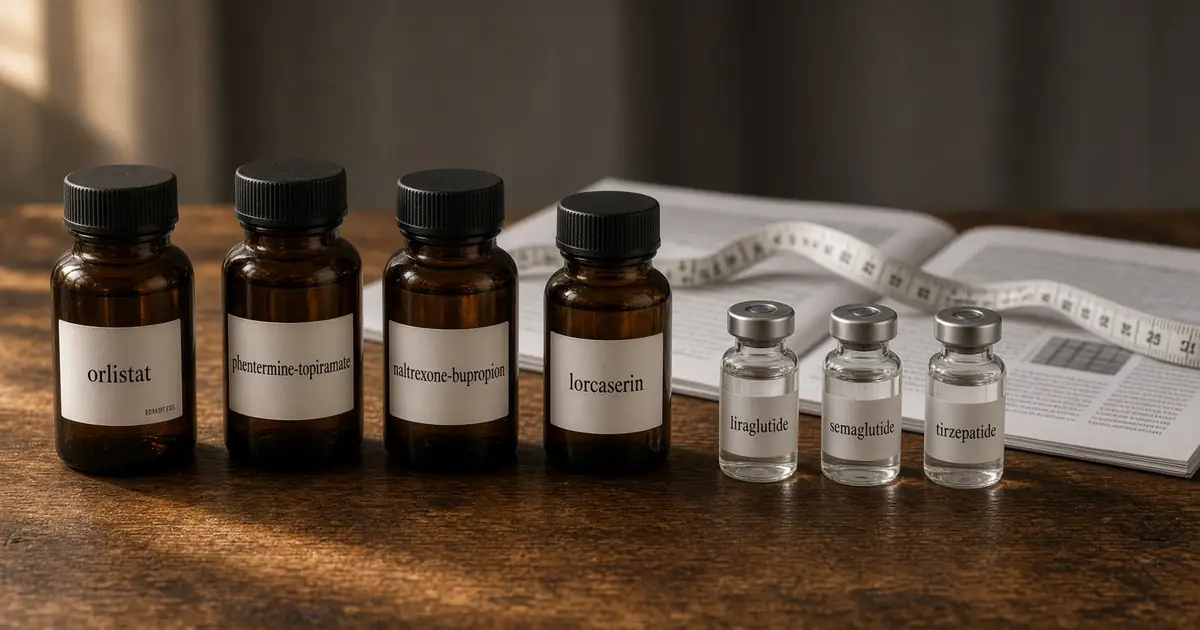
Ask someone who tried a weight-loss medicine in 2010 what it was like, and you'll hear about pills, modest results and a lot of stopping early. Ask about Wegovy or Zepbound now, and the numbers people quote are in the teens and twenties. That gap is real, but it's also easy to overstate. Here's what each generation of drug showed in its main trials, read straight from the papers and FDA's own announcements.
Facts are as of November 5, 2026. Sources, with retrieval dates, are at the bottom.
The quick version of the record
- The two combination pills of the 2010s: average weight loss of about 6% to 10% at 56 weeks in their main trials, vs about 1% on placebo. [V]
- Semaglutide in STEP 1: -14.9% at 68 weeks, vs -2.4% on placebo. [V]
- Tirzepatide in SURMOUNT-1: -15.0% to -20.9% at 72 weeks across three strengths, vs -3.1% on placebo. [V]
- One older drug, lorcaserin, was pulled from the U.S. market in 2020 after a safety trial found more cancers on the drug. [V]
The pill era
Orlistat is the old-timer here. Its best-known trial, XENDOS, followed 3,305 adults with obesity for four years, everyone also making lifestyle changes. [V] Average weight loss was 5.8 kg on orlistat and 3.0 kg on placebo. [V] The trial's headline was diabetes. New cases were 6.2% on orlistat and 9.0% on placebo, and an exploratory analysis traced that difference to people who started with impaired glucose tolerance. [V] Staying on treatment was hard, though: 52% of the orlistat group and 34% of the placebo group finished. [V]
Phentermine plus topiramate (Qsymia) pairs phentermine, a short-term weight-loss drug, with topiramate, a seizure and migraine medicine. [V] FDA approved it on July 17, 2012. [V] In the CONQUER trial, 2,487 adults with weight-related conditions were followed for 56 weeks. Average weight change was -7.8% and -9.8% on the two strengths tested, vs -1.2% on placebo. [V] Dry mouth, tingling, constipation, insomnia and altered taste were more common on the drug. [V] FDA approved it with a safety program because topiramate exposure early in pregnancy raises the risk of cleft lip and palate. [V]
Naltrexone plus bupropion (Contrave) was designed to act on brain pathways that regulate body weight. [V] In COR-I, 1,742 adults were followed for 56 weeks, with average weight change of -6.1% on the higher strength vs -1.3% on placebo. [V] Only half of the participants completed the full 56 weeks on treatment. [V]
- -5.8 kgorlistat over 4 years, vs -3.0 kg on placebo (XENDOS) [V]
- -9.8%phentermine-topiramate higher strength at 56 weeks, vs -1.2% (CONQUER) [V]
- -6.1%naltrexone-bupropion at 56 weeks, vs -1.3% (COR-I) [V]
The one that came off the market
Lorcaserin (Belviq) was approved in 2012 and is a reminder of why long safety trials matter. [V] FDA required a cardiovascular study of about 12,000 people. Heart risk came out no different from placebo, but 7.7% of people on lorcaserin were diagnosed with cancer, vs 7.1% on placebo, with the gap widening the longer people took it. [V] FDA asked the maker to withdraw it, saying the risks were greater than the benefits, and the company did. [V]
The first GLP-1 steps
GLP-1 drugs act on receptors for a hormone released by the gut, which helps reduce appetite. [V] They're peptides, which is why they show up so much on this site. Liraglutide, a once-daily injection, is the earlier GLP-1 in this story. In the SCALE trial of 3,731 adults without diabetes, average loss at 56 weeks was 8.4 kg on liraglutide vs 2.8 kg on placebo. [V] That's in the same range as the best pills. The jump came with the next molecules.
Semaglutide and tirzepatide
In STEP 1, 1,961 adults without diabetes took once-weekly semaglutide or placebo for 68 weeks alongside a lifestyle program. [V] Average weight change was -14.9% vs -2.4%, and half the semaglutide group lost 15% or more. [V] Nausea and diarrhea were the most common side effects, usually mild to moderate and fading over time, and 4.5% stopped because of gut problems, vs 0.8% on placebo. [V] FDA approved Wegovy for weight management on June 4, 2021, calling it the first new drug for chronic weight management since 2014. [V]
SURMOUNT-1 enrolled 2,539 adults without diabetes for 72 weeks. Tirzepatide, which acts on both GLP-1 and GIP receptors, produced average changes of -15.0% to -20.9% across its three strengths, vs -3.1% on placebo. [V] FDA approved it as Zepbound on November 8, 2023. [V]
“sustained, clinically relevant reduction in body weight”
Why you can't just line the numbers up
It's tempting to put these figures side by side and declare a winner. The trials don't allow that cleanly. They enrolled different people, ran for different lengths of time (56 weeks to four years) and counted dropouts differently. [V] COR-I, for example, analyzed people who stayed on the drug, while STEP 1 and SURMOUNT-1 counted everyone randomized regardless of whether they stopped. [V] Placebo groups lost different amounts, too, from about 1% to 3%. [V] None of these were head-to-head trials. [V] What the record does support is the broad pattern: average weight loss in the newer GLP-1 trials was clearly larger than in the older drugs' trials, measured against each one's own placebo group. [V]
What this history doesn't tell you
Trial averages hide a wide spread. In STEP 1, 86% of the semaglutide group lost at least 5%, and about half lost 15% or more, which means plenty landed in between. [V] These were also trials of FDA-approved products made under their approvals. They say nothing about compounded or "research" versions, which our GLP-1 explainer covers. And none of this is a guide to choosing a treatment. That's a conversation for a clinician.
Peptide Policy Watch
Before Wegovy: what the older weight-loss drugs showed in their big trials, and why the GLP-1 numbers looked so different
Printable checklist
Talking it over with a clinician? Some starting points
Points from this story to talk through with a clinician or pharmacist who knows your history.
- What did the main trial for this medicine actually measure, and for how long?
- Which side effects led people to stop in the trials?
- What happens if I stop the medicine later on?
Print view Select it, then use your browser’s Print command to print only this box.
The longer arc
Weight medicine went from modest pills to injectable peptides in about a decade, and the next wave, from amylin pairings to triple agonists, is already in late trials. Our peptide medicines timeline traces how we got here, the CagriSema explainer covers one of the next contenders, and the retatrutide trial breakdown covers another. If you want to read the trial papers yourself, our guide to clinical trial listings is a good place to start.
Sources (retrieved November 5, 2026)
- Torgerson JS et al., "XENical in the prevention of diabetes in obese subjects (XENDOS) study," Diabetes Care 2004;27(1):155-161, PMID 14693982 (abstract via Europe PMC) [V] — https://doi.org/10.2337/diacare.27.1.155
- Gadde KM et al., "Effects of low-dose, controlled-release, phentermine plus topiramate combination on weight and associated comorbidities in overweight and obese adults (CONQUER)," Lancet 2011, PMID 21481449 (abstract via Europe PMC) [V] — https://doi.org/10.1016/S0140-6736(11)60205-5
- FDA news release, "FDA approves weight-management drug Qsymia," July 17, 2012 [V, archived copy] — https://web.archive.org/web/20170118093051/http://www.fda.gov/newsevents/newsroom/pressannouncements/ucm312468.htm
- Greenway FL et al., "Effect of naltrexone plus bupropion on weight loss in overweight and obese adults (COR-I)," Lancet 2010, PMID 20673995 (abstract via Europe PMC) [V] — https://doi.org/10.1016/S0140-6736(10)60888-4
- FDA, "FDA requests the withdrawal of the weight-loss drug Belviq, Belviq XR (lorcaserin) from the market," February 2020 [V] — https://www.fda.gov/drugs/drug-safety-and-availability/fda-requests-withdrawal-weight-loss-drug-belviq-belviq-xr-lorcaserin-market
- Pi-Sunyer X et al., "A Randomized, Controlled Trial of 3.0 mg of Liraglutide in Weight Management" (SCALE), N Engl J Med 2015, PMID 26132939 (abstract via Europe PMC) [V] — https://doi.org/10.1056/NEJMoa1411892
- Wilding JPH et al., "Once-Weekly Semaglutide in Adults with Overweight or Obesity" (STEP 1), N Engl J Med 2021;384:989-1002, PMID 33567185 (abstract via Europe PMC) [V] — https://doi.org/10.1056/NEJMoa2032183
- Jastreboff AM et al., "Tirzepatide Once Weekly for the Treatment of Obesity" (SURMOUNT-1), N Engl J Med 2022, PMID 35658024 (abstract via Europe PMC) [V] — https://doi.org/10.1056/NEJMoa2206038
- FDA news release, "FDA Approves New Medication for Chronic Weight Management," November 8, 2023 [V] — https://www.fda.gov/news-events/press-announcements/fda-approves-new-medication-chronic-weight-management
- FDA news release, "FDA Approves New Drug Treatment for Chronic Weight Management, First Since 2014," June 4, 2021 [V, archived copy] — https://web.archive.org/web/20210604235421/https://www.fda.gov/news-events/press-announcements/fda-approves-new-drug-treatment-chronic-weight-management-first-2014
Cite or link to this page
Peptide Policy Watch staff. “Before Wegovy: what the older weight-loss drugs showed in their big trials, and why the GLP-1 numbers looked so different.” Peptide Policy Watch. Published November 5, 2026. https://peptidepolicywatch.com/2026/11/05/weight-loss-drugs-before-glp-1-orlistat-qsymia-contrave-trials/
Spot a mistake? See how we source and our corrections policy.
Image: AI-generated. Image credits