
The PEPTIDES for Veterans Act (H.R. 10212): what the bill would actually do
Maybe a post in your feed said Congress wants peptides at the VA, and the replies split fast. One person reads it as veterans getting peptides next year. Another says it's already law. The bill text is short enough to check in a few minutes, and it says something more careful, and more interesting, than either.
Facts are as of November 3, 2026. Sources, with retrieval dates, are at the bottom.
Before you read on
- H.R. 10212, the PEPTIDES for Veterans Act, was introduced in the House on September 1, 2026, by Rep. Nancy Mace (R-S.C.). [V]
- It hasn't passed anything. It was sent to the House Committee on Veterans' Affairs, then to that committee's Health Subcommittee on September 8. Congress.gov lists no cosponsors and no later action. [V]
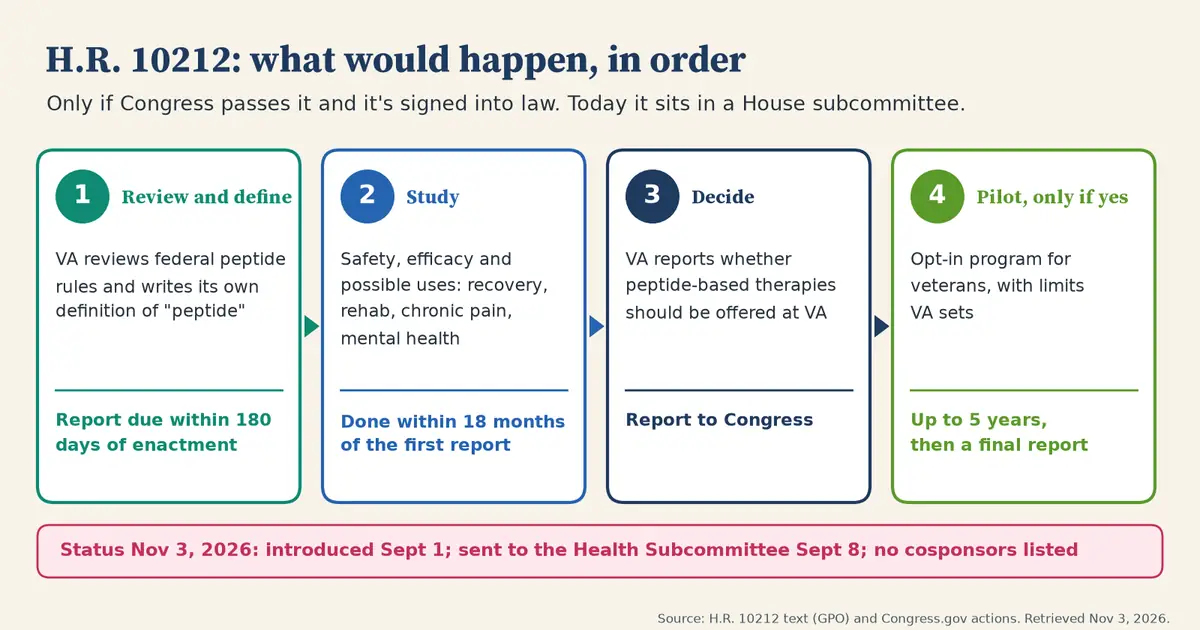
- If it became law, the Department of Veterans Affairs would first define "peptide," then study peptide-based therapies, then decide whether to offer them. A pilot comes only if that decision is yes. [V]
- It wouldn't change FDA approval rules or the compounding lists. It's about what VA studies and offers. [V]
Key dates so far
- September 1, 2026: introduced in the House and referred to the Committee on Veterans' Affairs. [V]
- September 8, 2026: referred to the committee's Subcommittee on Health. [V]
- November 3, 2026: still no cosponsors, and no hearing or markup listed on Congress.gov. [V]
The name is an acronym, and the bill's official title spells out each letter of PEPTIDES. [V] Congress.gov files it under the policy area "Armed Forces and National Security." [V]
What the bill would set in motion
The text runs to three sections, and the order matters. Each step depends on the one before it.
First, a definition. VA would review federal regulations and guidance on peptides, with special attention to how "peptide" is defined, and settle on its own definition for the law's purposes. The review is meant to weigh research that has come out since those rules and definitions were written. [V] A report to Congress would be due within 180 days of enactment, and it would also define "peptide-based therapy" and explain how VA's definition differs from others in federal rules. [V]
That definition question isn't academic. FDA's 2020 rule counts a chain of more than 40 amino acids as a protein, which is why insulin moved to the biologics pathway while shorter chains stayed drugs. [V] Our page on the 2020 polypeptide change covers that line in detail.
Second, a study. Once that report lands, VA would study whether peptide-based therapies are safe and effective for veterans at VA medical facilities, and what therapeutic benefit they might offer. The bill tells VA to review medical research, set up clinical procedures, look at possible uses such as chronic pain, mental health, rehab and recovery, overall physical wellness and other conditions tied to military service, and consider how safe peptides are for clinical and rehab use. [V] The study would have to wrap up within 18 months of the first report. [V]
Third, a decision. The study report would include findings, recommendations and VA's determination on whether these therapies should be made available to veterans at VA facilities. [V]
Fourth, maybe a pilot. Only if VA says yes would a pilot program start. Veterans would take part only if they chose to, VA could set geographic, clinical or other limits, and the pilot would end within five years. A final report would describe how well the treatments worked for which conditions, give guidance on wider rollout across VA and list the problems encountered. [V]

Where it stands, and what it would take
A bill that sits in subcommittee is at the very start of the road. The House describes the path: a committee studies a bill and may release it; then it goes to a floor vote, the Senate repeats the process in its own committee and on its floor, the two chambers settle any differences, and the final version goes to the president to sign or veto within ten days. [V] H.R. 10212 hasn't cleared the first of those steps, and Congress.gov lists no related or companion bills. [V]
What people get wrong
"Veterans can get peptides at the VA now." Nothing in the bill takes effect unless it becomes law, and even then the first step is a definition and a report. [V]
"This bill approves peptides." It doesn't touch FDA approval. It directs a VA review, study and possible pilot. [V]
"Congress already decided peptides work." The bill asks VA to study safety and efficacy and decide afterward. That's a question, not a finding. [V]
How it fits with the rest of peptide policy
The bill arrives in a busy season. HHS's interim six-peptide compounding policy, which covers BPC-157, TB-500, epitalon, KPV, MOTS-c and semax, is open for public comment until 11:59 PM Eastern on November 13, 2026. [V] That policy is about which substances licensed pharmacies may compound. H.R. 10212 is about what one health system, VA, would study and offer. They're separate tracks that happen to be moving at the same time.
For why most peptides can't simply be prescribed and covered today, see why doctors can't prescribe or get peptides covered. For the compounding side, see our brief on the six-peptide policy and how the comment period works.
Limits and unknowns
We're working from the introduced text only. Bills often change in committee, and Congress.gov had no official summary of this one posted as of today. [V] The bill doesn't say which peptides would be studied, how the study would be designed or what it would cost, and we haven't found a cost estimate. [U]
What would signal real movement
Watch for cosponsors, a Senate companion bill, a Health Subcommittee hearing or a markup vote. Any of those would show up in the bill's Congress.gov record, and we'll update this page if they do. Until then, H.R. 10212 is an idea on paper, and a fairly modest one: study first, decide later.
Peptide Policy Watch
The PEPTIDES for Veterans Act (H.R. 10212): what the bill would actually do
Printable checklist
Questions for your clinician
Print or copy these questions for your next visit with a clinician or pharmacist.
- Is this an FDA-approved medicine, a compounded drug, or something with no approval for human use?
- What do the studies in people show, how large and how long were they, and where can I read them?
- How might my own health history, conditions and current medicines change how this applies to me?
- Is there an official label or other primary document I can read, and who would know if something goes wrong?
Print view Select it, then use your browser’s Print command to print only this box.
Common questions
Is the PEPTIDES for Veterans Act law?
No. H.R. 10212 was introduced on September 1, 2026, and referred to the House Veterans' Affairs Health Subcommittee on September 8. Congress.gov lists no cosponsors and no later action. [V] Source: Congress.gov, H.R. 10212
What would H.R. 10212 require VA to do?
Define "peptide" and report to Congress within 180 days, then study peptide-based therapies within 18 months and decide whether to offer them. A voluntary pilot of up to five years would follow only if VA says yes. [V] Source: H.R. 10212 text (GPO)
Does the bill change FDA approval or compounding rules?
No. The text directs a VA review, study and possible pilot. It doesn't amend FDA approval rules or the 503A compounding lists. [V] Source: H.R. 10212 text (GPO)
Sources (retrieved November 3, 2026 unless noted)
- H.R. 10212, PEPTIDES for Veterans Act, introduced in House September 1, 2026, text via the Government Publishing Office [V] — https://www.govinfo.gov/content/pkg/BILLS-119hr10212ih/html/BILLS-119hr10212ih.htm
- Congress.gov, H.R. 10212 bill record: actions, titles, cosponsors, related bills and summaries (via the Congress.gov API) [V] — https://www.congress.gov/bill/119th-congress/house-bill/10212/all-actions
- U.S. House of Representatives, "The Legislative Process" [V] — https://www.house.gov/the-house-explained/the-legislative-process
- FDA, "Definition of the Term 'Biological Product'," final rule, 85 FR 10057, February 21, 2020 (retrieved November 2, 2026) [V] — https://www.federalregister.gov/documents/2020/02/21/2020-03505/definition-of-the-term-biological-product
- Regulations.gov, docket HHS-OASH-2026-0496 (comment close 11:59 PM Eastern, November 13, 2026) [V] — https://www.regulations.gov/docket/HHS-OASH-2026-0496
- HHS, "Enforcement Discretion Policy Regarding 503ASection of federal drug law covering compounding by state-licensed pharmacies and doctors, usually for a prescription written for one patient. Glossary entry Compounding Using Certain Peptide Bulk Drug Substances," Federal Register, October 30, 2026, 91 FR 68526 (retrieved October 30, 2026) [V] — https://www.federalregister.gov/d/2026-22192
Cite or link to this page
Peptide Policy Watch staff. “The PEPTIDES for Veterans Act (H.R. 10212): what the bill would actually do.” Peptide Policy Watch. Published November 3, 2026. https://peptidepolicywatch.com/2026/11/03/peptides-for-veterans-act-hr-10212-what-it-would-do/
Link: https://peptidepolicywatch.com/2026/11/03/peptides-for-veterans-act-hr-10212-what-it-would-do/
Spot a mistake? See how we source and our corrections policy.
Image: AI-generated. Image credits