
HHS's peptide policy is in the Federal Register: what the comment period does and doesn't decide
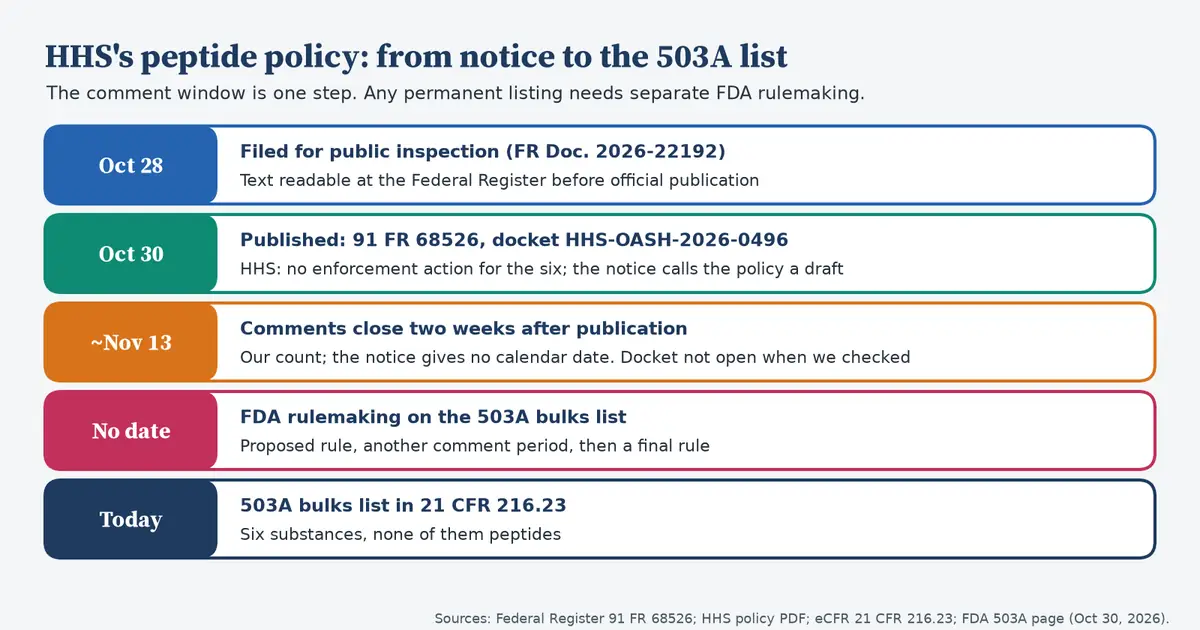
Two days after it showed up on the public inspection desk, HHS's compounding policy for six peptides is now official text. It ran in the October 30 Federal Register at 91 FR 68526, and the clock on a two-week comment window has started. That window is real, but it is narrower than it looks. Here's what was published, how the comment step fits into the slower process that could make any of this permanent, and what is still unsettled.
Facts are as of October 30, 2026. Sources, with retrieval dates, are at the bottom.
The gist
- HHS's notice of availability for the peptide policy was published October 30, 2026, at 91 FR 68526-68527, FR Doc. 2026-22192, under docket HHS-OASH-2026-0496. [V]
- The notice takes written comments through regulations.gov until two weeks after publication. By our count that is about November 13; the notice itself gives no calendar date. [V]
- The comment step doesn't decide whether BPC-157, TB-500, epitalon, KPV, MOTS-c or semax join FDA's 503ASection of federal drug law covering compounding by state-licensed pharmacies and doctors, usually for a prescription written for one patient. Glossary entry bulks list. That takes separate FDA rulemaking, and HHS says comments could feed into it. [V]
- When we checked at 2:34 AM CT on October 30, the docket was not yet open on regulations.gov's public data service. [V]
- 91 FR 68526where the notice starts in the October 30 Federal Register [V]
- 2 weekscomment window the notice sets, counted from publication [V]
- 6substances on the 503A bulks list in federal regulations today, none of them peptides [V]
What actually ran on October 30
The Federal Register files this document under Notices, with the action line "Notice of availability." [V] It is a short, two-page announcement that points readers to the full policy on HHS's website, and it names the HHS web copy as the place to check for the latest version. [V] The policy itself, with its two appendices, is the same document we covered on October 29. We compared tonight's copy of the HHS PDF with the one we saved the day before and found no change to the text. [V]
The notice repeats the core promise in one sentence: If a pharmacy with a state license, a federal facility or a licensed doctor compounds with one of the Appendix A peptides, HHS says it won't bring an enforcement case. [V] It frames this as a way "to expand and improve patient access." [V] It also says the policy creates no rights for anyone and doesn't bind HHS or the public. [V]
Why "notice of availability" matters
A notice of availability announces that a document exists. It isn't a rule. The publication record lists no effective date [V], and nothing in the notice amends the Code of Federal Regulations. [V] That fits what the policy is: a statement about where HHS will and won't spend its enforcement effort, layered on top of the existing law.
The notice also calls the document a "draft" policy in its background section, while HHS's own appendix calls it an interim policy. [V] Read together, the wording suggests HHS could still revise the text after the comment period. The notice doesn't say how or when that would happen. [U]
When the window closes
The notice says comments can be submitted "until 2 weeks after date of publication in the Federal Register." [V] Counting from October 30, that lands on Friday, November 13, 2026. That is our arithmetic, not a date printed in the notice, and the Federal Register's own data for the document leaves the comment-close field empty. [V]
The route the notice names is regulations.gov, under docket HHS-OASH-2026-0496. [V] At 2:34 AM CT on October 30, a lookup of that docket on the regulations.gov public data service returned "not found," and a search for documents filed under it came back empty. [V] The docket may open later in the day; we'll add the time it does. [U]
Where comments go after that
Here's the part that matters most for the six peptides' long-term status. Under section 503A, a pharmacy may compound from a bulk ingredient only if it meets a USP or NF monograph, is part of a drug FDA has approved, or appears on FDA's 503A bulks list. [V] That list lives in federal regulations at 21 CFR 216.23. [V]
FDA builds the list slowly. Its February 2019 final rule placed six substances on it and turned down four others, and none of the ten is a peptide. [V] A September 2019 proposal would add five more and reject 26; FDA's page, current as of May 14, 2026, still describes a final regulation on that proposal as coming after it considers comments. [V] FDA says it handles nominated substances "on a rolling basis through notice-and-comment rulemaking." [V]
The regulation spells out four things FDA weighs for each candidate: the substance's physical and chemical characterization, safety issues in compounded products, any evidence on effectiveness, and its history of use in compounding. [V] HHS's policy text links the comment step to that process directly. It says public comments "may provide additional evidence that FDA can consider in rulemaking to address some or all of the substances." [V] The notice adds that FDA's future rulemakings "may propose adding some or all of these peptides" to the list. [V]
So a comment filed now is input to a record. It isn't a vote, and nothing in either document says how many comments, or what kind, would change the outcome. [V]
What the comment period doesn't touch
- The six-peptide list itself is not on a timer. The policy stays in place while FDA works through the 503A bulks list, and HHS says it may revisit all or part of the policy if a safety signal or product quality problem shows up. [V]
- Other peptides aren't added by commenting. CJC-1295, ipamorelin, AOD-9604, selank, dihexa, thymosin alpha-1 and retatrutide aren't in Appendix A. [V] Our retatrutide compounding page explains why that one sits under different rules.
- State rules stay where they were. The notice speaks only for federal enforcement. [V]
- It doesn't make anything FDA-approved. The notice states that compounded drugs are not FDA-approved and that FDA doesn't review their safety, effectiveness or quality before marketing. [V]
We don't suggest what anyone should say in a comment, or whether to file one. The notice and docket are public, and the policy text is the best guide to what HHS is asking about.
“FDA's future rulemakings may propose adding some or all of these peptides to the 503A bulks list based on the available evidence.”
Limits and unknowns
- The close date is computed. If HHS posts a different date on the docket, the docket controls, and we'll correct this page. [U]
- We don't know when, or whether, FDA will propose a rule covering any of the six. No rulemaking date has been announced. [V]
- The 2019 proposal shows how long this can take: seven years on, FDA still lists it as awaiting a final regulation. [V]
- How HHS will weigh comments, and whether it will publish a revised policy after the window closes, isn't stated. [U]
- The evidence HHS cites for each peptide is a separate question. We traced it, study by study, in HHS's reasons for the six peptides, checked against the research.
Dates on this docket
- Oct. 28, 2026Filed for public inspection, 11:15 am per the filing line [V]
- Oct. 30, 2026Published at 91 FR 68526; comment window opens [V]
- About Nov. 13, 2026Comment window closes, two weeks after publication by our count [V]
- No date setAny FDA proposed rule on adding the six peptides to the 503A bulks list [V]
For the bigger picture, the regulation timeline puts this notice in sequence, and the 14-peptide status table shows where every peptide we track stands today.
Peptide Policy Watch
HHS's peptide policy is in the Federal Register: what the comment period does and doesn't decide
Printable checklist
Questions for your clinician
General questions drawn from this page, to take to a clinician or pharmacist who knows your health history.
- Is this an FDA-approved medicine, a compounded drug, or something with no approval for human use?
- What do the studies in people show, how large and how long were they, and where can I read them?
- How might my own health history, conditions and current medicines change how this applies to me?
- Is there an official label or other primary document I can read, and who would know if something goes wrong?
Print view Select it, then use your browser’s Print command to print only this box.
Sources (retrieved October 30, 2026 unless noted)
- Federal Register, "Enforcement Discretion Policy Regarding 503A Compounding Using Certain Peptide Bulk Drug Substances," notice of availability, 91 FR 68526-68527, FR Doc. 2026-22192, Docket No. HHS-OASH-2026-0496, RIN 0910-ZD94, published October 30, 2026 [V] — https://www.federalregister.gov/documents/2026/10/30/2026-22192/enforcement-discretion-policy-regarding-503a-compounding-using-certain-peptide-bulk-drug-substances
- Government Publishing Office, official PDF of FR Doc. 2026-22192 [V] — https://www.govinfo.gov/content/pkg/FR-2026-10-30/pdf/2026-22192.pdf
- Federal Register API, document record for 2026-22192 (type, action, citation, comment-close field) [V] — https://www.federalregister.gov/api/v1/documents/2026-22192.json
- HHS, "Enforcement Discretion Policy Regarding 503A Compounding Using Certain Peptide Bulk Drug Substances," with Appendices A and B (copy compared with our October 29 copy) [V] — https://www.hhs.gov/sites/default/files/hhs-503a-peptide-enforcement-discretion-policy-appendix-b.pdf
- Regulations.gov public data service, docket and document lookups for HHS-OASH-2026-0496, checked 2:34 AM CT [V] — https://api.regulations.gov/v4/dockets/HHS-OASH-2026-0496
- FDA, "Bulk Drug Substances Used in Compounding Under Section 503A of the FD&C Act," content current as of 05/14/2026 [V] — https://www.fda.gov/drugs/human-drug-compounding/bulk-drug-substances-used-compounding-under-section-503a-fdc-act
- eCFR, 21 CFR 216.23, bulk drug substances that can be used to compound under section 503A [V] — https://www.ecfr.gov/current/title-21/chapter-I/subchapter-C/part-216/subpart-B/section-216.23
Spot a mistake? See how we source and our corrections policy.