
HHS's reasons for each of the six peptides, checked against the research
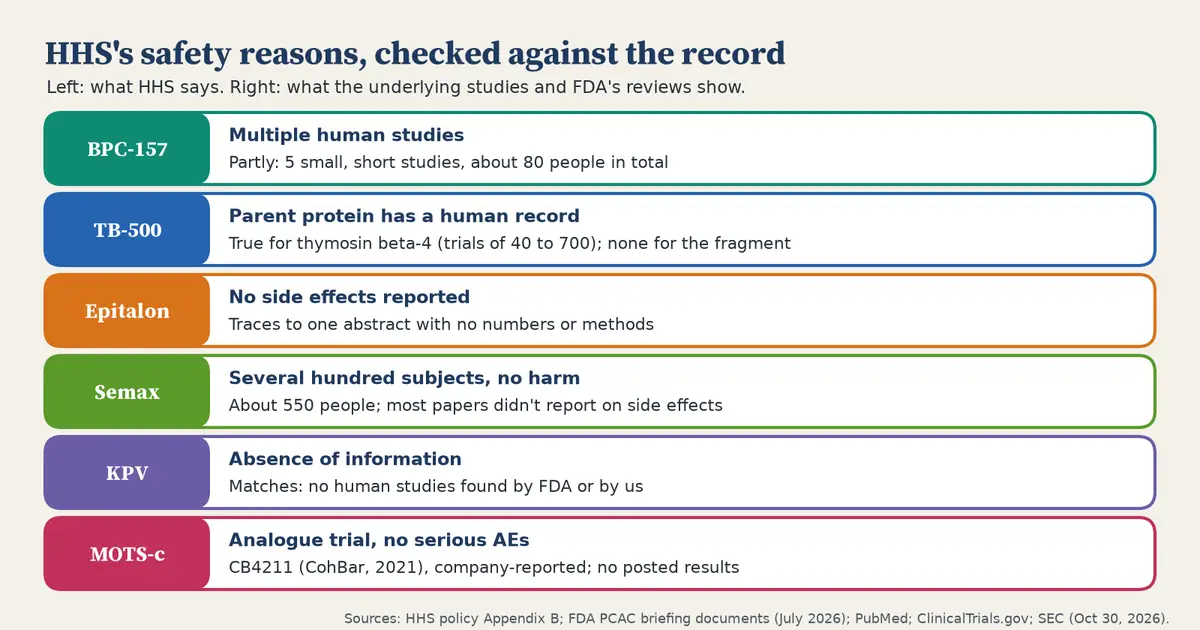
HHS gave a one-sentence reason for each peptide in its interim compounding policy. We traced every one of those sentences back to the studies behind it, and most of them hold up, at least in part. Two lean on evidence HHS doesn't name. One clashes with what FDA's own reviewers wrote.
These facts are as of October 30, 2026, the day the policy's notice ran in the Federal Register at 91 FR 68526. [V]
At a glance
- HHS's reasons are safety arguments, not claims that any peptide works. Each one says, in some form, that FDA's concerns weren't based on harm anyone saw in people. [V]
- Best supported: KPV (FDA and our own search found no human studies, which is what HHS says) and the thymosin beta-4 part of the TB-500 reason (trials with hundreds of people). [V]
- Partly supported: BPC-157 (five small, short studies, about 80 people in all) and semax (about 550 people, but most papers didn't report on side effects). [V]
- Hardest to check: epitalon's "no side effects" line, and MOTS-c, where HHS cites a trial of a related compound and rodent work that FDA's reviewers said doesn't inform safety. [V]
- 6peptides, each with its own HHS reason [V]
- 5small BPC-157 studies in FDA's review, about 80 people [V]
- 0human studies of KPV found by FDA or by our search [V]
How we checked
We started from Appendix B of the HHS policy, which gives the reason for each peptide. For each reason we read the matching FDA briefing document from the July 2026 Pharmacy Compounding Advisory Committee meeting, since that is the record HHS was answering. Then we pulled the studies themselves from PubMed, ClinicalTrials.gov and, for one company, its SEC filings. [V]
Each card below gives HHS's words, the kind of evidence behind them, what that evidence shows and what it leaves open. A [V] means we read it in the primary source. [S] means the source is a company or secondary report. [U] marks our own inference, which no source states outright.
BPC-157: "multiple human studies"
Claim
HHS says BPC-157's "historical use is now documented and quantified showing its use as well as multiple human studies." [V]
What research shows
- Human
- five small studies plus one registered trial
FDA's reviewers found five clinical studies of BPC-157, covering about 24 healthy volunteers, about 26 people with ulcerative colitis, 17 with knee pain, 12 with interstitial cystitis and 2 healthy volunteers. [V] We read three of them on PubMed: a chart review of 17 knee-pain patients at one clinic (16 reached by phone), a 12-person bladder-pain pilot with no comparison group, and a 2-person safety pilot. None reported side effects. [V]
What is unknown
Whether "multiple human studies" adds up to a safety record. FDA called the studies short and small, with limited safety information and unclear safety monitoring. We couldn't check HHS's "documented and quantified" use, because HHS doesn't say where those numbers come from. [U]
This card describes the kind of research that exists.
"Multiple" is accurate. FDA counted five studies, and ClinicalTrials.gov also lists a phase 1 study in healthy volunteers in Mexico (NCT02637284). [V] The studies we read came from private clinics, used no standard symptom scales or control groups, and followed people for weeks rather than months. [V] Small early studies like these are how most medicines begin, and the record so far contains no serious harms. It is still too thin to say much about rare or long-term effects.
“No serious adverse events appear to have been reported with these studies.”
FDA's next sentence matters too. The reviewers wrote that the studies "had small sample sizes" and that the authors "provided limited information on safety data." [V] The most common side effects in the healthy-volunteer abstracts were headache and flatulence. [V]
TB-500: the parent protein carries the argument
Claim
HHS says FDA's TB-500 safety concerns "are inferential rather than observed," that the parent protein "has a controlled human safety record across several routes," and that the fragment "is rapidly truncated in human serum." [V]
What research shows
- Human for thymosin beta-4; lab and animal for the TB-500 fragment
FDA states "thymosin beta-4 and TB-500 are not the same substance" and found no human data for TB-500 at all. [V] Thymosin beta-4 itself has placebo-controlled trials: 40 healthy volunteers in a 2010 study, 84 in a 2021 Chinese study, and two eye-drop trials of 601 and 700 people. Serious adverse events were rare and similar between groups (3 of 299 versus 2 of 302, then none in either group of about 350). [V]
What is unknown
Whether TB-500 behaves like its parent. It is a seven-amino-acid piece, and no study has given it to people. [V]
This card describes the kind of research that exists.
Of the six, this reason is built most carefully, and each of its three parts checks out to a different degree.
"Inferential rather than observed" is accurate, but it follows from having no data. FDA wrote that "potential safety risks associated with the use of TB-500 in humans are unknown," because nobody has looked. [V]
The parent protein's record is real. Neither healthy-volunteer study reported a serious adverse event or a dose-limiting toxicity, and three authors of the 2021 study list an affiliation with the company developing that version of the protein. [V] The eye-drop trials posted full results on ClinicalTrials.gov. [V]
"Rapidly truncated in human serum" comes from lab work. A 2016 study found that human serum produced fewer TB-500 breakdown products than liver and kidney preparations did. [V] A 2024 study tested TB-500 in lab systems and in rats. In the rats, the main breakdown product was a two-amino-acid piece, and a three-amino-acid piece was still detectable at 72 hours. [V] Its authors suggest that TB-500's reported wound-healing activity may come from one of those pieces. [V] That is early-stage research, the usual first step for any medicine, and it points in HHS's direction. It doesn't measure what happens in a person. FDA's brief also notes that broken-down metabolites have been detected in horses. [V]
Epitalon: tracing "no side effects"
Claim
HHS says "CDER's safety concerns are mechanistic rather than based on observed harm, the limited controlled human exposure reported no side effects." [V]
What research shows
- Human
- three small studies; most older work is on a related extract
FDA found no clinical studies assessing epitalon's safety. Of the 23 nominated articles it reviewed, "None of the articles submitted discussed the use of epitalon"; seven covered epithalamin, a pineal extract. [V] FDA did find three human studies: a 75-woman placebo-controlled study of melatonin markers and clock genes, a smaller study of clock genes in night-shift workers, and an eye-disease study. [V]
What is unknown
Where HHS's "no side effects" comes from. HHS doesn't cite a source. [U]
This card describes the kind of research that exists.
"Mechanistic rather than based on observed harm" is a fair description of FDA's concerns, which rested on how the peptide might act, not on reported injuries. [V] The "no side effects" line is harder. FDA's brief says the 75-person study "did not specify blinding" and was short and small. [V]
The closest match we found is a 2007 Russian-language paper by Korkushko and colleagues, one of the two nominated articles FDA set aside because it was only in Russian. [V] Its English abstract says the pineal peptides studied were "having no side effects," but it gives no participant numbers or methods, and it covers epithalamin and epitalon together. [V] We think HHS's line traces there. That is our inference. [U]
FDA's brief adds a piece of history that isn't in HHS's reason. On September 2, 2010, FDA gave epitalon orphan-drug status for retinitis pigmentosa, an inherited eye disease; that status was withdrawn or revoked on January 6, 2016. [V] Orphan designation is a step toward development, not an approval.
Semax: "several hundred subjects"
Claim
HHS says FDA's own list of nasal-spray studies covers "several hundred subjects with no reported adverse outcome," and that FDA's worries about bleeding and abuse potential have "no clinical counterpart" in it. [V]
What research shows
- Human
- mostly Russian studies
- including children
FDA's brief lists 33 to 47 healthy adults, 69 adults with medical conditions and 451 children, roughly 550 people. [V] FDA wrote: "In one reference the authors report that no AEs were observed and in the other references AEs were not discussed." [V]
What is unknown
Whether "no reported adverse outcome" means none happened or none were looked for. Most of the papers don't say. [V]
This card describes the kind of research that exists.
HHS's count is right: "several hundred" is a fair summary of FDA's own table. [V] The weak point is the second half of the sentence. FDA's bleeding question came from a 2002 meeting abstract describing semax in rats and people, which discussed possible anti-clotting properties. No full article for it could be found. [V] FDA added that it couldn't get full study details for the children or for the adults with chronic brain ischemia. [V] Saying those signals have "no clinical counterpart" is true in that nobody reported one, but the studies mostly didn't report side effects at all. [V]
FDA also found one adverse-event report for semax in its own database, and noted that 503ASection of federal drug law covering compounding by state-licensed pharmacies and doctors, usually for a prescription written for one patient. Glossary entry compounders "generally do not report adverse events to FDA." [V] A quiet database is weak evidence either way.
KPV: "an absence of information"
Claim
HHS says "CDER's safety conclusion reflects an absence of information rather than an observed signal." [V]
What research shows
- Lab and animal only
FDA wrote that it "has not identified, any clinical studies or human exposure data for KPV via any route of administration." [V] On October 30 we searched PubMed for KPV papers tagged as clinical trials and found none, and ClinicalTrials.gov returned no studies listing KPV as an intervention. [V]
What is unknown
Everything about KPV in people, which both FDA and HHS acknowledge. [V]
This card describes the kind of research that exists.
This is the most accurate of the six reasons, because it makes the smallest claim. HHS and FDA agree on the facts. Where they differ is on what an empty record means. FDA's reviewers treated the gap as a reason for caution, and HHS treated it as no reason to act. That is our summary of the two documents. [U] FDA's brief does review five lab and animal studies of KPV, which is early-stage research, the usual first step for any medicine. [V] No human safety record exists yet.
MOTS-c: a related compound and rodent studies
Claim
HHS says "a randomized placebo-controlled trial of a MOTS-c analogue reported no serious adverse events" and "the rodent studies reported metabolic benefit without systemic toxicity." [V]
What research shows
- Human for a related compound (company-reported); animal for MOTS-c
The trial that fits HHS's description is CohBar's two-part early trial of CB4211 (NCT03998514). The registry describes it as randomized and placebo-controlled, with participants and investigators masked, with 88 people enrolled, completed April 19, 2021. [V] CohBar called CB4211 "a novel and improved analog of MOTS-c" and reported it "appeared safe with no serious adverse events." [S] No results are posted on ClinicalTrials.gov. [V]
What is unknown
Whether HHS meant this trial, since it doesn't name one [U], and whether results for a modified compound carry over to MOTS-c itself. [U]
This card describes the kind of research that exists.
The analogue trial is real, and the company's summary supports HHS's wording. CohBar's 2021 filing said the second stage enrolled 20 people with obesity and fatty liver disease for four weeks. [S] It was a company press release, though, not a peer-reviewed paper, and the registry has no posted results to check it against. [V]
The rodent claim is where HHS and FDA part ways. FDA's MOTS-c brief says there is "no available nonclinical data to inform safety considerations" and no human studies of MOTS-c itself. [V] HHS describes the rodent studies as reporting "metabolic benefit," which suggests they were built to measure effects rather than toxicity. If so, both statements can be true: the rodent work found no toxicity, and it wasn't designed to look for it. That reading is ours. [U]
Where each reason lands
| The question | Answer | What the record shows |
|---|---|---|
| BPC-157: "multiple human studies" | Partly | Five small, short studies (about 80 people), none reporting serious harms, with limited safety reporting. [V] |
| TB-500: parent protein's record | Yes for the protein | Thymosin beta-4 has placebo-controlled trials of 40 to 700 people. TB-500 itself has no human data. [V] |
| Epitalon: "no side effects" | Hard to trace | The likely source is a Russian abstract with no numbers or methods. Our inference. [U] |
| Semax: "several hundred subjects" | Count yes, safety partly | About 550 people, but most papers didn't report on side effects. [V] |
| KPV: "absence of information" | Yes | Neither FDA nor our search found any human studies. [V] |
| MOTS-c: analogue trial and rodent studies | Partly | The analogue trial is company-reported, and FDA says the animal data doesn't inform safety. [S] |
Limits and unknowns
- We matched some reasons to sources ourselves. HHS doesn't cite studies in Appendix B. The CB4211 trial for MOTS-c and the Korkushko abstract for epitalon are our best matches, not HHS's stated sources. [U]
- We read abstracts for some studies. For the BPC-157 and thymosin beta-4 papers we relied on PubMed abstracts and FDA's summaries, not full texts. The Russian-language epitalon and semax papers we couldn't read at all. [V]
- "No side effects reported" isn't the same as "safe." Small studies can't detect rare problems, and several of these papers didn't say how side effects were tracked. [V]
- The policy can change. HHS says it may revisit the policy "if, among other things, a safety signal or product quality issue arises." [V]
- None of this is about whether the peptides work. HHS's reasons concern safety records, and so does this page. Nothing here is a reason to use or avoid any peptide. The owner of this site is not a medical professional, and a doctor is the right person to ask about your own health.
What would change this scorecard
- Posted results for the CB4211 trial, or a named source from HHS for any of the six reasons.
- A peer-reviewed human study of TB-500, KPV or MOTS-c itself.
- Public comments on the policy that add new evidence. HHS says comments "may provide additional evidence that FDA can consider in rulemaking." [V]
For the policy itself, start with what the HHS policy says, then how the comment period works. The 14-peptide overview shows where each one stands with FDA.
Peptide Policy Watch
HHS's reasons for each of the six peptides, checked against the research
Printable checklist
Questions for your clinician
General questions drawn from this page, to take to a clinician or pharmacist who knows your health history.
- Is this an FDA-approved medicine, a compounded drug, or something with no approval for human use?
- What do the studies in people show, how large and how long were they, and where can I read them?
- How might my own health history, conditions and current medicines change how this applies to me?
- Is there an official label or other primary document I can read, and who would know if something goes wrong?
Print view Select it, then use your browser’s Print command to print only this box.
Sources (retrieved October 30, 2026 unless noted)
- HHS, "Enforcement Discretion Policy Regarding 503A Compounding Using Certain Peptide Bulk Drug Substances," Appendix B (reasons by substance) [V] — https://www.hhs.gov/sites/default/files/hhs-503a-peptide-enforcement-discretion-policy-appendix-b.pdf
- Federal Register, notice of availability for the HHS policy, 91 FR 68526-68527, FR Doc. 2026-22192, published October 30, 2026 [V] — https://www.federalregister.gov/documents/2026/10/30/2026-22192/enforcement-discretion-policy-regarding-503a-compounding-using-certain-peptide-bulk-drug-substances
- FDA, Pharmacy Compounding Advisory Committee briefing document, BPC-157-related bulk drug substances, July 2026 [V] — https://www.fda.gov/media/193343/download
- FDA, Pharmacy Compounding Advisory Committee briefing document, TB-500-related bulk drug substances, July 2026 [V] — https://www.fda.gov/media/193349/download
- FDA, Pharmacy Compounding Advisory Committee briefing document, epitalon-related bulk drug substances, July 2026 [V] — https://www.fda.gov/media/193345/download
- FDA, Pharmacy Compounding Advisory Committee briefing document, semax-related bulk drug substances, July 2026 [V] — https://www.fda.gov/media/193348/download
- FDA, Pharmacy Compounding Advisory Committee briefing document, KPV-related bulk drug substances, July 2026 [V] — https://www.fda.gov/media/193346/download
- FDA, Pharmacy Compounding Advisory Committee briefing document, MOTS-c-related bulk drug substances, July 2026 [V] — https://www.fda.gov/media/193347/download
- Lee E, Padgett B, "Intra-Articular Injection of BPC 157 for Multiple Types of Knee Pain," Alternative Therapies in Health and Medicine, 2021 (PubMed abstract) [V] — https://pubmed.ncbi.nlm.nih.gov/34324435/
- Lee E et al., "Effect of BPC-157 on Symptoms in Patients with Interstitial Cystitis: A Pilot Study," Alternative Therapies in Health and Medicine, 2024 (PubMed abstract) [V] — https://pubmed.ncbi.nlm.nih.gov/39325560/
- Lee E, Burgess K, "Safety of Intravenous Infusion of BPC157 in Humans: A Pilot Study," Alternative Therapies in Health and Medicine, 2025 (PubMed abstract) [V] — https://pubmed.ncbi.nlm.nih.gov/40131143/
- Ruff D et al., "A randomized, placebo-controlled, single and multiple dose study of intravenous thymosin beta4 in healthy volunteers," Annals of the New York Academy of Sciences, 2010 (PubMed abstract) [V] — https://pubmed.ncbi.nlm.nih.gov/20536472/
- Wang X et al., "A first-in-human, randomized, double-blind, single- and multiple-dose, phase I study of recombinant human thymosin β4 in healthy Chinese volunteers," Journal of Cellular and Molecular Medicine, 2021 (PubMed abstract) [V] — https://pubmed.ncbi.nlm.nih.gov/34346165/
- ClinicalTrials.gov, NCT02974907 (ARISE-2), thymosin beta-4 eye drops for dry eye, 601 enrolled, posted results [V] — https://clinicaltrials.gov/study/NCT02974907
- ClinicalTrials.gov, NCT03937882 (ARISE-3), thymosin beta-4 eye drops for dry eye, 700 enrolled, posted results [V] — https://clinicaltrials.gov/study/NCT03937882
- Zvereva I et al., "Comparison of various in vitroDone in a dish or test tube, using cells or tissue outside a living body. Glossary entry model systems of the metabolism of synthetic doping peptides," Journal of Proteomics, 2016 (PubMed abstract) [V] — https://pubmed.ncbi.nlm.nih.gov/27569051/
- Rahaman KA et al., "Simultaneous quantification of TB-500 and its metabolites in in-vitro experiments and rats," Journal of Chromatography B, 2024 (PubMed abstract) [V] — https://pubmed.ncbi.nlm.nih.gov/38382158/
- Korkushko OV et al., "[Normalizing effect of the pineal gland peptides on the daily melatonin rhythm in old monkeys and elderly people]," Advances in Gerontology, 2007 (Russian; English abstract on PubMed) [V] — https://pubmed.ncbi.nlm.nih.gov/17969590/
- ClinicalTrials.gov, NCT03998514, "A Phase 1a/1b Study of CB4211 in Healthy Non-obese Subjects and Subjects With Nonalcoholic Fatty Liver Disease," CohBar, Inc., no posted results [V] — https://clinicaltrials.gov/study/NCT03998514
- CohBar, Inc., Form 8-K Exhibit 99.2, "CohBar Announces Positive Topline Results from the Phase 1a/1b Study of CB4211," August 10, 2021 (company-reported) [S] — https://www.sec.gov/Archives/edgar/data/1522602/000121390021041377/ea145151ex99-2_cohbar.htm
- PubMed search for KPV or Lys-Pro-Val papers tagged clinical trial or randomized controlled trial, 0 results, and ClinicalTrials.gov intervention search for KPV, 0 results [V] — https://pubmed.ncbi.nlm.nih.gov/?term=%28KPV%5Btiab%5D+OR+%22Lys-Pro-Val%22%5Btiab%5D%29+AND+%28clinical+trial%5Bpt%5D+OR+randomized+controlled+trial%5Bpt%5D%29
- ClinicalTrials.gov, NCT02637284, phase 1 study of BPC-157 in healthy volunteers (listed in FDA's BPC-157 brief) [V] — https://clinicaltrials.gov/study/NCT02637284
Spot a mistake? See how we source and our corrections policy.