
The 2020 "polypeptide" change: why insulin became a biologic and most peptides stayed drugs
Maybe you were reading about a peptide's legal status and hit a phrase like "the 2020 polypeptide change," or a line saying insulin "became a biologic." It sounds like a list got shuffled and some molecules were kicked off it. The real story is tidier, and it holds a clear win for patients: the change opened the door to cheaper insulin competitors. It also drew a line, at 40 amino acids, that still shapes how the peptides people ask about are handled today.
Facts are as of November 2, 2026. Sources, with retrieval dates, are at the bottom.
In four lines
- On March 23, 2020, ten years after Congress set the deadline, FDA moved a group of protein medicines (insulin, growth hormone, some fertility hormones) from drug approvals to biologics licenses. [V]
- FDA's rule counts a chain as a "protein" only when it has more than 40 amino acids. Chains of 40 or fewer are "peptides" and stay drugs. [V]
- The point of the move was competition: once these products were biologics, rivals could file as biosimilars, and in 2021 FDA approved the first interchangeable insulin. [V]
- Compounding changed for the products that moved. For short peptides, the drug rules, including the 503ASection of federal drug law covering compounding by state-licensed pharmacies and doctors, usually for a prescription written for one patient. Glossary entry bulks lists, still apply. [V]
What actually happened on March 23, 2020
The Biologics Price Competition and Innovation Act, usually shortened to the BPCI Act, became law on March 23, 2010. It built a shorter approval route for copies of biologic medicines, similar in spirit to how generics work for ordinary drugs, and it gave FDA ten years to move a small set of products over. [V]
Why did anything need to move? For historical reasons, some protein medicines had been approved as ordinary drugs under the Food, Drug, and Cosmetic Act rather than licensed as biologics under the Public Health Service Act. FDA's own examples are insulin and its analogs, human growth hormone, pancreatic enzymes and reproductive hormones. [V] As drugs, they couldn't serve as the reference product for a biosimilar. So on the deadline, each of those drug approvals was "deemed" to be a biologics license, with no new application needed. [V]
FDA posted the full list of affected approvals. It runs from insulin brands and somatropin products to chorionic gonadotropin, menotropins, hyaluronidase and thyrotropin alfa, and FDA corrected it on April 2, 2020. [V] One name on it surprises people who follow peptide news: tesamorelin, sold as Egrifta and Egrifta SV under an application first approved November 10, 2010. [V]
- March 23, 2010
BPCI Act signed
Congress creates a shorter licensing route for biosimilars and sets a ten-year transition for protein products approved as drugs.
- December 2018
A preview list and a proposal
FDA posts a preliminary list of affected products and proposes its reading of the word "protein."
- February 21, 2020
FDA's definition rule
The final rule says a "protein" means a defined chain of more than 40 amino acids, effective March 23, 2020.
- March 23, 2020
The switch
Approved drug applications for these products are deemed biologics licenses and leave FDA's Orange Book listing for its Purple Book.
- July 28, 2021
First interchangeable insulin
FDA licenses Semglee (insulin glargine-yfgn) as the first interchangeable biosimilar for its reference product.
Where the number 40 comes from
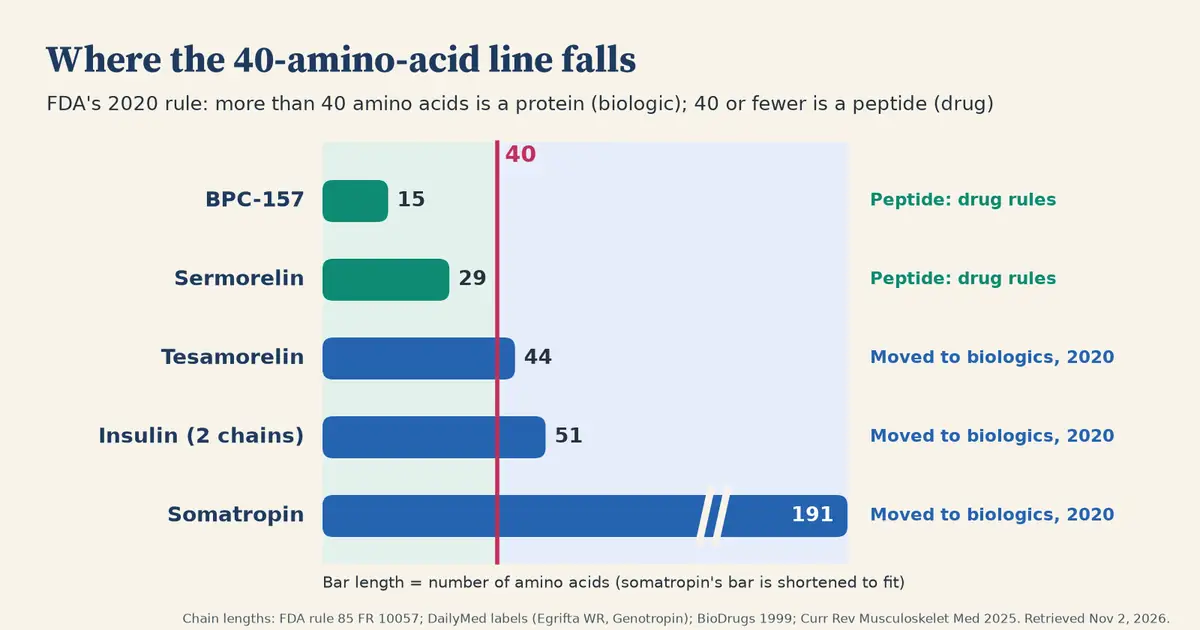
The law says "protein" but never says how big a protein is. FDA filled that gap with a rule published February 21, 2020: a protein is a chain of alpha amino acids, in a specific, defined order, that runs longer than 40 units. [V] Anything at 40 or below is a peptide in FDA's reading, which keeps it outside the biologics definition and regulated as a drug, unless it fits that definition some other way. [V]
FDA was candid that the cutoff is a judgment call. The rule's preamble says sources don't agree on precise definitions of "protein," "polypeptide" and "peptide," and it walks through textbooks and dictionaries to show where they overlap. [V] Only four comments came in on the proposal. [V]
Late in the process, Congress also tidied the wording. After FDA's December 2018 proposal, a 2020 spending law (the Further Consolidated Appropriations Act, section 605) deleted an old exception for "chemically synthesized" polypeptides, so FDA dropped its planned definition of that term as no longer needed. [V]
One counting quirk trips people up. When chains pair up the way they do in nature, FDA adds them together. Insulin has two chains, so FDA counts it as 51 amino acids, comfortably on the protein side. [V]
“this legislative change does not affect ‘peptides’ (i.e., polymers composed of 40 or fewer amino acids)”
Which side of the line familiar molecules sit on
Chain length comes from each molecule's label or a published review. The status column reflects the 2020 rule only; it says nothing about how well any of these work.
| Molecule | Chain length | Side of the line | Source |
|---|---|---|---|
| BPC-157 | 15 amino acids | Peptide (drug rules) | 2025 review [V] |
| Sermorelin | 29 amino acids | Peptide (drug rules) | 1999 review [V] |
| Tesamorelin (Egrifta) | 44 amino acids plus a small chemical group | Protein (moved to biologics in 2020) | FDA label and list [V] |
| Insulin | 51, counting both chains | Protein (moved to biologics in 2020) | FDA final rule [V] |
| Somatropin (growth hormone) | 191 amino acids | Protein (moved to biologics in 2020) | FDA label [V] |
Tesamorelin and sermorelin make a neat pair. Both are versions of the hormone that tells the pituitary to release growth hormone. Tesamorelin's label describes the full 44-amino-acid sequence of that hormone with a small chemical group attached, which put it over the line. [V] Sermorelin is a 29-amino-acid version, so it stayed a drug. [V] Our tesamorelin page and sermorelin page cover each one's history.
- 40amino acids or fewer: a peptide in FDA's reading [V]
- 51amino acids: how FDA counts insulin's two chains [V]
- 2021the year FDA approved the first interchangeable insulin [V]
The access win behind the paperwork
FDA's patient explainer frames the transition around access. Once these medicines were biologics, other makers could seek approval for biosimilar and interchangeable versions, which FDA says helps keep the market competitive and may make medicines more affordable. [V] It also told patients the change shouldn't alter how their medicines look or how they're prescribed and dispensed. [V]
That promise turned concrete quickly. On July 28, 2021, FDA licensed Semglee, an insulin glargine, under the biosimilar pathway, and its approval letter says it was the first product to win an interchangeability determination against its reference product. [V] That kind of competition simply wasn't available for insulin while it sat under drug law.
What changed for compounding
Here the move had a cost. FDA told compounders that, from March 23, 2020, the transitioned products would not qualify for the compounding exemptions in sections 503A and 503BSection of federal drug law for outsourcing facilities: larger compounders that register with FDA and must follow drug-manufacturing quality rules. Glossary entry. [V] Outsourcing facilities had reported using four affected substances: human chorionic gonadotropin, hyaluronidase, FSH (urofollitropin) and menotropins. [V] Hyaluronidase, then on Category 1An interim FDA group of nominated bulk ingredients that FDA generally does not object to pharmacies using while its review continues. Not an approval. Glossary entry of the 503B interim list, came off it as of March 23. [V] FDA pointed to a separate 2018 guidance on mixing, diluting or repackaging licensed biologics for the narrow cases it covers. [V]
For peptides of 40 amino acids or fewer, none of that applies. They remain drugs, so their path in pharmacies runs through the 503A and 503B bulks process. That's where BPC-157 and the other peptides in HHS's October 2026 interim policy are being handled. See how the 503A bulks list works and our brief on the six-peptide policy.
Peptide Policy Watch
The 2020 "polypeptide" change: why insulin became a biologic and most peptides stayed drugs
Printable checklist
Questions for your clinician
Points from this story to talk through with a clinician or pharmacist who knows your history.
- Is this an approved biologic, an approved drug, or a compounded preparation, and where would I see that on the label?
- Is there a biosimilar or interchangeable version, and could my pharmacy offer it?
- If a medicine moved to biologics in 2020, does that change who can prepare it or how it's supplied?
- For a short peptide, what review stage is it at on FDA's compounding lists?
Print view Select it, then use your browser’s Print command to print only this box.
Limits and unknowns
The 40-amino-acid line is FDA's interpretation, set by rule. FDA itself said there's no precise scientific consensus on the terms, so a future rule or court case could draw it differently. [V] We read FDA's transition list, final rule, Q&A guidance and patient and provider explainers; we didn't review every product's later history, such as brands discontinued after 2020. Semglee's approval shows the pathway working for one insulin. It doesn't tell you prices at any given pharmacy, and FDA's patient sheet notes the agency doesn't set prices. [V] The chain lengths for BPC-157 and sermorelin come from published reviews rather than FDA labels, since neither has a current US label. [V]
What to watch
HHS's six-peptide compounding policy is open for comment until 11:59 PM Eastern on November 13, 2026. It's written under section 503A, the drug-compounding framework, which is the lane short peptides stayed in after 2020. [V] Our timeline of peptide medicines shows how insulin got here, and what "legal" means for peptides puts the 2020 rule next to the other kinds of status.
So when someone says peptides were "delisted" in 2020, you can gently correct the record: the big protein hormones changed lanes, and the short chains stayed right where they were.
Common questions
Were peptides delisted or reclassified in 2020?
No. On March 23, 2020, a set of protein medicines approved as drugs, such as insulin, growth hormone and some fertility hormones, were deemed biologics licenses. FDA says the change does not affect peptides, which it defines as chains of 40 or fewer amino acids; those stay drugs. Source: FDA, Deemed to be a License provision page
Where does the 40-amino-acid cutoff come from?
FDA's final rule published February 21, 2020 defines a protein as an amino acid chain with a specific, defined sequence of more than 40 amino acids. FDA counts chains that pair up in nature together, so insulin counts as 51. Source: Federal Register, 85 FR 10057
What did the transition mean for insulin prices and choice?
It let other makers file biosimilar and interchangeable versions. In July 2021 FDA licensed Semglee as the first interchangeable insulin. FDA's patient sheet notes the agency does not regulate drug pricing. Source: FDA, Semglee approval package
Can pharmacies still compound the products that moved?
FDA told compounders that, from March 23, 2020, the transitioned biologics would not qualify for the 503A and 503B compounding exemptions. Hyaluronidase also came off the 503B Category 1 list that day. Source: FDA notice to compounders, March 2020
Sources (retrieved November 2, 2026 unless noted)
- FDA, "The 'Deemed to be a License' Provision of the BPCI Act," content current as of 02/09/2024 [V] — https://www.fda.gov/drugs/guidance-compliance-regulatory-information/deemed-be-license-provision-bpci-act
- FDA, List of Approved NDAs for Biological Products That Were Deemed to be BLAs on March 23, 2020 (corrected April 2, 2020) [V] — https://www.fda.gov/media/119229/download
- Federal Register, "Definition of the Term 'Biological Product,'" final rule, 85 FR 10057, February 21, 2020 (FR Doc. 2020-03505) [V] — https://www.federalregister.gov/d/2020-03505
- FDA, "The 'Deemed To Be a License' Provision of the BPCI Act: Questions and Answers," guidance for industry, March 2020 [V] — https://www.fda.gov/media/119274/download
- FDA, "Information for Patients About Regulatory Changes for Certain Biological Product Medications" [V] — https://www.fda.gov/media/135341/download
- FDA, "Notice to Compounders: Changes that affect compounding as of March 23, 2020," content current as of 03/05/2020 [V] — https://www.fda.gov/drugs/human-drug-compounding/notice-compounders-changes-affect-compounding-march-23-2020
- FDA, Semglee (insulin glargine-yfgn) approval package, BLA 761201, approval letter dated July 28, 2021 [V] — https://www.accessdata.fda.gov/drugsatfda_docs/nda/2021/761201Orig1s000Approv.pdf
- DailyMed, EGRIFTA WR (tesamorelin) label, set id 839334d3-8c1d-4c26-9036-2ab524a6ea75, effective July 29, 2026 [V] — https://dailymed.nlm.nih.gov/dailymed/lookup.cfm?setid=839334d3-8c1d-4c26-9036-2ab524a6ea75
- DailyMed, GENOTROPIN (somatropin) label, set id ffebf88b-d257-4542-9808-74d9b7167765, effective August 4, 2026 [V] — https://dailymed.nlm.nih.gov/dailymed/lookup.cfm?setid=ffebf88b-d257-4542-9808-74d9b7167765
- Prakash A, Goa KL, "Sermorelin: a review of its use in the diagnosis and treatment of children with idiopathic growth hormone deficiency," BioDrugs, 1999, PMID 18031173 (abstract via Europe PMC) [V] — https://pubmed.ncbi.nlm.nih.gov/18031173/
- "Regeneration or Risk? A Narrative Review of BPC-157 for Musculoskeletal Healing," Current Reviews in Musculoskeletal Medicine, 2025, PMID 40789979 (abstract via Europe PMC) [V] — https://pmc.ncbi.nlm.nih.gov/articles/PMC12446177/
- Regulations.gov, docket HHS-OASH-2026-0496 (comment close 11:59 PM Eastern, November 13, 2026) [V] — https://www.regulations.gov/docket/HHS-OASH-2026-0496
- HHS, "Enforcement Discretion Policy Regarding 503A Compounding Using Certain Peptide Bulk Drug Substances," with appendices (retrieved October 29, 2026) [V] — https://www.hhs.gov/sites/default/files/hhs-503a-peptide-enforcement-discretion-policy-appendix-b.pdf
Spot a mistake? See how we source and our corrections policy.
Image: AI-generated. Image credits