
USP says HHS's six-peptide policy is missing quality safeguards. What a monograph is, and why it matters
When a pharmacist opens a drum of an established drug ingredient, there's usually a public rulebook for it: what the substance is, how pure it has to be, and a physical sample to test against. On November 3, 2026, the organization that writes those rulebooks said the six peptides in HHS's new compounding policy don't have one. Here's what the U.S. Pharmacopeia actually said, and where it fits in the comment period that closes next week.
Facts are as of November 4, 2026. Sources, with retrieval dates, are at the bottom.
Before you read on
- USP, the nonprofit that sets official U.S. drug quality standards, said HHS's 503ASection of federal drug law covering compounding by state-licensed pharmacies and doctors, usually for a prescription written for one patient. Glossary entry peptide policy lacks safeguards it considers essential for quality and safety. [V]
- USP says none of the six peptides has a USP–NF monograph, a USP Reference Standard or an official established name. [V]
- USP says its own scientific review before the July 2026 advisory committee meeting found the six weren't characterized well enough to judge quality consistently. [V]
- Public comments on the policy close at 11:59 PM Eastern on November 13, 2026. The docket showed 10 comments on November 4. [V]
What USP said, in plain terms
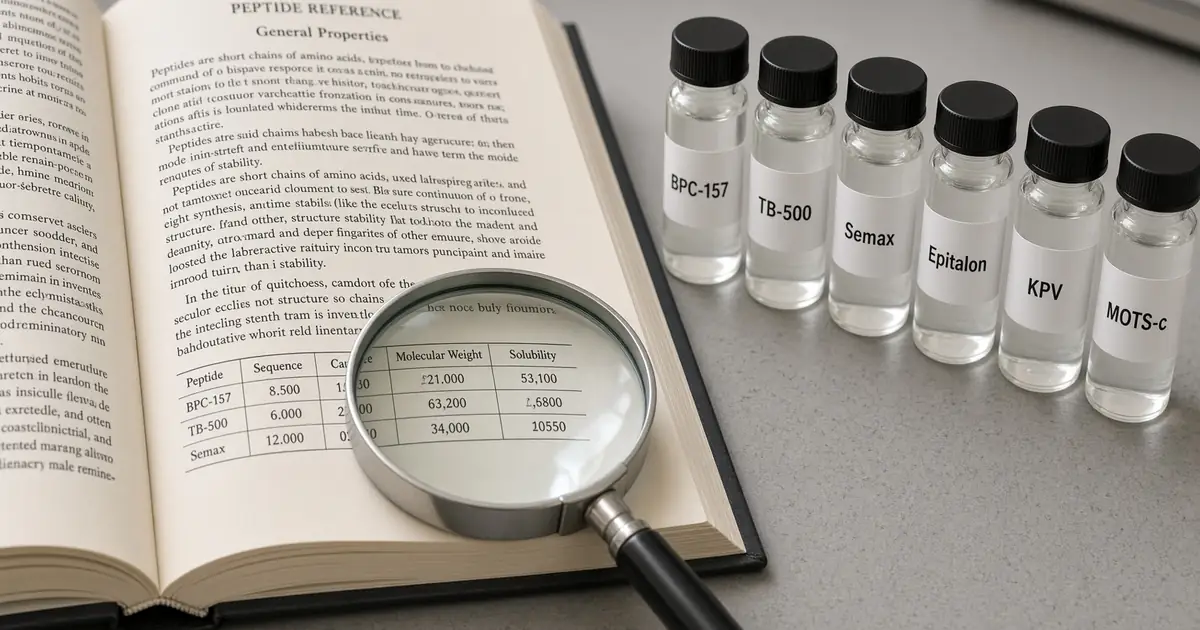
The statement makes three linked points. First, the peptides covered by the HHS policy (BPC-157, TB-500, Semax, Epitalon, KPV and MOTS-c) have no USP–NF monographs, no USP Reference Standards and no established names from naming bodies such as USAN or INN. [V] Second, USP wrote that its review ahead of the July 2026 Pharmacy Compounding Advisory Committee found the substances "not sufficiently characterized" for consistent quality evaluation. [V] Third, USP said the general standards the policy points to can't, by themselves, give adequate quality assurance, because they don't set specifications tied to each individual peptide. [V]
USP also drew a line around its own role. According to the statement, "neither existing nor potential new USP standards replace a regulator's role" in deciding whether a product is safe and effective. [V]
“does not include essential safeguards needed to help ensure the quality and safety of compounded preparations”
Monographs and reference standards, quickly
A monograph is a written standard for one substance. USP says monographs cover identity, strength, purity and performance, and that the USP–NF compendium holds more than 5,000 standards in all. [V] A reference standard is the physical side: USP describes them as highly characterized specimens that labs test against, and it offers more than 5,800 of them. [V] Meeting a USP standard isn't permission to sell anything, either. USP says compliance is "not a license to market." [V] For a stand-alone walk-through of that vocabulary — what a monograph checks, how one is written, and what it is not — see What a USP monograph actually is.
Why does this matter for compounding? Under section 503A, a bulk ingredient generally has to meet an applicable USP or NF monograph if one exists. If not, it has to be part of an FDA-approved drug or appear on FDA's 503A bulks list. [V] The HHS policy is written for peptides that clear none of those bars. [V] Our bulks list explainer covers that route in detail.
Where this meets the policy's own conditions
The HHS policy doesn't ignore quality. Its conditions require a defined identity for each peptide (including amino acid sequence, structure and molecular weight) and a certificate of analysis from an FDA-registered facility, with testing consistent with criteria FDA describes in guidance. [V] Our COA and CGMP explainer walks through what those documents do and don't prove.
USP's argument is that a certificate needs a benchmark. Without a monograph setting peptide-specific limits, and a reference sample to compare against, USP says quality can't be "reliably and consistently established." [V] HHS hasn't responded publicly to the statement that we found. [U]
The comment window
The policy was published in the Federal Register on October 30, 2026 (91 FR 68526, docket HHS-OASH-2026-0496). [V] The docket listed 10 comments when we checked the Federal Register's data at 1:55 AM Central on November 4. [V] Updated Nov 4, 2026, 10:11 AM CT: that count still read 10 at the Federal Register's 9:55 AM CT refresh, and regulations.gov now shows 9 comments posted for public view, up from none the day before. [V] Updated Nov 5, 2026, 10:05 AM CT: still 9 posted, while the Federal Register's count reads 12. [V] Updated Nov 6, 2026, 2:30 AM CT: regulations.gov now shows 72 posted, while the Federal Register's nested count reads 18. [V] Quality rules turn out to be the thread running through those first comments: a testing business, a telehealth service and two individual commenters all focus on identity, purity or certificates of analysis, the same ground USP covers. [V] Our tally of who's commenting now sorts all 115 posted comments by type, as of 10:08 AM CST on November 9. [V] Our comment-period guide explains how to file, and the six-peptide breakdown covers each substance.
What we couldn't confirm
The HHS text we saved doesn't list which USP general chapters it relies on, so we can't say which standards USP was referring to. [U] We also don't know whether USP has filed a formal comment on the docket. [U] If HHS answers USP before the window closes, we'll add it here.
Peptide Policy Watch
USP says HHS's six-peptide policy is missing quality safeguards. What a monograph is, and why it matters
Printable checklist
Questions for your clinician
General questions drawn from this page, to take to a clinician or pharmacist who knows your health history.
- Is this an FDA-approved medicine, a compounded drug, or something with no approval for human use?
- What do the studies in people show, how large and how long were they, and where can I read them?
- How might my own health history, conditions and current medicines change how this applies to me?
- Is there an official label or other primary document I can read, and who would know if something goes wrong?
Print view Select it, then use your browser’s Print command to print only this box.
Common questions
What did USP say about HHS's peptide compounding policy?
In a November 3, 2026 statement, USP said the policy lacks safeguards it considers essential for the quality and safety of compounded preparations, and that none of the six peptides has a USP–NF monograph, a USP Reference Standard or an official established name. [V] Source: USP statement, Nov. 3, 2026
What is a USP monograph?
It's a written public standard for one substance. USP says monographs cover identity, strength, purity and performance. A reference standard is the matching physical sample labs test against. [V] Source: USP, overview of monographs
When do comments on the HHS peptide policy close?
At 11:59 PM Eastern on November 13, 2026, under docket HHS-OASH-2026-0496. [V] Source: Federal Register, 91 FR 68526
Sources (retrieved November 4, 2026 unless noted)
- U.S. Pharmacopeia, "USP statement on quality and safety considerations for unapproved peptides," November 3, 2026 [V] — https://www.usp.org/news/usp-statement-on-quality-and-safety-considerations-for-unapproved-peptides
- U.S. Pharmacopeia, "Overview of monographs" [V] — https://www.usp.org/about/public-policy/overview-of-monographs
- U.S. Pharmacopeia, "Reference Standards" [V] — https://www.usp.org/reference-standards
- HHS, Enforcement Discretion Policy Regarding 503A Compounding Using Certain Peptide Bulk Drug Substances, October 28, 2026 (retrieved October 29, 2026) [V] — https://www.hhs.gov/sites/default/files/hhs-503a-peptide-enforcement-discretion-policy-appendix-b.pdf
- Federal Register, 91 FR 68526, document 2026-22192, October 30, 2026, including docket comment count via the Federal Register API (10 at 1:55 AM and 9:55 AM CT, November 4) [V] — https://www.federalregister.gov/documents/2026/10/30/2026-22192/enforcement-discretion-policy-regarding-503a-compounding-using-certain-peptide-bulk-drug-substances
- FDA, "Bulk Drug Substances Used in Compounding Under Section 503A of the FD&C Act" [V] — https://www.fda.gov/drugs/human-drug-compounding/bulk-drug-substances-used-compounding-under-section-503a-fdc-act
- Regulations.gov public data service, comment search and comment records for docket HHS-OASH-2026-0496 (9 posted), checked 10:11 AM CT, November 4, 2026, 10:05 AM CT, November 5, 2026, and 2:30 AM CT, November 6, 2026 (72 posted) [V] — https://www.regulations.gov/docket/HHS-OASH-2026-0496
Cite or link to this page
Peptide Policy Watch staff. “USP says HHS's six-peptide policy is missing quality safeguards. What a monograph is, and why it matters.” Peptide Policy Watch. Published November 4, 2026. Updated November 9, 2026. https://peptidepolicywatch.com/2026/11/04/usp-hhs-peptide-policy-quality-safeguards-monographs/
Link: https://peptidepolicywatch.com/2026/11/04/usp-hhs-peptide-policy-quality-safeguards-monographs/
Spot a mistake? See how we source and our corrections policy.
Image: AI-generated. Image credits